Arrays & Hashing
Most array interview problems become easy once you replace a repeated search with a hash lookup. Learn the four recurring techniques (seen sets, frequency counts, canonical keys, prefix/suffix arrays), then watch six LeetCode problems solved step by step.
🎯 What you'll learn
- When a hash map or set removes a nested loop
- Frequency counting and canonical keys
- Choosing hashable keys in Python, TypeScript and C#
- Six LeetCode problems: duplicates, anagrams, top-k, product except self, longest consecutive
📚 Before you start
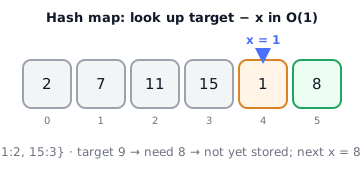
Arrays give O(1) access by index; hash maps and sets give O(1) average access by value. Most "easy" and many "medium" interview problems reduce to one idea: replace a repeated search with a hash lookup. If your brute force has a nested loop whose inner loop is searching for something, a hash map usually removes it.
1When to Reach for a Hash Map or Set
| You need to… | Use | Example |
|---|---|---|
| know whether you've seen a value before | set | contains duplicate, cycle detection |
| find the index or count of a value | map value → index / count | two sum, frequencies |
| group items that are "equivalent" | map canonical key → list | group anagrams |
| test membership many times | build a set once, then O(1) per query | longest consecutive sequence |
| count occurrences then pick the most common | map + sort/heap/buckets | top k frequent |
2Four Recurring Techniques
- Seen set / complement lookup. Walk once; for each element, check whether the value that would complete the answer is already stored.
- Frequency counting.
Counterin Python, aMapin JS/TS, aDictionary<T,int>in C#. Two strings are anagrams exactly when their frequency maps are equal. - Canonical keys. Map every item to a normalized key (sorted letters, a tuple of counts, a normalized pattern), then group by that key.
- Prefix/suffix arrays. Precompute running products or sums from both ends to answer "everything except i" in O(1) per index (covered further in
03-prefix_sums).
3Template: Group by a Canonical Key
The same skeleton solves "group anagrams", "group shifted strings" and "find duplicate files by content": compute a key, append to a bucket.
function groupBySignature(words: string[]): string[][] {
  const groups = new Map<string, string[]>();
  for (const w of words) {
    const key = [...w].sort().join("");
    if (!groups.has(key)) groups.set(key, []);
    groups.get(key)!.push(w);
  }
  return [...groups.values()];
}from collections import defaultdict
def group_by_signature(words):
groups = defaultdict(list) # signature -> words with that signature
for w in words:
key = "".join(sorted(w)) # canonical form: sorted letters
groups[key].append(w)
return list(groups.values())Complexity: O(n · k log k) for n words of length k (sorting each word). Using a 26-letter count tuple as the key makes it O(n · k).
4Choosing the Key Type
- Python: tuples are hashable, lists are not. Use
tuple(counts)or"".join(sorted(w))as a key. - JavaScript/TypeScript:
Mapkeys compare by reference for objects/arrays, so convert arrays to strings (counts.join("#")). Plain objects coerce keys to strings, which is whyMapis preferred for non-string keys. - C#:
Dictionary<string, …>works directly; for composite keys use arecord structor a value tuple(int, int), which implement value equality.
5Sets for O(1) Membership
Building a set costs O(n) once; afterwards each in/has/Contains is O(1) average. That turns "for each x, check whether x+1 exists" from O(n²) into O(n). This is the core of Longest Consecutive Sequence in Part 2.
Under the HoodWhy Hash Lookups Are O(1) on Average▾
A hash table stores entries in an array of buckets; hash(key) % capacity picks the bucket. With a good hash function and a load factor kept below a threshold (≈0.66 in CPython's dict, 0.75 in Java/C#), each bucket holds O(1) entries on average, so lookups are O(1). When the table fills up it resizes (doubling the capacity and rehashing everything), which is why inserts are amortized O(1). The worst case is O(n), when many keys collide; this is why languages randomize string hashing (Python's PYTHONHASHSEED, .NET's randomized string hashing) to resist deliberately colliding inputs. See languages/javascript/23-hashing_and_hash_tables for the full mechanics.
⚠️ Common Pitfalls
- Using a list for membership tests (
x in list) inside a loop: O(n²). - Mutable keys: Python lists and JS arrays can't be used as value-based keys; convert to tuples/strings.
- Insert-before-check bugs in complement lookups: with
[3, 3], target 6, check for the complement before storing the current value. - Forgetting that maps cost O(n) space; mention it when you state complexity.
- Relying on dict ordering in languages/versions where it isn't guaranteed (C#
Dictionaryenumeration order is not guaranteed).
📋 Quick Reference
Repeated search inside a loop → hash map/set
seen = set();  if target - x in seen: …;  seen.add(x)
freq: Counter(s) · new Map() · Dictionary<char,int>
group: key = canonical(item); groups[key].append(item)
Time O(n) average · Space O(n)Six classic problems in increasing difficulty. Try each one for 15–20 minutes before reading the approach.
1Contains Duplicate (LeetCode 217)
🟢 Easy. Return true if any value appears at least twice in nums, otherwise false.
nums = [1,2,3,1] → true
nums = [1,2,3,4] → false
Approach. Insert each number into a set; if it's already there, you've found a duplicate. (Sorting and comparing neighbours also works in O(n log n) time and O(1) extra space.)
Complexity. O(n) time, O(n) space.
function containsDuplicate(nums: number[]): boolean {
  const seen = new Set<number>();
  for (const x of nums) {
    if (seen.has(x)) return true;
    seen.add(x);
  }
  return false;
}def contains_duplicate(nums):
seen = set()
for x in nums:
if x in seen:
return True
seen.add(x)
return False2Valid Anagram (LeetCode 242)
🟢 Easy. Given strings s and t, return true if t is an anagram of s (same letters, same counts).
s = "anagram", t = "nagaram" → trueApproach. Different lengths → false immediately. Otherwise count letters of s up and letters of t down; every count must end at zero.
Complexity. O(n) time, O(1) space for a fixed alphabet (O(k) for k distinct characters).
function isAnagram(s: string, t: string): boolean {
  if (s.length !== t.length) return false;
  const counts = new Map<string, number>();
  for (let i = 0; i < s.length; i++) {
    counts.set(s[i], (counts.get(s[i]) ?? 0) + 1);
    counts.set(t[i], (counts.get(t[i]) ?? 0) - 1);
  }
  for (const v of counts.values()) if (v !== 0) return false;
  return true;
}def is_anagram(s, t):
if len(s) != len(t):
return False
counts = {}
for a, b in zip(s, t):
counts[a] = counts.get(a, 0) + 1
counts[b] = counts.get(b, 0) - 1
return all(v == 0 for v in counts.values())3Group Anagrams (LeetCode 49)
🟠 Medium. Group the strings in strs so that anagrams are together. Any order is accepted.
strs = ["eat","tea","tan","ate","nat","bat"]
→ [["bat"],["nat","tan"],["ate","eat","tea"]]
Approach. Use a canonical key per word. Sorting the letters gives O(k log k) per word; a 26-slot count tuple gives O(k). Append each word to the bucket for its key.
Complexity. O(n·k) time with count keys, O(n·k) space.
function groupAnagrams(strs: string[]): string[][] {
  const groups = new Map<string, string[]>();
  for (const w of strs) {
    const counts = new Array(26).fill(0);
    for (const c of w) counts[c.charCodeAt(0) - 97]++;
    const key = counts.join("#");
    if (!groups.has(key)) groups.set(key, []);
    groups.get(key)!.push(w);
  }
  return [...groups.values()];
}from collections import defaultdict
def group_anagrams(strs):
groups = defaultdict(list)
for w in strs:
counts = [0] * 26
for c in w:
counts[ord(c) - 97] += 1
groups[tuple(counts)].append(w)
return list(groups.values())4Top K Frequent Elements (LeetCode 347)
🟠 Medium. Return the k most frequent elements of nums. The answer is unique; any order.
nums = [1,1,1,2,2,3], k = 2 → [1,2]Approach. Count frequencies, then bucket sort by frequency: buckets[f] holds the numbers that occur f times (f ≤ n). Walk buckets from high to low until you have k numbers. A size-k heap gives O(n log k) and is the more general answer; buckets give O(n).
Complexity. O(n) time with buckets, O(n) space.
function topKFrequent(nums: number[], k: number): number[] {
  const counts = new Map<number, number>();
  for (const x of nums) counts.set(x, (counts.get(x) ?? 0) + 1);
  const buckets: number[][] = Array.from({ length: nums.length + 1 }, () => []);
  for (const [x, f] of counts) buckets[f].push(x);
  const result: number[] = [];
  for (let f = buckets.length - 1; f > 0 && result.length < k; f--) {
    for (const x of buckets[f]) {
      result.push(x);
      if (result.length === k) break;
    }
  }
  return result;
}def top_k_frequent(nums, k):
counts = {}
for x in nums:
counts[x] = counts.get(x, 0) + 1
buckets = [[] for _ in range(len(nums) + 1)]
for x, f in counts.items():
buckets[f].append(x)
result = []
for f in range(len(buckets) - 1, 0, -1):
for x in buckets[f]:
result.append(x)
if len(result) == k:
return result
return result5Product of Array Except Self (LeetCode 238)
🟠 Medium. Return answer where answer[i] is the product of all elements except nums[i], in O(n) time without division.
nums = [1,2,3,4] → [24,12,8,6]Approach. answer[i] = (product of everything left of i) × (product of everything right of i). First pass left→right writes the prefix products into answer; second pass right→left multiplies in a running suffix product.
Complexity. O(n) time, O(1) extra space (the output array doesn't count).
function productExceptSelf(nums: number[]): number[] {
  const n = nums.length;
  const answer = new Array(n).fill(1);
  let prefix = 1;
  for (let i = 0; i < n; i++) { answer[i] = prefix; prefix *= nums[i]; }
  let suffix = 1;
  for (let i = n - 1; i >= 0; i--) { answer[i] *= suffix; suffix *= nums[i]; }
  return answer;
}def product_except_self(nums):
n = len(nums)
answer = [1] * n
prefix = 1
for i in range(n):
answer[i] = prefix
prefix *= nums[i]
suffix = 1
for i in range(n - 1, -1, -1):
answer[i] *= suffix
suffix *= nums[i]
return answer6Longest Consecutive Sequence (LeetCode 128)
🟠 Medium. Return the length of the longest run of consecutive integers in an unsorted array, in O(n) time.
nums = [100,4,200,1,3,2] → 4 (1,2,3,4)Approach. Put everything in a set. A number starts a run only if x − 1 is not in the set; from each start, count upward while x + 1 exists. Every number is visited at most twice (once as a candidate, once inside a run), so the total is O(n), even though there's a nested loop.
Complexity. O(n) time, O(n) space.
function longestConsecutive(nums: number[]): number {
  const s = new Set(nums);
  let best = 0;
  for (const x of s) {
    if (s.has(x - 1)) continue;          // not a run start
    let length = 1;
    while (s.has(x + length)) length++;
    best = Math.max(best, length);
  }
  return best;
}def longest_consecutive(nums):
s = set(nums)
best = 0
for x in s:
if x - 1 not in s: # x starts a run
length = 1
while x + length in s:
length += 1
best = max(best, length)
return best🧠 Key takeaways
- A nested loop that searches is the signal to use a hash map or set.
- Techniques: seen set, frequency count, canonical key grouping, prefix/suffix arrays.
- Keys must be hashable by value: tuples/strings in Python, strings in JS
Map, records/tuples in C#. - Hash operations are O(1) average, O(n) worst case; maps cost O(n) space.
🛠️ Practice exercises
Each exercise is a file in this topic folder. Code exercises are self-checking: run them and make the checks pass.
✅ Check yourself
Answer the questions — feedback is instant.