Math & Matrix
A few math identities and matrix tricks come up constantly: gcd, fast exponentiation, modular arithmetic, the sieve, cycle detection, and in-place matrix transformations. Learn each with a template, the language pitfalls (overflow, BigInt, negative modulo), and watch Rotate Image, Spiral Matrix and binary exponentiation animated.
🎯 What you'll learn
- gcd, fast power, the sieve and modular arithmetic
- In-place matrix rotation, spiral order and marker tricks
- Overflow and precision across Python, TS and C#
- Six LeetCode problems with animated walkthroughs
📚 Before you start
A handful of math tools and matrix manipulations show up again and again: gcd (Euclid), fast exponentiation (O(log n) by squaring), modular arithmetic for huge answers ("return the result mod 10⁹ + 7"), the sieve of Eratosthenes for primes, cycle detection on number sequences, and in-place matrix transformations (rotate, spiral order, marking rows/columns). None of these need deep math, just the right identity and careful indexing.
1Templates
function gcd(a: number, b: number): number {
  while (b) [a, b] = [b, a % b];
  return a;
}

function fastPow(x: number, n: number, mod: number): number {
  let result = 1n, base = BigInt(x) % BigInt(mod), e = BigInt(n);
  const m = BigInt(mod);
  while (e > 0n) {                   // BigInt avoids precision loss above 2^53
    if (e & 1n) result = (result * base) % m;
    base = (base * base) % m;
    e >>= 1n;
  }
  return Number(result);
}

function sieve(n: number): number[] {
  const isPrime = new Array(n).fill(true);
  isPrime[0] = isPrime[1] = false;
  for (let p = 2; p * p < n; p++) if (isPrime[p]) for (let q = p * p; q < n; q += p) isPrime[q] = false;
  return isPrime.flatMap((v, i) => (v && i < n ? [i] : []));
}

function mathDemo(a: number, b: number, x: number, k: number, m: number, n: number): any[] {
  return [gcd(a, b), fastPow(x, k, m), sieve(n)];
}def gcd(a, b):
while b:
a, b = b, a % b # Euclid: gcd(a, b) = gcd(b, a mod b)
return a
def fast_pow(x, n, mod): # x^n mod m in O(log n)
result = 1
x %= mod
while n:
if n & 1:
result = result * x % mod
x = x * x % mod
n >>= 1
return result
def sieve(n): # primes < n in O(n log log n)
is_prime = [True] * n
is_prime[0:2] = [False, False][:n]
for p in range(2, int(n ** 0.5) + 1):
if is_prime[p]:
for q in range(p * p, n, p):
is_prime[q] = False
return [i for i in range(n) if is_prime[i]]
def math_demo(a, b, x, k, m, n):
return [gcd(a, b), fast_pow(x, k, m), sieve(n)]2Modular Arithmetic
(a + b) % m = ((a % m) + (b % m)) % m, and the same for multiplication: reduce after every step to keep numbers small.- Division needs a modular inverse: for a prime m,
a⁻¹ = a^(m−2) mod m(Fermat), computed with fast power. - In JavaScript, products above 2⁵³ lose precision: use BigInt for modular multiplication with large moduli. In C#, use
long(andcheckedblocks if you want overflow errors).
3Matrix Patterns
| Task | Idea |
|---|---|
| rotate 90° clockwise in place | transpose (swap m[i][j] and m[j][i]), then reverse each row |
| rotate counter-clockwise | transpose, then reverse each column (or reverse rows first) |
| spiral order | four boundaries top, bottom, left, right; walk one edge, shrink that boundary |
| set matrix zeroes in O(1) space | use the first row and column as markers (plus one flag for the first column) |
| diagonal traversal | cells with the same r + c (anti-diagonal) or r − c (diagonal) |
| 2D binary search (sorted rows & columns) | start at the top-right; move left or down: O(m + n) |
Under the HoodWhy Fast Power Is O(log n)▾
Write n in binary: x¹³ = x⁸ · x⁴ · x¹ (13 = 1101₂). Squaring x repeatedly gives x, x², x⁴, x⁸ … (one squaring per bit), and you multiply in the powers whose bit is set. So you do about 2·log₂ n multiplications instead of n. The same trick computes Fibonacci numbers in O(log n) with matrix exponentiation, and it underpins RSA and Diffie–Hellman (modular exponentiation with 2048-bit numbers).
⚠️ Common Pitfalls
- Overflow before taking the modulus (
a * bin 32-bit C#, or above 2⁵³ in JS). - Negative modulo in JS/C# (
-7 % 3 == -1): normalize with((x % m) + m) % m. - Negative exponents in
pow(x, n): use1 / x^(−n), and beware−(−2³¹)overflowing in C#. - Spiral off-by-one: after walking the top row,
top += 1before the right column, and check bounds before walking back. - Sieve upper bound: the outer loop only needs
p * p < n.
📋 Quick Reference
gcd: while b: a, b = b, a % b · lcm = a / gcd * b
fast pow: while n: if n&1: r *= x; x *= x; n >>= 1   (mod after each step)
sieve: for p*p < n: if prime: mark p*p, p*p+p, …
rotate CW: transpose + reverse rows · spiral: shrink 4 boundariesSix problems: three in-place matrix transformations, binary exponentiation, the sieve, and cycle detection on a number sequence.
1Rotate Image (LeetCode 48)
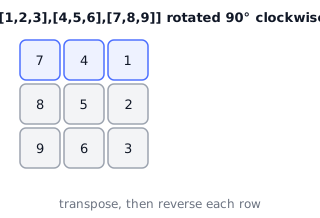
🟠 Medium. Rotate an n × n matrix 90° clockwise in place.
[[1,2,3],[4,5,6],[7,8,9]] → [[7,4,1],[8,5,2],[9,6,3]]Approach. Transpose (swap across the main diagonal), then reverse every row. Both steps are in place.
Complexity. O(n²) time, O(1) extra space.
function rotate(matrix: number[][]): void {
  const n = matrix.length;
  for (let i = 0; i < n; i++)
    for (let j = i + 1; j < n; j++) [matrix[i][j], matrix[j][i]] = [matrix[j][i], matrix[i][j]];
  for (const row of matrix) row.reverse();
}def rotate(matrix):
n = len(matrix)
for i in range(n):
for j in range(i + 1, n):
matrix[i][j], matrix[j][i] = matrix[j][i], matrix[i][j] # transpose
for row in matrix:
row.reverse() # mirror2Spiral Matrix (LeetCode 54)
🟠 Medium. Return all elements of an m × n matrix in spiral order.
[[1,2,3],[4,5,6],[7,8,9]] → [1,2,3,6,9,8,7,4,5]Approach. Keep four boundaries. Walk the top row left→right (then top++), the right column top→bottom (right--), the bottom row right→left if rows remain (bottom--), and the left column bottom→top if columns remain (left++).
Complexity. O(m · n) time, O(1) extra space.
function spiralOrder(matrix: number[][]): number[] {
  const res: number[] = [];
  let top = 0, bottom = matrix.length - 1, left = 0, right = matrix[0].length - 1;
  while (top <= bottom && left <= right) {
    for (let c = left; c <= right; c++) res.push(matrix[top][c]);
    top++;
    for (let r = top; r <= bottom; r++) res.push(matrix[r][right]);
    right--;
    if (top <= bottom) { for (let c = right; c >= left; c--) res.push(matrix[bottom][c]); bottom--; }
    if (left <= right) { for (let r = bottom; r >= top; r--) res.push(matrix[r][left]); left++; }
  }
  return res;
}def spiral_order(matrix):
res = []
top, bottom, left, right = 0, len(matrix) - 1, 0, len(matrix[0]) - 1
while top <= bottom and left <= right:
for c in range(left, right + 1):
res.append(matrix[top][c])
top += 1
for r in range(top, bottom + 1):
res.append(matrix[r][right])
right -= 1
if top <= bottom:
for c in range(right, left - 1, -1):
res.append(matrix[bottom][c])
bottom -= 1
if left <= right:
for r in range(bottom, top - 1, -1):
res.append(matrix[r][left])
left += 1
return res3Set Matrix Zeroes (LeetCode 73)
🟠 Medium. If a cell is 0, set its entire row and column to 0, in place with O(1) extra space.
[[1,1,1],[1,0,1],[1,1,1]] → [[1,0,1],[0,0,0],[1,0,1]]Approach. Use the first row and first column as marker storage: for each zero at (r, c), set matrix[r][0] and matrix[0][c] to 0. Remember separately whether the first column itself had a zero. Then zero cells based on the markers (skipping row/column 0), then handle the first row and column last.
Complexity. O(m · n) time, O(1) extra space.
function setZeroes(matrix: number[][]): void {
  const m = matrix.length, n = matrix[0].length;
  const firstColZero = matrix.some((row) => row[0] === 0);
  for (let r = 0; r < m; r++) for (let c = 1; c < n; c++) if (matrix[r][c] === 0) { matrix[r][0] = 0; matrix[0][c] = 0; }
  for (let r = 1; r < m; r++) for (let c = 1; c < n; c++) if (matrix[r][0] === 0 || matrix[0][c] === 0) matrix[r][c] = 0;
  if (matrix[0][0] === 0) matrix[0].fill(0);
  if (firstColZero) for (let r = 0; r < m; r++) matrix[r][0] = 0;
}def set_zeroes(matrix):
m, n = len(matrix), len(matrix[0])
first_col_zero = any(matrix[r][0] == 0 for r in range(m))
for r in range(m):
for c in range(1, n):
if matrix[r][c] == 0:
matrix[r][0] = matrix[0][c] = 0 # markers
for r in range(1, m):
for c in range(1, n):
if matrix[r][0] == 0 or matrix[0][c] == 0:
matrix[r][c] = 0
if matrix[0][0] == 0:
for c in range(n):
matrix[0][c] = 0
if first_col_zero:
for r in range(m):
matrix[r][0] = 04Pow(x, n) (LeetCode 50)
🟠 Medium. Implement x raised to the integer power n (n may be negative).
x = 2, n = 10 → 1024Approach. Binary exponentiation: square the base each step and multiply it into the result when the current bit of n is 1. For negative n, compute the positive power and take the reciprocal.
Complexity. O(log |n|) time, O(1) space.
function myPow(x: number, n: number): number {
  if (n < 0) { x = 1 / x; n = -n; }
  let result = 1;
  while (n > 0) {
    if (n % 2 === 1) result *= x;      // avoid bitwise ops: |n| may exceed 2^31 - 1
    x *= x;
    n = Math.floor(n / 2);
  }
  return result;
}def my_pow(x, n):
if n < 0:
x, n = 1 / x, -n
result = 1.0
while n:
if n & 1:
result *= x
x *= x
n >>= 1
return result5Count Primes (LeetCode 204)
🟠 Medium. Return the number of primes strictly less than n.
n = 10 → 4 (2, 3, 5, 7)Approach. Sieve of Eratosthenes: for every prime p with p² < n, mark multiples starting at p² (smaller multiples were already marked by smaller primes). Count the unmarked numbers.
Complexity. O(n log log n) time, O(n) space.
function countPrimes(n: number): number {
  if (n < 3) return 0;
  const isPrime = new Uint8Array(n).fill(1);
  isPrime[0] = isPrime[1] = 0;
  for (let p = 2; p * p < n; p++) if (isPrime[p]) for (let q = p * p; q < n; q += p) isPrime[q] = 0;
  return isPrime.reduce((a, b) => a + b, 0);
}def count_primes(n):
if n < 3:
return 0
is_prime = [True] * n
is_prime[0] = is_prime[1] = False
p = 2
while p * p < n:
if is_prime[p]:
for q in range(p * p, n, p):
is_prime[q] = False
p += 1
return sum(is_prime)6Happy Number (LeetCode 202)
🟢 Easy. Repeatedly replace n by the sum of the squares of its digits. n is happy if this reaches 1; otherwise it loops forever. Return whether n is happy.
19 → 82 → 68 → 100 → 1 → happyApproach. The sequence either reaches 1 or enters a cycle. Detect the cycle with a seen set, or with Floyd's tortoise and hare for O(1) space (exactly like a linked list cycle).
Complexity. O(log n) per step; the sequence quickly falls below a few hundred.
function isHappy(n: number): boolean {
  const next = (x: number): number => { let s = 0; while (x) { const d = x % 10; s += d * d; x = Math.floor(x / 10); } return s; };
  let slow = n, fast = next(n);
  while (fast !== 1 && slow !== fast) { slow = next(slow); fast = next(next(fast)); }
  return fast === 1;
}def is_happy(n):
def nxt(x):
return sum(int(d) ** 2 for d in str(x))
slow, fast = n, nxt(n)
while fast != 1 and slow != fast:
slow, fast = nxt(slow), nxt(nxt(fast))
return fast == 1🧠 Key takeaways
- Euclid gcd, fast power O(log n), sieve O(n log log n).
- Reduce mod m after every step; use BigInt in JS and
longin C# for big products. - Rotate CW = transpose + reverse rows; spiral = shrink four boundaries; O(1) markers in row/col 0.
- Number sequences that may loop → cycle detection (seen set or Floyd).
🛠️ Practice exercises
Each exercise is a file in this topic folder. Code exercises are self-checking: run them and make the checks pass.
✅ Check yourself
Answer the questions — feedback is instant.