CAP Theorem
When the network splits a cluster, every distributed data system must choose: refuse requests to stay consistent, or keep answering and risk disagreeing. Partition a three-node cluster and watch the CP and AP choices play out, then add PACELC's everyday latency trade-off.
🎯 What you'll learn
- Consistency, availability and partition tolerance, precisely
- Why partition tolerance isn't optional
- CP vs AP behaviour during a partition, with real examples
- Per-operation choices and PACELC
📚 Before you start
1The Three Properties, Defined Precisely
CAP theorem states that a distributed data system can provide at most two of the following three guarantees at the same time, during a network partition:
- Consistency (C) — every read receives the most recent write, or an error. Every node that responds to a request agrees on the current value; there is no such thing as one node returning old data while another returns new data.
- Availability (A) — every request to a non-failing node receives a response (not an error, not a timeout) — though not necessarily the most recent write.
- Partition tolerance (P) — the system continues to operate despite an arbitrary number of messages being dropped or delayed between nodes (a network partition: some nodes can't talk to some other nodes for a while).
The precise, easy-to-misstate claim: you cannot have all three simultaneously once a partition actually occurs. Outside of a partition (the normal, healthy case), a well-built system can absolutely offer both consistency and availability — CAP is specifically a statement about what has to give during a partition, not a permanent, constant tradeoff.
2Why Partition Tolerance Isn't Really an Optional Choice
CAP is often (mis)taught as "pick any 2 of C, A, P" — as if P were a design choice on equal footing with C and A. In a real distributed system, spanning more than one machine, over a real network, partitions will happen — a switch fails, a cable gets cut, a datacenter loses connectivity, a process pauses long enough for peers to consider it unreachable. A system that "chooses" not to tolerate partitions isn't choosing CA over CP/AP — it's simply going to fail completely (become fully unavailable, everywhere) the moment a partition occurs, because it has no defined behavior for that case at all.
This reframes the real question CAP forces onto every distributed system's design: given that a partition WILL eventually happen, when it does, do you sacrifice Consistency or Availability? That's a genuine design choice — CP or AP — made concretely, node by node, for the duration of the partition.
3CP: Choosing Consistency, Sacrificing Availability During a Partition
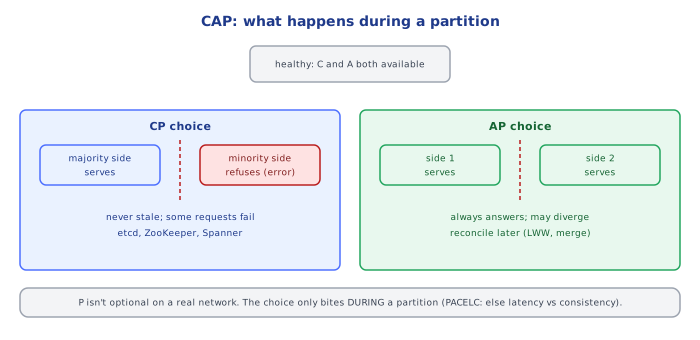
A CP system, when partitioned, refuses to serve requests it can't guarantee are consistent — some nodes go unavailable (return errors/timeouts) rather than risk serving stale or conflicting data:
Cluster of 3 nodes, partitioned into [Node A] | [Node B, Node C]

A CP system:
  - Node A, isolated and unable to confirm it has the latest write, REFUSES
    reads/writes rather than risk serving stale data -> Node A is UNAVAILABLE
  - Nodes B and C, still able to talk to each other, may continue serving
    (if they still have a majority -- see quorum-based systems)
Concrete examples: a strongly-consistent configuration store like etcd or ZooKeeper (used specifically because callers need a guaranteed-current value, e.g. for leader election — serving a stale "who is the leader" answer to two different callers would be actively dangerous) is built CP. A traditional single-primary relational database, when its primary is unreachable, typically refuses writes rather than let a secondary accept writes it can't guarantee are consistent with the primary.
4AP: Choosing Availability, Sacrificing (Strict) Consistency During a Partition
An AP system keeps serving requests on both sides of a partition, accepting that the two sides may temporarily disagree:
Same partition: [Node A] | [Node B, Node C]

An AP system:
  - Node A keeps serving reads AND writes using whatever data it has locally
  - Nodes B/C also keep serving reads and writes
  - If a client wrote to Node A during the partition, and another client
    reads from Node B, it may get a DIFFERENT (older, or conflicting) value
  - Once the partition heals, the system must RECONCILE the divergent
    writes (last-write-wins, vector clocks, application-level merge logic,
    etc. -- how reconciliation works is implementation-specific)
Concrete examples: Cassandra and DynamoDB are classically AP-oriented (configurable, but designed to keep serving during a partition, favoring uptime), because for their common use cases (a shopping cart, a metrics store, a social feed) briefly serving slightly-stale data to keep the system responsive is a better tradeoff than an outage. A CDN cache is AP by nature — an edge node cut off from origin keeps serving its (possibly stale) cached content rather than erroring.
5This Is a Per-System (Often Per-Operation) Choice, Not a Universal Ranking
Neither CP nor AP is "more correct" in the abstract — the right choice depends entirely on what an inconsistent-but-available response would cost versus what an unavailable response would cost, for that specific piece of data:
| Data | Favor | Why |
|---|---|---|
| Bank account balance used to authorize a withdrawal | CP | Serving a stale balance could let someone overdraw; an error is safer than a wrong answer |
| "Who is the current leader" in a coordination service | CP | Two callers getting two different "current" leaders can cause split-brain damage |
| Product view count / "likes" counter | AP | A slightly stale count is harmless; an outage on every product page load is far worse |
| Shopping cart contents | AP | Losing availability during checkout browsing is worse than briefly showing a slightly stale cart, which is usually reconciled on the next write |
Many real systems aren't purely one or the other everywhere — they make this choice per operation or per data type, using a strongly-consistent store for account balances and an eventually-consistent one for view counters, even within the same product.
- Wallet balance (used to pay for vet visits): stored in a CP database. During a partition, the isolated region returns "payments temporarily unavailable" rather than risk spending the same money twice.
- "12 people viewed this cat tree": AP counter. During a partition each region keeps counting; numbers reconcile later, and nobody is harmed by a stale count.
6PACELC: A Refinement Worth Knowing
CAP technically only describes behavior during a partition — it says nothing about the consistency/latency tradeoff a system makes when there is no partition, which is the vast majority of the time. PACELC extends the idea: if Partitioned, choose Availability or Consistency; Else (normal operation), choose Latency or Consistency. Even with no partition at all, a strongly consistent system typically pays a latency cost (coordinating with other replicas before acknowledging a write) that an eventually-consistent system avoids — so the C-vs-something tradeoff doesn't fully disappear even in the healthy case, it just becomes a latency tradeoff instead of an availability one.
⚠️ Common Pitfalls
- Treating "pick 2 of 3" as a literal, always-available menu — partition tolerance isn't optional in a real networked system; the real, constant choice is CP vs AP for what happens when (not if) a partition occurs.
- Assuming a system is CP or AP everywhere, uniformly — many real systems make the choice per data type or per operation (strongly-consistent account balances, eventually-consistent view counters, in the same product).
- Forgetting CAP only describes partition behavior — during normal, healthy operation, a well-built system can offer both consistency and availability; conflating "CP system" with "always slow or unavailable" misreads the theorem.
- Ignoring the reconciliation problem in an AP design — choosing availability during a partition defers, but doesn't eliminate, the need to actually reconcile divergent writes once the partition heals; a design that hand-waves this isn't actually finished.
- Not considering PACELC's latency dimension — evaluating a database purely on its partition-time CAP category while ignoring its normal-operation consistency/latency tradeoff misses a large part of the real-world cost difference between systems.
📋 Quick Reference
C = Consistency: every read sees the latest write (or an error) -- all nodes agree
A = Availability: every request to a healthy node gets a non-error response
P = Partition tolerance: system keeps functioning despite dropped/delayed messages

P is NOT optional in a real network -- partitions WILL happen
Real choice: when partitioned, sacrifice C (go CP) or sacrifice A (go AP)?

CP examples: etcd, ZooKeeper, traditional single-primary RDBMS (refuses writes when isolated)
AP examples: Cassandra, DynamoDB (configurable), CDN edge caches (serve stale rather than error)

PACELC: if Partitioned -> Availability or Consistency; Else -> Latency or Consistency
        (the C-vs-something tradeoff exists even with NO partition, as a latency cost)
🧠 Key takeaways
- CAP is about behaviour during a partition; in healthy times a system can be both consistent and available.
- Partitions will happen, so the real choice is CP (refuse to stay correct) or AP (answer and reconcile later).
- Choose per data type or operation: money and leader election lean CP, counters and carts lean AP.
- PACELC: even without partitions there's a trade-off between latency and consistency.
🎤 Interview Q&A
Q1State the CAP theorem.core▾
In a distributed system, during a network partition you must choose between consistency (every read sees the latest write, or an error) and availability (every request gets a non-error response, possibly stale). Partitions are unavoidable, so the real choice is CP or AP behaviour when they happen.
- Is CA possible? Only if you assume no partitions, which means a single node, not a distributed system.
Q2Give examples of CP and AP systems.core▾
CP: ZooKeeper, etcd, HBase, and relational databases with synchronous replication refuse writes when they can't reach a quorum. AP: Cassandra, DynamoDB (default), Riak keep accepting reads/writes and reconcile later. Many systems are tunable per operation.
- Is MongoDB CP or AP? With majority write/read concerns it behaves CP; with weaker settings, closer to AP.
Q3What does PACELC add?core▾
If Partition: choose Availability or Consistency; Else (normal operation): choose Latency or Consistency. It captures that even without partitions, stronger consistency costs latency (waiting for replicas).
- Example? DynamoDB is PA/EL; Spanner is PC/EC.
Q4How do you choose consistency for different data in one system?senior▾
Per data type and operation: account balances, inventory reservations and unique usernames need strong consistency; likes, view counts, feeds and recommendations tolerate eventual consistency. Mixing is normal.
- What's read-your-writes consistency? A user always sees their own updates, even if others see them later.
Q5What's a common misconception about CAP?core▾
That you pick two of three permanently. In reality, you only trade C vs A during partitions, the 'C' in CAP is linearizability (not ACID consistency), and systems offer a spectrum of consistency levels, not a binary.
- What consistency models sit in between? Causal, session (read-your-writes, monotonic reads) and bounded staleness.
🛠️ Practice exercises
Each exercise is a file in this topic folder. Code exercises are self-checking: run them and make the checks pass.
✅ Check yourself
Answer the questions — feedback is instant.