{this.state.user.name}
:Loading…
; } } ``` Note the shape all three share: `render` is called to compute *what* to show, and `componentDidMount`/`componentDidUpdate`/`componentWillUnmount` are called around it to run side effects tied to *when* it happened. This is the split hooks eventually generalized. ## 3. The Function-Component Equivalent: `useEffect` ```tsx function UserProfile({ userId }: { userId: string }) { const [user, setUser] = useState{user.name}
:Loading…
; } ``` This one `useEffect` call replaces `componentDidMount` **and** `componentDidUpdate` **and** `componentWillUnmount` at once — see the mapping table in section 4. The full mechanics of the dependency array, cleanup timing, and common bugs are covered in depth in the "UseEffect" topic; this topic focuses on how that mapping lines up with the class model and the commit phase underneath both. 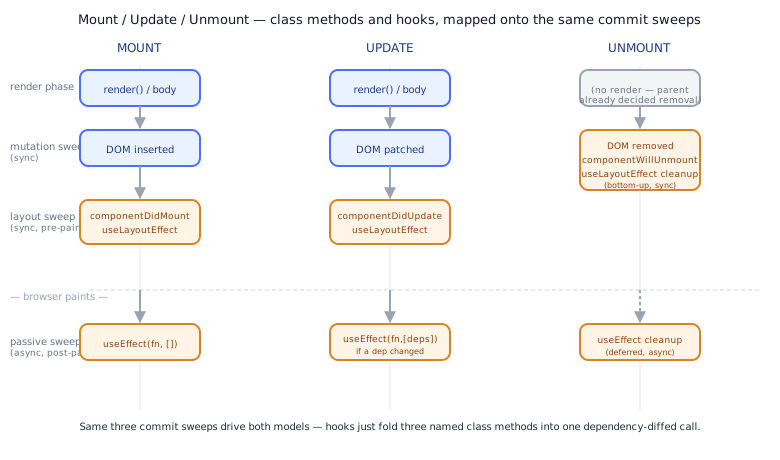 ## 4. The Mapping, Precisely | Class method | Fires | `useEffect` equivalent | |---|---|---| | `constructor` | Once, before first render | `useState(initialValue)` (lazy initializer form for expensive setup) | | `render` | Every render | The function component's own body | | `componentDidMount` | Once, after first commit | `useEffect(() => { ... }, [])` | | `componentDidUpdate` | After every commit except the first | `useEffect(() => { ... }, [deps])` — runs after mount **and** whenever a listed dependency changes; you don't get a "not the first time" flag for free, you compare inside the effect if you truly need mount excluded | | `componentWillUnmount` | Once, before removal | The function **returned** from `useEffect`'s callback | | `getDerivedStateFromProps` | Before every render, mount and update | Computing a value directly in the render body from props (no effect needed) | | `shouldComponentUpdate` | Before re-rendering, to allow bailing out | `React.memo` (covered in "Performance optimization") | | `getSnapshotBeforeUpdate` | Right before the DOM is mutated, after render | `useLayoutEffect` reading the DOM just before your own update (covered in "UseLayoutEffect") | The important asymmetry: a single `useEffect` with a dependency array covers mount, every relevant update, *and* unmount cleanup — three class methods collapse into one hook because the hook is keyed on "did this value change," not on "which named phase are we in." ## 5. Cleanup Runs Before the *Next* Effect, Not Just on Unmount This is the detail that trips people coming from classes the hardest: the cleanup function isn't only for unmount. React runs it before *every* re-run of the effect, including ordinary updates — not just the final unmount. ```tsx useEffect(() => { const id = setInterval(() => console.log("tick"), 1000); return () => clearInterval(id); // runs before the NEXT effect AND on unmount }, [intervalMs]); ``` If `intervalMs` changes, React runs the cleanup from the *previous* effect (clearing the old interval) before running the *new* effect (starting a new one with the updated delay) — in that order, every time. On final unmount, there is no "next effect" to run, so only the cleanup fires. This single rule is why `useEffect` can replace `componentDidMount` + `componentDidUpdate` + `componentWillUnmount` with one function: "clean up the old thing, then set up the new thing" describes an update, and "clean up the old thing, don't set anything up" describes an unmount — same cleanup call, different question of whether a following effect exists. ## 6. Under the Hood: What Actually Runs, and When ### Fibers carry a `tag` that tells the commit phase which lifecycle model to run Every fiber has a numeric `tag` (`ClassComponent`, `FunctionComponent`, `HostComponent`, etc.). During the commit phase, React switches on this tag to decide what side-effect code to invoke for that fiber — `commitClassLifeCycles` for class fibers (which directly calls `instance.componentDidMount()` / `instance.componentDidUpdate(prevProps, prevState)` on the class instance sitting at `fiber.stateNode`), versus effect-list processing for function fibers. Class lifecycle methods are not some separate mechanism layered on top of fibers — they are function calls React makes directly against your class instance, from inside the same commit walk that also updates the DOM. ### Function-component effects live on `fiber.updateQueue`, not `memoizedState` alone Each `useEffect` call appends a hook node to the fiber's hooks linked list (`memoizedState`, described in the "State" topic's Under the Hood section) *and* an effect object — `{ tag, create, destroy, deps }` — onto a separate circular list at `fiber.updateQueue`. `tag` records whether this is a passive effect (`useEffect`) or a layout effect (`useLayoutEffect`); `create` is your callback; `destroy` is whatever your callback returned last time (or `undefined`); `deps` is the array React compares next render. ### Dependency comparison happens before the effect list is even scheduled On each render, React compares the new `deps` array against the previous one **element-by-element with `Object.is`** (not the array reference itself — a fresh `[userId]` array every render is fine, it's `userId` that must be stable). If every element matches, React tags this effect as "no work needed" and its `create`/`destroy` are skipped entirely for this commit — the hook node's `deps` are still updated, but nothing runs. This is exactly the same `Object.is` comparator used for `React.memo`'s props check (see "Rendering and reconciliation"); it's one general mechanism reused in multiple hooks. ### Commit order: mutations → layout effects (sync) → paint → passive effects (async) The commit phase is not "run everything for this fiber, then move to the next fiber." It's three sweeps across the *whole* tree of committed fibers, in this order: 1. **Mutation sweep** — DOM insertions/updates/removals happen. For unmounting fibers, this is also where `componentWillUnmount` and any `useLayoutEffect` cleanup fire — bottom-up, children before their parents, because a parent's DOM node might still be needed as a reference point for removing its children first. Both run **synchronously**, before anything paints. 2. **Layout sweep** — remaining `useLayoutEffect` callbacks and `componentDidMount`/`componentDidUpdate` run here, synchronously, before the browser paints. This is why layout effects can read/write layout without a visible flash — nothing has been painted yet. 3. **Passive sweep** — `useEffect` callbacks run here, asynchronously, scheduled *after* the browser has painted. A `useEffect` cleanup for an **unmounting** component is deferred into this same asynchronous sweep too, not the synchronous mutation sweep — which is why a `useEffect` cleanup can observably fire later than a sibling class's `componentWillUnmount` for the same removal, even though both are "unmount cleanup." ``` commit: mutation sweep → DOM changes; componentWillUnmount + useLayoutEffect cleanup (bottom-up, sync) layout sweep → useLayoutEffect setup, componentDidMount/Update (sync, pre-paint) ── browser paints ── passive sweep → useEffect setup; useEffect cleanup for unmounted trees too (async, post-paint) ``` ### Why unmount cleanup order is bottom-up Because the mutation sweep must remove a parent's DOM node only after its children have already been detached (or the child's own cleanup — which might try to read `parentNode`, or unsubscribe from something the parent set up — would run against a half-torn-down tree), React always unmounts a subtree depth-first, calling every descendant's cleanup/`componentWillUnmount` before it calls the parent's. This isn't a documented "nice to know" — it's a direct consequence of doing a single DOM removal pass without leaving dangling references mid-walk. ## 7. Common Pitfalls 1. **Expecting `componentDidUpdate` (or a bare `useEffect(fn)` with no dependency array) to run only when "the relevant thing" changed** — `componentDidUpdate` fires after *every* update regardless of cause, and an effect with no dependency array runs after *every single render*. Both require you to compare old vs. new yourself, or supply a dependency array, if you only care about specific changes. 2. **Putting side effects directly in the render/component body** instead of `componentDidMount`/`useEffect`** — the render phase (or a function component's body) can run more than once per commit or be thrown away entirely (see "Rendering and reconciliation"); only commit-phase hooks are guaranteed to run exactly once per actual DOM update. 3. **Forgetting `componentWillUnmount`/effect cleanup entirely** — subscriptions, intervals, and event listeners set up in `componentDidMount`/`useEffect` keep running (and keep references alive) after the component is gone, unless you tear them down in the matching cleanup. 4. **Missing a dependency in `useEffect`'s array** — the effect keeps closing over a stale value from whatever render created it (this is the JavaScript **Closures** topic's "closures capture variables, not values" playing out inside a hook); the effect doesn't magically see updated outer variables just because they changed elsewhere. 5. **Assuming cleanup only runs on unmount** — as section 5 explains, it runs before every subsequent effect re-run too; code that assumes "this only happens once, at the very end" will run far more often than expected for a changing dependency. 6. **Calling `setState` unconditionally inside `componentDidUpdate`** without a guard — since `componentDidUpdate` fires after every update including the one this `setState` itself causes, an unguarded call creates an infinite re-render loop. The functional equivalent, an unconditional `setState` inside `useEffect` with no dependency array, has the identical failure mode. ## 8. Quick Reference | Phase | Class method(s) | Hook equivalent | Runs during | |---|---|---|---| | Mount | `constructor`, `render`, `componentDidMount` | function body runs, then `useEffect(fn, [])` | render phase, then layout/passive sweep | | Update | `render`, `componentDidUpdate` | function body runs, then `useEffect(fn, [deps])` if deps changed | render phase, then layout/passive sweep | | Unmount | `componentWillUnmount` | cleanup function returned from `useEffect` | mutation sweep, bottom-up | | Bail out of updating | `shouldComponentUpdate` | `React.memo` | before the render phase even calls the function | | Read DOM right before it changes | `getSnapshotBeforeUpdate` | `useLayoutEffect` | layout sweep, pre-paint | ``` useEffect(() => { setup(); return () => cleanup(); // runs before next effect, AND on unmount }, [deps]); deps omitted -> runs after every render (mount + every update) deps = [] -> runs once, after mount only deps = [a, b] -> runs after mount, and after any render where a or b changed (Object.is comparison, element by element) ```