Binary Search
Binary search finds a boundary among n candidates in O(log n), not just an element in a sorted array. Learn one bug-resistant template for exact matches, lower/upper bounds and search-on-the-answer, handle rotated arrays, and watch three LeetCode problems animated.
🎯 What you'll learn
- Exact match, boundary and search-on-the-answer flavours
- One half-open template and its invariant
- Rotated arrays and the partition idea
- Six LeetCode problems up to Median of Two Sorted Arrays
📚 Before you start
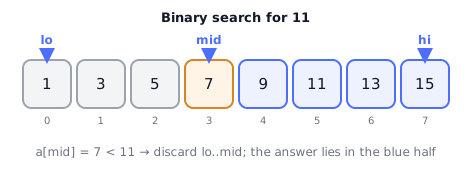
Binary search halves the search space on every step, so it finds an answer among n candidates in O(log n): 30 steps for a billion items. It applies far beyond "find x in a sorted array": any time candidates can be split into a "no" part followed by a "yes" part (a monotonic predicate), you can binary search for the boundary. That includes searching for a numeric answer such as a speed, a capacity or a time.
1Three Flavours
| Flavour | Question | Example |
|---|---|---|
| Exact match | Is x present, and where? | Binary Search (704) |
| Boundary (lower/upper bound) | First index where a[i] ≥ x (or > x) | insert position, first/last occurrence, count of x |
| Search on the answer | Smallest value v such that feasible(v) is true | Koko Eating Bananas, ship packages, split array |
2One Template to Rule Them All
Most bugs come from mixing up <= / < and mid / mid ± 1. Use one half-open template for everything and reason only about the predicate:
function lowerBound(nums: number[], target: number): number {
  let lo = 0, hi = nums.length;
  while (lo < hi) {
    const mid = (lo + hi) >>> 1;
    if (nums[mid] < target) lo = mid + 1; else hi = mid;
  }
  return lo;
}

function minFeasible(lo: number, hi: number, feasible: (x: number) => boolean): number {
  while (lo < hi) {
    const mid = lo + Math.floor((hi - lo) / 2);
    if (feasible(mid)) hi = mid; else lo = mid + 1;
  }
  return lo;
}def lower_bound(nums, target):
"""First index i with nums[i] >= target (len(nums) if none)."""
lo, hi = 0, len(nums) # search space [lo, hi)
while lo < hi:
mid = (lo + hi) // 2
if nums[mid] < target:
lo = mid + 1 # answer is right of mid
else:
hi = mid # mid could be the answer
return lo
def min_feasible(lo, hi, feasible):
"""Smallest x in [lo, hi] with feasible(x) True; feasible must be monotonic (F..F T..T)."""
while lo < hi:
mid = (lo + hi) // 2
if feasible(mid):
hi = mid
else:
lo = mid + 1
return loInvariant: the answer is always inside [lo, hi) (or [lo, hi] in min_feasible). Each iteration shrinks the range by at least one, so the loop terminates, and when lo == hi that's the answer.
upper_bound(x)(first index witha[i] > x) is the same code with<=in the comparison.count of x=upper_bound(x) − lower_bound(x).- Python has these built in:
bisect.bisect_leftandbisect.bisect_right. C# hasArray.BinarySearch(returns the bitwise complement of the insertion point when not found).
3Search on the Answer
When asked for "the minimum X such that something is possible":
- Identify the range of candidate answers
[lo, hi](e.g. speed 1 to max pile). - Write
feasible(x), usually a greedy O(n) check. - Confirm monotonicity: if x works, every larger x works too.
- Binary search the boundary: total O(n log range).
4Rotated and Partially Sorted Arrays
In a rotated sorted array, one half around mid is always sorted. Check which half is sorted (nums[lo] <= nums[mid]), test whether the target lies inside that sorted half, and discard the other. The minimum of a rotated array is found by comparing nums[mid] with nums[hi].
Under the HoodOverflow and Termination▾
mid = (lo + hi) / 2 can overflow 32-bit integers in C#/Java when lo + hi > 2³¹ − 1; use lo + (hi − lo) / 2. In JavaScript, (lo + hi) >>> 1 is a safe unsigned shift for array indices. Python integers don't overflow. Termination: with lo < hi, mid is always < hi, so hi = mid strictly shrinks the range and lo = mid + 1 does too. If you write lo = mid instead, the loop can get stuck when hi = lo + 1 (then you'd need mid = (lo + hi + 1) / 2).
⚠️ Common Pitfalls
- Mixing templates (
<=withhi = mid) → infinite loops or skipped answers. - Non-monotonic predicate: binary search silently returns garbage.
- Integer overflow in
(lo + hi) / 2in typed languages. - Wrong answer range in search-on-answer (e.g. lower bound 0 when the answer must be ≥ 1).
- Forgetting duplicates: with repeated values, decide whether you want the first or last occurrence.
📋 Quick Reference
lower_bound: lo,hi = 0,n; while lo<hi: mid; a[mid]<x → lo=mid+1 else hi=mid
upper_bound: same with a[mid] <= x
answer search: lo..hi range; feasible(mid) → hi=mid else lo=mid+1
rotated: one half is sorted; test target there
O(log n) · answer search O(n log range)Six problems across the three flavours: exact match, boundaries, rotated arrays, search on the answer, and the hard partition search.
1Binary Search (LeetCode 704)
🟢 Easy. Return the index of target in the sorted array nums, or −1.
nums = [-1,0,3,5,9,12], target = 9 → 4Approach. Lower bound, then check that the element there equals the target.
Complexity. O(log n) time, O(1) space.
function search(nums: number[], target: number): number {
  let lo = 0, hi = nums.length;
  while (lo < hi) {
    const mid = (lo + hi) >>> 1;
    if (nums[mid] < target) lo = mid + 1; else hi = mid;
  }
  return lo < nums.length && nums[lo] === target ? lo : -1;
}def search(nums, target):
lo, hi = 0, len(nums)
while lo < hi:
mid = (lo + hi) // 2
if nums[mid] < target:
lo = mid + 1
else:
hi = mid
return lo if lo < len(nums) and nums[lo] == target else -12Find First and Last Position of Element (LeetCode 34)
🟠 Medium. Return [first, last] positions of target in sorted nums, or [-1, -1], in O(log n).
nums = [5,7,7,8,8,10], target = 8 → [3,4]Approach. first = lower_bound(target), last = lower_bound(target + 1) − 1 (or upper_bound − 1). If first is out of range or doesn't hold the target, return [-1, -1].
Complexity. O(log n) time.
function lowerBound(nums: number[], x: number): number {
  let lo = 0, hi = nums.length;
  while (lo < hi) { const mid = (lo + hi) >>> 1; if (nums[mid] < x) lo = mid + 1; else hi = mid; }
  return lo;
}

function searchRange(nums: number[], target: number): number[] {
  const first = lowerBound(nums, target);
  if (first === nums.length || nums[first] !== target) return [-1, -1];
  return [first, lowerBound(nums, target + 1) - 1];
}from bisect import bisect_left
def search_range(nums, target):
first = bisect_left(nums, target)
if first == len(nums) or nums[first] != target:
return [-1, -1]
return [first, bisect_left(nums, target + 1) - 1]3Search in Rotated Sorted Array (LeetCode 33)
🟠 Medium. A sorted array of distinct values was rotated at an unknown pivot. Return the index of target or −1 in O(log n).
nums = [4,5,6,7,0,1,2], target = 0 → 4Approach. At every step one half of [lo, hi] is sorted. If nums[lo] <= nums[mid], the left half is sorted: go left if nums[lo] <= target < nums[mid], otherwise right. Else the right half is sorted: go right if nums[mid] < target <= nums[hi].
Complexity. O(log n) time, O(1) space.
function searchRotated(nums: number[], target: number): number {
  let lo = 0, hi = nums.length - 1;
  while (lo <= hi) {
    const mid = (lo + hi) >>> 1;
    if (nums[mid] === target) return mid;
    if (nums[lo] <= nums[mid]) {
      if (nums[lo] <= target && target < nums[mid]) hi = mid - 1; else lo = mid + 1;
    } else {
      if (nums[mid] < target && target <= nums[hi]) lo = mid + 1; else hi = mid - 1;
    }
  }
  return -1;
}def search_rotated(nums, target):
lo, hi = 0, len(nums) - 1
while lo <= hi:
mid = (lo + hi) // 2
if nums[mid] == target:
return mid
if nums[lo] <= nums[mid]: # left half sorted
if nums[lo] <= target < nums[mid]:
hi = mid - 1
else:
lo = mid + 1
else: # right half sorted
if nums[mid] < target <= nums[hi]:
lo = mid + 1
else:
hi = mid - 1
return -14Find Minimum in Rotated Sorted Array (LeetCode 153)
🟠 Medium. Return the minimum of a rotated sorted array of distinct values in O(log n).
nums = [3,4,5,1,2] → 1Approach. Compare nums[mid] with nums[hi]: if nums[mid] > nums[hi], the drop (and the minimum) is to the right of mid; otherwise the minimum is at mid or to its left.
Complexity. O(log n) time.
function findMin(nums: number[]): number {
  let lo = 0, hi = nums.length - 1;
  while (lo < hi) {
    const mid = (lo + hi) >>> 1;
    if (nums[mid] > nums[hi]) lo = mid + 1; else hi = mid;
  }
  return nums[lo];
}def find_min(nums):
lo, hi = 0, len(nums) - 1
while lo < hi:
mid = (lo + hi) // 2
if nums[mid] > nums[hi]:
lo = mid + 1
else:
hi = mid
return nums[lo]5Koko Eating Bananas (LeetCode 875)
🟠 Medium. Koko eats at speed k bananas/hour, one pile per hour at most (leftover hours are wasted). Return the minimum k that finishes all piles within h hours.
piles = [3,6,7,11], h = 8 → 4Approach. Search on the answer. Speeds range from 1 to max(piles). hours(k) = Σ ceil(pile / k) decreases as k grows (monotonic), so binary search the smallest k with hours(k) ≤ h.
Complexity. O(n log max(piles)) time, O(1) space.
function minEatingSpeed(piles: number[], h: number): number {
  const hours = (k: number) => piles.reduce((t, p) => t + Math.ceil(p / k), 0);
  let lo = 1, hi = Math.max(...piles);
  while (lo < hi) {
    const mid = (lo + hi) >>> 1;
    if (hours(mid) <= h) hi = mid; else lo = mid + 1;
  }
  return lo;
}def min_eating_speed(piles, h):
def hours(k):
return sum((p + k - 1) // k for p in piles) # ceil division
lo, hi = 1, max(piles)
while lo < hi:
mid = (lo + hi) // 2
if hours(mid) <= h:
hi = mid
else:
lo = mid + 1
return lo6Median of Two Sorted Arrays (LeetCode 4)
🔴 Hard. Return the median of two sorted arrays in O(log(min(m, n))).
a = [1,2], b = [3,4] → 2.5Approach. Binary search a partition of the shorter array A: take i elements from A and j = half − i from B so the left side holds half of all elements. The partition is correct when A[i−1] ≤ B[j] and B[j−1] ≤ A[i]; if A[i−1] > B[j], take fewer from A (move left), else more. The median comes from the max of the left side and the min of the right side.
Complexity. O(log min(m, n)) time, O(1) space.
function findMedianSortedArrays(a: number[], b: number[]): number {
  if (a.length > b.length) [a, b] = [b, a];
  const m = a.length, n = b.length, half = (m + n + 1) >> 1;
  let lo = 0, hi = m;
  while (lo <= hi) {
    const i = (lo + hi) >> 1, j = half - i;
    const aL = i > 0 ? a[i - 1] : -Infinity, aR = i < m ? a[i] : Infinity;
    const bL = j > 0 ? b[j - 1] : -Infinity, bR = j < n ? b[j] : Infinity;
    if (aL <= bR && bL <= aR) {
      return (m + n) % 2 ? Math.max(aL, bL) : (Math.max(aL, bL) + Math.min(aR, bR)) / 2;
    }
    if (aL > bR) hi = i - 1; else lo = i + 1;
  }
  return 0;
}def find_median_sorted_arrays(a, b):
if len(a) > len(b):
a, b = b, a
m, n = len(a), len(b)
half = (m + n + 1) // 2
lo, hi = 0, m
while lo <= hi:
i = (lo + hi) // 2
j = half - i
a_left = a[i - 1] if i > 0 else float("-inf")
a_right = a[i] if i < m else float("inf")
b_left = b[j - 1] if j > 0 else float("-inf")
b_right = b[j] if j < n else float("inf")
if a_left <= b_right and b_left <= a_right:
if (m + n) % 2:
return float(max(a_left, b_left))
return (max(a_left, b_left) + min(a_right, b_right)) / 2
if a_left > b_right:
hi = i - 1
else:
lo = i + 1
return 0.0🧠 Key takeaways
- Binary search needs a monotonic predicate (no…no yes…yes), not necessarily a sorted array.
- Use one template:
while lo < hi,hi = midorlo = mid + 1; reason about the invariant. - Search on the answer: range of candidates + greedy feasibility check → O(n log range).
- Rotated arrays: one half is sorted; avoid overflow with
lo + (hi − lo) / 2.
🛠️ Practice exercises
Each exercise is a file in this topic folder. Code exercises are self-checking: run them and make the checks pass.
✅ Check yourself
Answer the questions — feedback is instant.