Prefix Sums
Prefix sums turn any range sum into one subtraction, and combined with a hash map they count subarrays with a given sum in O(n), even with negative numbers. Learn the 1D, hash-map and 2D variants plus difference arrays, with animated walkthroughs of three LeetCode problems.
🎯 What you'll learn
- Range sums in O(1) after O(n) preprocessing
- Prefix + hash map: count, longest, divisible-by-k
- 2D prefix sums with inclusion–exclusion
- Difference arrays for range updates
📚 Before you start
A prefix sum array stores running totals so that the sum of any range is one subtraction: sum(i..j) = prefix[j+1] − prefix[i]. Combined with a hash map of previously seen prefix sums, it answers "how many subarrays have sum k?" in O(n), and unlike sliding windows it works with negative numbers.
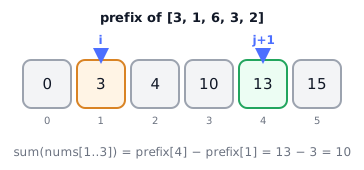
1Recognition Cues
- "sum of elements between i and j", many range queries on a static array
- "number of subarrays with sum equal to k", "subarray sum divisible by k", "equal number of 0s and 1s"
- "pivot/equilibrium index" (left sum equals right sum)
- 2D: "sum of a sub-rectangle", many rectangle queries on a matrix
2Templates
function buildPrefix(nums: number[]): number[] {
  const prefix = new Array(nums.length + 1).fill(0);
  for (let i = 0; i < nums.length; i++) prefix[i + 1] = prefix[i] + nums[i];
  return prefix;
}

function countSubarraysWithSum(nums: number[], k: number): number {
  const seen = new Map<number, number>([[0, 1]]);
  let running = 0, count = 0;
  for (const x of nums) {
    running += x;
    count += seen.get(running - k) ?? 0;
    seen.set(running, (seen.get(running) ?? 0) + 1);
  }
  return count;
}def build_prefix(nums):
prefix = [0] * (len(nums) + 1) # prefix[i] = sum of nums[0:i]
for i, x in enumerate(nums):
prefix[i + 1] = prefix[i] + x
return prefix # sum(i..j) = prefix[j+1] - prefix[i]
def count_subarrays_with_sum(nums, k):
seen = {0: 1} # prefix sum -> how many times seen
running = count = 0
for x in nums:
running += x
count += seen.get(running - k, 0) # earlier prefixes that leave sum k
seen[running] = seen.get(running, 0) + 1
return countThe seen = {0: 1} initialization represents the empty prefix, so subarrays starting at index 0 are counted.
3Why Prefix + Hash Map Works
If the running sum at index j is P[j], a subarray (i..j] sums to k exactly when P[i] = P[j] − k. So at each j, the number of valid subarrays ending at j is the number of earlier prefixes equal to P[j] − k, which a hash map counts in O(1).
Variants change what you store or look up:
| Problem | Transform | Map stores |
|---|---|---|
| subarray sum = k | none | prefix → count |
| longest subarray with sum k | none | prefix → first index |
| equal 0s and 1s | map 0 → −1, find sum 0 | prefix → first index |
| sum divisible by k | use prefix % k (normalize negatives) | remainder → count |
42D Prefix Sums
For a matrix, P[r+1][c+1] = sum of the rectangle from (0,0) to (r,c):
P[r+1][c+1] = M[r][c] + P[r][c+1] + P[r+1][c] − P[r][c]
sum(r1..r2, c1..c2) = P[r2+1][c2+1] − P[r1][c2+1] − P[r2+1][c1] + P[r1][c1]
Building costs O(R·C); every rectangle query is then O(1). This is inclusion–exclusion: add the two overlapping strips, subtract the doubly counted corner.
5Related: Difference Arrays
The inverse trick: to add v to every element in [l, r] many times, write diff[l] += v and diff[r+1] −= v, then take one prefix sum at the end. Range updates become O(1) each (car pooling, corporate flight bookings).
⚠️ Common Pitfalls
- Forgetting
{0: 1}(or index −1 for "first index" variants), which misses subarrays starting at 0. - Updating the map before querying it, which counts the empty subarray when k = 0.
- Negative remainders: in Python
-1 % 5 == 4, but in JS/C#-1 % 5 == -1; normalize with((x % k) + k) % k. - Integer overflow in C#/Java with large sums: use
long. - Using a sliding window when numbers can be negative.
📋 Quick Reference
prefix[i+1] = prefix[i] + a[i];  sum(i..j) = prefix[j+1] - prefix[i]
count sum=k: seen={0:1}; run+=x; ans+=seen[run-k]; seen[run]++
2D: P[r+1][c+1] = M[r][c] + P[r][c+1] + P[r+1][c] - P[r][c]
diff array: diff[l]+=v; diff[r+1]-=v; prefix at the endSix problems: range queries, the prefix + hash map family (counting, longest, divisibility), and 2D prefix sums.
1Range Sum Query – Immutable (LeetCode 303)
🟢 Easy. Design NumArray(nums) with sumRange(left, right) returning the inclusive range sum. Many queries will be made.
nums = [-2,0,3,-5,2,-1]
sumRange(0,2) → 1 · sumRange(2,5) → -1 · sumRange(0,5) → -3
Approach. Precompute the prefix array once in the constructor; each query is one subtraction.
Complexity. O(n) build, O(1) per query, O(n) space.
class NumArray {
  private prefix: number[] = [0];
  constructor(nums: number[]) {
    for (const x of nums) this.prefix.push(this.prefix[this.prefix.length - 1] + x);
  }
  sumRange(left: number, right: number): number {
    return this.prefix[right + 1] - this.prefix[left];
  }
}class NumArray:
def __init__(self, nums):
self.prefix = [0]
for x in nums:
self.prefix.append(self.prefix[-1] + x)
def sum_range(self, left, right):
return self.prefix[right + 1] - self.prefix[left]2Find Pivot Index (LeetCode 724)
🟢 Easy. Return the leftmost index where the sum of elements to its left equals the sum to its right (−1 if none).
nums = [1,7,3,6,5,6] → 3 (1+7+3 = 5+6)Approach. With total known, the right sum at i is total − leftSum − nums[i]. Walk once, maintaining leftSum.
Complexity. O(n) time, O(1) space.
function pivotIndex(nums: number[]): number {
  const total = nums.reduce((a, b) => a + b, 0);
  let left = 0;
  for (let i = 0; i < nums.length; i++) {
    if (left === total - left - nums[i]) return i;
    left += nums[i];
  }
  return -1;
}def pivot_index(nums):
total = sum(nums)
left = 0
for i, x in enumerate(nums):
if left == total - left - x:
return i
left += x
return -13Subarray Sum Equals K (LeetCode 560)
🟠 Medium. Return the number of contiguous subarrays whose sum equals k. Values may be negative.
nums = [1,1,1], k = 2 → 2Approach. Running prefix sum + a map counting how often each prefix has occurred. At each position, add the count of running − k.
Complexity. O(n) time, O(n) space.
function subarraySum(nums: number[], k: number): number {
  const seen = new Map<number, number>([[0, 1]]);
  let running = 0, count = 0;
  for (const x of nums) {
    running += x;
    count += seen.get(running - k) ?? 0;
    seen.set(running, (seen.get(running) ?? 0) + 1);
  }
  return count;
}def subarray_sum(nums, k):
seen = {0: 1}
running = count = 0
for x in nums:
running += x
count += seen.get(running - k, 0)
seen[running] = seen.get(running, 0) + 1
return count4Contiguous Array (LeetCode 525)
🟠 Medium. In a binary array, return the length of the longest contiguous subarray with an equal number of 0s and 1s.
nums = [0,1,0] → 2Approach. Treat 0 as −1; then 'equal counts' means 'sum 0'. Store the first index where each prefix sum appears (with sum 0 at index −1). When a prefix repeats, the subarray between the two occurrences sums to 0.
Complexity. O(n) time, O(n) space.
function findMaxLength(nums: number[]): number {
  const first = new Map<number, number>([[0, -1]]);
  let running = 0, best = 0;
  for (let i = 0; i < nums.length; i++) {
    running += nums[i] === 1 ? 1 : -1;
    if (first.has(running)) best = Math.max(best, i - first.get(running)!);
    else first.set(running, i);
  }
  return best;
}def find_max_length(nums):
first = {0: -1}
running = best = 0
for i, x in enumerate(nums):
running += 1 if x == 1 else -1
if running in first:
best = max(best, i - first[running])
else:
first[running] = i
return best5Subarray Sums Divisible by K (LeetCode 974)
🟠 Medium. Return the number of non-empty subarrays whose sum is divisible by k.
nums = [4,5,0,-2,-3,1], k = 5 → 7Approach. Two prefixes with the same remainder mod k enclose a subarray divisible by k. Count remainders (normalized to be non-negative) and add the count of the current remainder at each step.
Complexity. O(n) time, O(k) space.
function subarraysDivByK(nums: number[], k: number): number {
  const counts = new Map<number, number>([[0, 1]]);
  let running = 0, total = 0;
  for (const x of nums) {
    running = (((running + x) % k) + k) % k;   // normalize negatives in JS
    total += counts.get(running) ?? 0;
    counts.set(running, (counts.get(running) ?? 0) + 1);
  }
  return total;
}def subarrays_div_by_k(nums, k):
counts = {0: 1}
running = total = 0
for x in nums:
running = (running + x) % k # Python % is already non-negative
total += counts.get(running, 0)
counts[running] = counts.get(running, 0) + 1
return total6Range Sum Query 2D – Immutable (LeetCode 304)
🟠 Medium. Design NumMatrix(matrix) with sumRegion(r1, c1, r2, c2) returning the sum of the sub-rectangle, in O(1) per query.
sumRegion(2,1,4,3) → 8 · sumRegion(1,1,2,2) → 11Approach. Build a (R+1)×(C+1) prefix table with inclusion–exclusion, then answer each query with four lookups.
Complexity. O(R·C) build, O(1) per query.
class NumMatrix {
  private P: number[][];
  constructor(matrix: number[][]) {
    const R = matrix.length, C = matrix[0].length;
    this.P = Array.from({ length: R + 1 }, () => new Array(C + 1).fill(0));
    for (let r = 0; r < R; r++)
      for (let c = 0; c < C; c++)
        this.P[r + 1][c + 1] = matrix[r][c] + this.P[r][c + 1] + this.P[r + 1][c] - this.P[r][c];
  }
  sumRegion(r1: number, c1: number, r2: number, c2: number): number {
    const P = this.P;
    return P[r2 + 1][c2 + 1] - P[r1][c2 + 1] - P[r2 + 1][c1] + P[r1][c1];
  }
}class NumMatrix:
def __init__(self, matrix):
R, C = len(matrix), len(matrix[0])
self.P = [[0] * (C + 1) for _ in range(R + 1)]
for r in range(R):
for c in range(C):
self.P[r + 1][c + 1] = matrix[r][c] + self.P[r][c + 1] + self.P[r + 1][c] - self.P[r][c]
def sum_region(self, r1, c1, r2, c2):
P = self.P
return P[r2 + 1][c2 + 1] - P[r1][c2 + 1] - P[r2 + 1][c1] + P[r1][c1]🧠 Key takeaways
sum(i..j) = prefix[j+1] − prefix[i]: O(n) build, O(1) per query.- Prefix + hash map counts subarrays with sum k in O(n) and handles negative numbers.
- Store counts for 'how many', first index for 'longest'; use remainders for divisibility.
- 2D prefix uses inclusion–exclusion; difference arrays make range updates O(1).
🛠️ Practice exercises
Each exercise is a file in this topic folder. Code exercises are self-checking: run them and make the checks pass.
✅ Check yourself
Answer the questions — feedback is instant.