Queues & Deques
Queues power BFS, time-window counters and simulations; deques enable the monotonic deque for sliding-window maximum in O(n). Learn the per-language pitfalls (shift and pop(0) are O(n)), circular buffers, and watch Sliding Window Maximum and a two-stack queue animated.
🎯 What you'll learn
- FIFO queues and deques in Python, TypeScript and C#
- Time-window eviction and circular buffers
- The monotonic deque for window max/min
- Six LeetCode problems up to Sliding Window Maximum
📚 Before you start
A queue is first-in, first-out: you add at the back and remove from the front. It's the backbone of BFS (graphs/01), task scheduling, rate limiting by time window, and simulations. A deque (double-ended queue) adds O(1) operations at both ends, which enables the monotonic deque: the standard O(n) answer to "maximum (or minimum) of every sliding window".
1Queues in Each Language
| Python | TypeScript / JavaScript | C# | |
|---|---|---|---|
| FIFO queue | collections.deque: append, popleft | array + head index (avoid shift(), which is O(n)) | Queue<T>: Enqueue, Dequeue, Peek |
| deque | deque: append, appendleft, pop, popleft | array with head index, or a ring buffer | LinkedList<T> (AddFirst/AddLast/RemoveFirst/RemoveLast) |
| priority queue | heapq (see trees/04) | implement a heap | PriorityQueue<TElement, TPriority> |
Interview trap:
list.pop(0)in Python andarray.shift()in JavaScript are O(n), so a BFS written with them becomes O(n²). Usedequeor a head pointer.
2Recognition Cues
- "process in arrival order", "level by level", "shortest number of steps" → queue (BFS)
- "requests in the last 3000 ms", "moving average of the last k values" → queue of timestamps/values, evict from the front
- "maximum/minimum of each window of size k" → monotonic deque
- "design a circular buffer", "bounded queue" → fixed array + head/tail indices modulo capacity
3Monotonic Deque Template
function windowMax(nums: number[], k: number): number[] {
  const dq: number[] = [];             // use a head pointer instead of shift() for O(1)
  let head = 0;
  const out: number[] = [];
  for (let i = 0; i < nums.length; i++) {
    if (head < dq.length && dq[head] <= i - k) head++;
    while (dq.length > head && nums[dq[dq.length - 1]] <= nums[i]) dq.pop();
    dq.push(i);
    if (i >= k - 1) out.push(nums[dq[head]]);
  }
  return out;
}from collections import deque
def window_max(nums, k):
dq = deque() # indices; values decreasing front → back
out = []
for i, x in enumerate(nums):
if dq and dq[0] <= i - k: # front fell out of the window
dq.popleft()
while dq and nums[dq[-1]] <= x:
dq.pop() # smaller values can never be a max again
dq.append(i)
if i >= k - 1:
out.append(nums[dq[0]]) # front is the window maximum
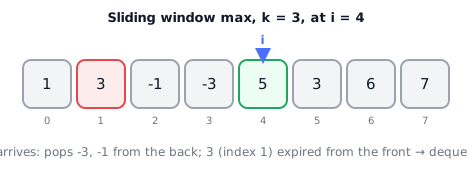
return outThe deque keeps indices whose values are decreasing from front to back. When a new value arrives, every smaller value behind it can never be a window maximum again (the new value is larger and stays in the window longer), so it's popped from the back. The front is evicted when it slides out of the window. Each index enters and leaves once: O(n) total, versus O(n·k) for recomputing each window's max.
4Circular Buffers
A fixed-capacity queue stores items in an array with head and size (or head and tail); positions wrap with % capacity. Enqueue writes at (head + size) % capacity; dequeue advances head. Everything is O(1) with no allocations, which is why ring buffers are used in network stacks, logging and audio.
Under the HoodWhy deque Is O(1) at Both Ends▾
CPython's deque is a doubly linked list of fixed-size blocks (64 slots each), so appends and pops at either end touch only the end block. Indexing into the middle is O(n). C#'s Queue<T> is a circular array that doubles when full (amortized O(1) enqueue). A JavaScript array used with shift() must re-index every remaining element, which is why the head-pointer trick matters.
⚠️ Common Pitfalls
- O(n) dequeues with
pop(0)/shift(). - Storing values instead of indices in a monotonic deque: you can't tell when the front leaves the window.
- Evicting at the wrong time: remove the expired front before reading the max.
- Off-by-one in circular buffers: distinguish full from empty (keep a
sizecounter). - Using a deque when a heap is needed: a monotonic deque works for sliding windows; arbitrary removals need a heap.
📋 Quick Reference
Queue: deque.append / popleft · Queue<T>.Enqueue / Dequeue · JS: arr + head index
Window max: pop front if out of window; pop back while ≤ x; push i; answer = a[front]
Circular: tail = (head + size) % cap
All O(1) per operation; sliding window max O(n)Six problems: queue design (two stacks, circular buffer), time-window eviction, simulation with queues, scheduling, and the monotonic deque for Sliding Window Maximum.
1Implement Queue using Stacks (LeetCode 232)
🟢 Easy. Implement a FIFO queue with only stack operations: push, pop, peek, empty.
push(1), push(2), peek() → 1, pop() → 1, empty() → falseApproach. Two stacks: inbox receives pushes; outbox serves pops. When outbox is empty, move everything from inbox (this reverses the order). Each element moves at most once.
Complexity. Amortized O(1) per operation.
class MyQueue {
  private inbox: number[] = [];
  private outbox: number[] = [];
  push(x: number): void { this.inbox.push(x); }
  private shift(): void {
    if (!this.outbox.length) while (this.inbox.length) this.outbox.push(this.inbox.pop()!);
  }
  pop(): number { this.shift(); return this.outbox.pop()!; }
  peek(): number { this.shift(); return this.outbox[this.outbox.length - 1]; }
  empty(): boolean { return !this.inbox.length && !this.outbox.length; }
}class MyQueue:
def __init__(self):
self.inbox, self.outbox = [], []
def push(self, x):
self.inbox.append(x)
def _shift(self):
if not self.outbox:
while self.inbox:
self.outbox.append(self.inbox.pop())
def pop(self):
self._shift()
return self.outbox.pop()
def peek(self):
self._shift()
return self.outbox[-1]
def empty(self):
return not self.inbox and not self.outbox2Number of Recent Calls (LeetCode 933)
🟢 Easy. ping(t) records a request at time t (strictly increasing) and returns how many requests happened in [t − 3000, t].
ping(1) → 1, ping(100) → 2, ping(3001) → 3, ping(3002) → 3Approach. Keep a queue of timestamps; on each ping, append t and evict from the front while the oldest is older than t − 3000. The queue length is the answer. This is the core of a sliding-window rate limiter.
Complexity. Amortized O(1) per ping.
class RecentCounter {
  private q: number[] = [];
  private head = 0;
  ping(t: number): number {
    this.q.push(t);
    while (this.q[this.head] < t - 3000) this.head++;
    return this.q.length - this.head;
  }
}from collections import deque
class RecentCounter:
def __init__(self):
self.q = deque()
def ping(self, t):
self.q.append(t)
while self.q[0] < t - 3000:
self.q.popleft()
return len(self.q)3Sliding Window Maximum (LeetCode 239)
🔴 Hard. Return the maximum of every contiguous window of size k.
nums = [1,3,-1,-3,5,3,6,7], k = 3 → [3,3,5,5,6,7]Approach. Monotonic decreasing deque of indices: pop the front when it leaves the window, pop smaller values from the back before pushing the new index, and read the maximum at the front.
Complexity. O(n) time, O(k) space.
function maxSlidingWindow(nums: number[], k: number): number[] {
  const dq: number[] = [];
  let head = 0;
  const out: number[] = [];
  for (let i = 0; i < nums.length; i++) {
    if (head < dq.length && dq[head] <= i - k) head++;
    while (dq.length > head && nums[dq[dq.length - 1]] <= nums[i]) dq.pop();
    dq.push(i);
    if (i >= k - 1) out.push(nums[dq[head]]);
  }
  return out;
}from collections import deque
def max_sliding_window(nums, k):
dq, out = deque(), []
for i, x in enumerate(nums):
if dq and dq[0] <= i - k:
dq.popleft()
while dq and nums[dq[-1]] <= x:
dq.pop()
dq.append(i)
if i >= k - 1:
out.append(nums[dq[0]])
return out4Design Circular Queue (LeetCode 622)
🟠 Medium. Implement a fixed-capacity circular queue: enQueue, deQueue, Front, Rear, isEmpty, isFull.
k=3: enQueue 1,2,3 → true; enQueue 4 → false; Rear → 3; deQueue; enQueue 4; Rear → 4Approach. A fixed array plus head and size. The tail slot is (head + size) % k; the rear element is at (head + size − 1) % k.
Complexity. O(1) per operation, O(k) space.
class MyCircularQueue {
  private buf: number[];
  private head = 0;
  private size = 0;
  constructor(k: number) { this.buf = new Array(k).fill(0); }
  enQueue(value: number): boolean {
    if (this.isFull()) return false;
    this.buf[(this.head + this.size) % this.buf.length] = value;
    this.size++;
    return true;
  }
  deQueue(): boolean {
    if (this.isEmpty()) return false;
    this.head = (this.head + 1) % this.buf.length;
    this.size--;
    return true;
  }
  Front(): number { return this.isEmpty() ? -1 : this.buf[this.head]; }
  Rear(): number { return this.isEmpty() ? -1 : this.buf[(this.head + this.size - 1) % this.buf.length]; }
  isEmpty(): boolean { return this.size === 0; }
  isFull(): boolean { return this.size === this.buf.length; }
}class MyCircularQueue:
def __init__(self, k):
self.buf = [0] * k
self.head = self.size = 0
def enqueue(self, value):
if self.is_full():
return False
self.buf[(self.head + self.size) % len(self.buf)] = value
self.size += 1
return True
def dequeue(self):
if self.is_empty():
return False
self.head = (self.head + 1) % len(self.buf)
self.size -= 1
return True
def front(self):
return -1 if self.is_empty() else self.buf[self.head]
def rear(self):
return -1 if self.is_empty() else self.buf[(self.head + self.size - 1) % len(self.buf)]
def is_empty(self):
return self.size == 0
def is_full(self):
return self.size == len(self.buf)5Dota2 Senate (LeetCode 649)
🟠 Medium. Senators from parties R and D vote in rounds; each can ban one opposing senator's future votes. Predict the winning party.
"RDD" → "Dire"Approach. Two queues of indices. Repeatedly compare the fronts: the earlier senator bans the other and re-enters at the back with index + n (next round). The party whose queue empties first loses.
Complexity. O(n) time (each round removes one senator), O(n) space.
function predictPartyVictory(senate: string): string {
  const n = senate.length, r: number[] = [], d: number[] = [];
  for (let i = 0; i < n; i++) (senate[i] === "R" ? r : d).push(i);
  let hr = 0, hd = 0;
  while (hr < r.length && hd < d.length) {
    const a = r[hr++], b = d[hd++];
    if (a < b) r.push(a + n); else d.push(b + n);
  }
  return hr < r.length ? "Radiant" : "Dire";
}from collections import deque
def predict_party_victory(senate):
n = len(senate)
r = deque(i for i, c in enumerate(senate) if c == "R")
d = deque(i for i, c in enumerate(senate) if c == "D")
while r and d:
a, b = r.popleft(), d.popleft()
if a < b:
r.append(a + n) # R acts first, bans D, votes again next round
else:
d.append(b + n)
return "Radiant" if r else "Dire"6Task Scheduler (LeetCode 621)
🟠 Medium. CPU tasks (letters) each take one unit; identical tasks need n idle units between them. Return the minimum total time.
tasks = [A,A,A,B,B,B], n = 2 → 8 (A B _ A B _ A B)Approach. The most frequent task forms the skeleton: (maxFreq − 1) full blocks of length n + 1, plus one final slot per task tied for the max frequency. If there are enough other tasks to fill every gap, no idling is needed and the answer is just the task count.
Complexity. O(T) time, O(26) space.
function leastInterval(tasks: string[], n: number): number {
  const counts = new Map<string, number>();
  for (const t of tasks) counts.set(t, (counts.get(t) ?? 0) + 1);
  const maxFreq = Math.max(...counts.values());
  const tied = [...counts.values()].filter((c) => c === maxFreq).length;
  return Math.max(tasks.length, (maxFreq - 1) * (n + 1) + tied);
}def least_interval(tasks, n):
counts = {}
for t in tasks:
counts[t] = counts.get(t, 0) + 1
max_freq = max(counts.values())
tied = sum(1 for c in counts.values() if c == max_freq)
return max(len(tasks), (max_freq - 1) * (n + 1) + tied)🧠 Key takeaways
- Use
deque/Queue<T>/ a head index:pop(0)andshift()are O(n). - Time windows: append new events, evict expired ones from the front.
- Monotonic deque: pop expired front, pop smaller back, push; front = window max → O(n).
- Circular buffers use
head,sizeand% capacityfor O(1) fixed-size queues.
🛠️ Practice exercises
Each exercise is a file in this topic folder. Code exercises are self-checking: run them and make the checks pass.
✅ Check yourself
Answer the questions — feedback is instant.