Linked Lists
Linked list problems test precise pointer manipulation. Master four techniques (dummy head, reversal, fast and slow pointers, merging), understand Floyd's cycle detection, and watch reversal, cycle detection and remove-nth-from-end animated before tackling LRU Cache.
🎯 What you'll learn
- The node type in Python, TypeScript and C#
- Dummy head, reversal, fast/slow pointers and merging
- Floyd's cycle detection and finding the entry
- Six LeetCode problems up to LRU Cache
📚 Before you start
A linked list is a chain of nodes where each node points to the next. You lose O(1) indexing, but you gain O(1) insertion and removal once you hold the neighbouring node. Interview problems are mostly about pointer manipulation without losing nodes, and four techniques cover almost all of them: the dummy head, reversal, fast and slow pointers, and merging.
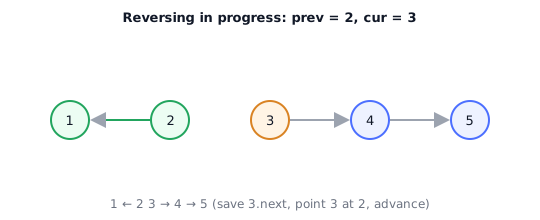
1The Node in Each Language
class ListNode:
    def __init__(self, val=0, next=None):
self.val, self.next = val, nextclass ListNode {
val: number;
next: ListNode | null;
constructor(val = 0, next: ListNode | null = null) {
this.val = val;
this.next = next;
}
}2The Four Techniques
| Technique | Use it for | Key idea |
|---|---|---|
| Dummy head | anything that might change the head (removal, merging, insertion) | dummy = ListNode(0, head); return dummy.next at the end |
| Reversal | reverse a list or a sub-list, palindrome check, reorder | nxt = cur.next; cur.next = prev; prev = cur; cur = nxt |
| Fast & slow | middle node, cycle detection, k-th from the end | fast moves 2 (or starts k ahead), slow moves 1 |
| Merge | merge sorted lists, merge k lists (with a heap) | compare heads, attach the smaller to a tail pointer |
3Templates
class ListNode {
  val: number;
  next: ListNode | null;
  constructor(val = 0, next: ListNode | null = null) {
    this.val = val;
    this.next = next;
  }
}
function _build(vals: number[]): ListNode | null {
const dummy = new ListNode(); let cur = dummy;
for (const v of vals) { cur.next = new ListNode(v); cur = cur.next; }
return dummy.next;
}
function _toList(node: ListNode | null): number[] {
const out: number[] = [];
while (node) { out.push(node.val); node = node.next; }
return out;
}
function reverseList(head: ListNode | null): ListNode | null {
let prev: ListNode | null = null, cur = head;
while (cur) {
const nxt: ListNode | null = cur.next;
cur.next = prev;
prev = cur;
cur = nxt;
}
return prev;
}class ListNode:
def __init__(self, val=0, next=None):
self.val = val
self.next = next
def _build(vals):
dummy = cur = ListNode()
for v in vals:
cur.next = ListNode(v); cur = cur.next
return dummy.next
def _to_list(node):
out = []
while node:
out.append(node.val); node = node.next
return out
def reverse_list(head):
prev = None
cur = head
while cur:
nxt = cur.next # 1. remember the rest
cur.next = prev # 2. reverse this pointer
prev, cur = cur, nxt # 3. advance both
return prev
def middle(head): # fast moves 2, slow moves 1
slow = fast = head
while fast and fast.next:
slow, fast = slow.next, fast.next.next
return slow4Floyd's Cycle Detection
If a list has a cycle, a fast pointer (2 steps) and a slow pointer (1 step) must meet inside it: once both are in the cycle, the gap shrinks by one every step. To find where the cycle starts, reset one pointer to the head and move both one step at a time; they meet at the cycle entry (the distances work out because head→entry = meeting point→entry modulo the cycle length).
5Recognition Cues
- "in place", "O(1) extra space" on a list → pointer manipulation (no copying to an array)
- "middle", "n-th from the end", "cycle" → fast & slow
- "reverse", "palindrome", "reorder L0→Ln→L1→Ln−1" → find middle + reverse second half + merge
- "design an LRU cache" → hash map + doubly linked list
Under the HoodWhy Interviewers Still Ask About Linked Lists▾
Real code rarely uses singly linked lists: arrays are faster thanks to CPU cache locality (nodes are scattered in memory, so each hop can be a cache miss). But they test precise reasoning about mutable references, and the same pointer patterns appear in LRU caches, allocators (free lists), the Linux kernel's intrusive lists, and the LinkedHashMap/OrderedDict structures behind real caches.
⚠️ Common Pitfalls
- Losing the rest of the list: save
cur.nextbefore overwriting it. - Special-casing the head instead of using a dummy node.
- Null dereference: check
fast and fast.nextbeforefast.next.next. - Off-by-one for "n-th from the end": move
fastn steps ahead ofslow, starting both at the dummy. - Creating cycles accidentally when reordering (terminate the first half with
None).
📋 Quick Reference
dummy = ListNode(0, head) … return dummy.next
reverse: nxt=cur.next; cur.next=prev; prev=cur; cur=nxt
middle: slow, fast = head, head; while fast and fast.next: slow=slow.next; fast=fast.next.next
cycle: meet → reset one to head → step both → entry
O(n) time · O(1) extra space for all of the aboveSix problems combining the four techniques, ending with LRU Cache, one of the most frequently asked design questions.
1Reverse Linked List (LeetCode 206)
🟢 Easy. Reverse a singly linked list and return the new head.
1 → 2 → 3 → 4 → 5 ⇒ 5 → 4 → 3 → 2 → 1Approach. Iterate with prev and cur; at each node save next, point cur.next back to prev, advance. (Recursive version: reverse the rest, then head.next.next = head; head.next = None, O(n) stack.)
Complexity. O(n) time, O(1) space.
class ListNode {
  val: number;
  next: ListNode | null;
  constructor(val = 0, next: ListNode | null = null) {
    this.val = val;
    this.next = next;
  }
}
function _build(vals: number[]): ListNode | null {
  const dummy = new ListNode(); let cur = dummy;
  for (const v of vals) { cur.next = new ListNode(v); cur = cur.next; }
  return dummy.next;
}
function _toList(node: ListNode | null): number[] {
  const out: number[] = [];
  while (node) { out.push(node.val); node = node.next; }
  return out;
}

function reverseList(head: ListNode | null): ListNode | null {
  let prev: ListNode | null = null, cur = head;
  while (cur) {
    const nxt: ListNode | null = cur.next;
    cur.next = prev;
    prev = cur;
    cur = nxt;
  }
  return prev;
}class ListNode:
def __init__(self, val=0, next=None):
self.val = val
self.next = next
def _build(vals):
dummy = cur = ListNode()
for v in vals:
cur.next = ListNode(v); cur = cur.next
return dummy.next
def _to_list(node):
out = []
while node:
out.append(node.val); node = node.next
return out
def reverse_list(head):
prev, cur = None, head
while cur:
nxt = cur.next
cur.next = prev
prev, cur = cur, nxt
return prev2Merge Two Sorted Lists (LeetCode 21)
🟢 Easy. Merge two sorted linked lists into one sorted list by splicing their nodes.
1→2→4 and 1→3→4 ⇒ 1→1→2→3→4→4Approach. Dummy head + tail pointer: repeatedly attach the smaller head, advance it; at the end attach whatever remains.
Complexity. O(n + m) time, O(1) space.
class ListNode {
  val: number;
  next: ListNode | null;
  constructor(val = 0, next: ListNode | null = null) {
    this.val = val;
    this.next = next;
  }
}
function _build(vals: number[]): ListNode | null {
  const dummy = new ListNode(); let cur = dummy;
  for (const v of vals) { cur.next = new ListNode(v); cur = cur.next; }
  return dummy.next;
}
function _toList(node: ListNode | null): number[] {
  const out: number[] = [];
  while (node) { out.push(node.val); node = node.next; }
  return out;
}

function mergeTwoLists(a: ListNode | null, b: ListNode | null): ListNode | null {
  const dummy = new ListNode(); let tail = dummy;
  while (a && b) {
    if (a.val <= b.val) { tail.next = a; a = a.next; } else { tail.next = b; b = b.next; }
    tail = tail.next;
  }
  tail.next = a ?? b;
  return dummy.next;
}class ListNode:
def __init__(self, val=0, next=None):
self.val = val
self.next = next
def _build(vals):
dummy = cur = ListNode()
for v in vals:
cur.next = ListNode(v); cur = cur.next
return dummy.next
def _to_list(node):
out = []
while node:
out.append(node.val); node = node.next
return out
def merge_two_lists(a, b):
dummy = tail = ListNode()
while a and b:
if a.val <= b.val:
tail.next, a = a, a.next
else:
tail.next, b = b, b.next
tail = tail.next
tail.next = a or b
return dummy.next3Linked List Cycle (LeetCode 141)
🟢 Easy. Return true if the linked list contains a cycle.
3 → 2 → 0 → -4 → (back to 2) → trueApproach. Floyd's tortoise and hare: slow moves 1, fast moves 2. If fast reaches the end there's no cycle; if they meet, there is.
Complexity. O(n) time, O(1) space (a visited set also works in O(n) space).
class ListNode {
  val: number;
  next: ListNode | null;
  constructor(val = 0, next: ListNode | null = null) {
    this.val = val;
    this.next = next;
  }
}
function _build(vals: number[]): ListNode | null {
  const dummy = new ListNode(); let cur = dummy;
  for (const v of vals) { cur.next = new ListNode(v); cur = cur.next; }
  return dummy.next;
}
function _toList(node: ListNode | null): number[] {
  const out: number[] = [];
  while (node) { out.push(node.val); node = node.next; }
  return out;
}

function hasCycle(head: ListNode | null): boolean {
  let slow = head, fast = head;
  while (fast && fast.next) {
    slow = slow!.next; fast = fast.next.next;
    if (slow === fast) return true;
  }
  return false;
}class ListNode:
def __init__(self, val=0, next=None):
self.val = val
self.next = next
def _build(vals):
dummy = cur = ListNode()
for v in vals:
cur.next = ListNode(v); cur = cur.next
return dummy.next
def _to_list(node):
out = []
while node:
out.append(node.val); node = node.next
return out
def has_cycle(head):
slow = fast = head
while fast and fast.next:
slow, fast = slow.next, fast.next.next
if slow is fast:
return True
return False4Remove Nth Node From End of List (LeetCode 19)
🟠 Medium. Remove the n-th node from the end of the list in one pass and return the head.
1→2→3→4→5, n = 2 ⇒ 1→2→3→5Approach. Dummy head; move fast n steps ahead of slow; then move both until fast.next is null. Now slow.next is the node to delete. The dummy handles removing the head itself.
Complexity. O(L) time, O(1) space.
class ListNode {
  val: number;
  next: ListNode | null;
  constructor(val = 0, next: ListNode | null = null) {
    this.val = val;
    this.next = next;
  }
}
function _build(vals: number[]): ListNode | null {
  const dummy = new ListNode(); let cur = dummy;
  for (const v of vals) { cur.next = new ListNode(v); cur = cur.next; }
  return dummy.next;
}
function _toList(node: ListNode | null): number[] {
  const out: number[] = [];
  while (node) { out.push(node.val); node = node.next; }
  return out;
}

function removeNthFromEnd(head: ListNode | null, n: number): ListNode | null {
  const dummy = new ListNode(0, head);
  let slow: ListNode = dummy, fast: ListNode = dummy;
  for (let i = 0; i < n; i++) fast = fast.next!;
  while (fast.next) { slow = slow.next!; fast = fast.next; }
  slow.next = slow.next!.next;
  return dummy.next;
}class ListNode:
def __init__(self, val=0, next=None):
self.val = val
self.next = next
def _build(vals):
dummy = cur = ListNode()
for v in vals:
cur.next = ListNode(v); cur = cur.next
return dummy.next
def _to_list(node):
out = []
while node:
out.append(node.val); node = node.next
return out
def remove_nth_from_end(head, n):
dummy = ListNode(0, head)
slow = fast = dummy
for _ in range(n):
fast = fast.next
while fast.next:
slow, fast = slow.next, fast.next
slow.next = slow.next.next
return dummy.next5Reorder List (LeetCode 143)
🟠 Medium. Reorder L0 → L1 → … → Ln into L0 → Ln → L1 → Ln−1 → … in place.
1→2→3→4→5 ⇒ 1→5→2→4→3Approach. Three techniques in sequence: find the middle (fast/slow), reverse the second half, then merge the two halves alternately. Cut the first half with slow.next = None to avoid a cycle.
Complexity. O(n) time, O(1) space.
class ListNode {
  val: number;
  next: ListNode | null;
  constructor(val = 0, next: ListNode | null = null) {
    this.val = val;
    this.next = next;
  }
}
function _build(vals: number[]): ListNode | null {
  const dummy = new ListNode(); let cur = dummy;
  for (const v of vals) { cur.next = new ListNode(v); cur = cur.next; }
  return dummy.next;
}
function _toList(node: ListNode | null): number[] {
  const out: number[] = [];
  while (node) { out.push(node.val); node = node.next; }
  return out;
}

function reorderList(head: ListNode | null): void {
  if (!head || !head.next) return;
  let slow: ListNode = head, fast: ListNode = head;
  while (fast.next && fast.next.next) { slow = slow.next!; fast = fast.next.next; }
  let second: ListNode | null = slow.next; slow.next = null;
  let prev: ListNode | null = null;
  while (second) { const nxt: ListNode | null = second.next; second.next = prev; prev = second; second = nxt; }
  let first: ListNode | null = head; second = prev;
  while (second) {
    const n1: ListNode | null = first!.next, n2: ListNode | null = second.next;
    first!.next = second; second.next = n1;
    first = n1; second = n2;
  }
}class ListNode:
def __init__(self, val=0, next=None):
self.val = val
self.next = next
def _build(vals):
dummy = cur = ListNode()
for v in vals:
cur.next = ListNode(v); cur = cur.next
return dummy.next
def _to_list(node):
out = []
while node:
out.append(node.val); node = node.next
return out
def reorder_list(head):
if not head or not head.next:
return
slow = fast = head
while fast.next and fast.next.next: # 1. middle
slow, fast = slow.next, fast.next.next
second, slow.next = slow.next, None
prev = None
while second: # 2. reverse second half
second.next, prev, second = prev, second, second.next
first, second = head, prev
while second: # 3. merge alternately
n1, n2 = first.next, second.next
first.next, second.next = second, n1
first, second = n1, n26LRU Cache (LeetCode 146)
🟠 Medium. Design a cache with capacity c: get(key) returns the value or −1; put(key, value) inserts/updates and evicts the least recently used key when over capacity. Both in O(1).
cap 2: put(1,1) put(2,2) get(1)→1 put(3,3) [evicts 2] get(2)→-1 put(4,4) [evicts 1] get(1)→-1Approach. A hash map from key to node gives O(1) lookup; a doubly linked list ordered by recency gives O(1) move-to-front and evict-from-back. Python's OrderedDict and JavaScript's insertion-ordered Map implement exactly this pair, so in interviews say what they do internally (and be ready to write the linked list by hand).
Complexity. O(1) per operation, O(capacity) space.
class LRUCache {
  private map = new Map<number, number>();     // Map keeps insertion order: first key = least recent
  private capacity: number;
  constructor(capacity: number) { this.capacity = capacity; }
  get(key: number): number {
    if (!this.map.has(key)) return -1;
    const v = this.map.get(key)!;
    this.map.delete(key);
    this.map.set(key, v);                      // move to most-recent end
    return v;
  }
  put(key: number, value: number): void {
    this.map.delete(key);
    this.map.set(key, value);
    if (this.map.size > this.capacity) this.map.delete(this.map.keys().next().value!);
  }
}class Node:
def __init__(self, key=0, val=0):
self.key, self.val = key, val
self.prev = self.next = None
class LRUCache:
def __init__(self, capacity):
self.cap = capacity
self.map = {}
self.head, self.tail = Node(), Node() # sentinels: head.next = most recent
self.head.next, self.tail.prev = self.tail, self.head
def _remove(self, node):
node.prev.next, node.next.prev = node.next, node.prev
def _add_front(self, node):
node.prev, node.next = self.head, self.head.next
self.head.next.prev = node
self.head.next = node
def get(self, key):
if key not in self.map:
return -1
node = self.map[key]
self._remove(node)
self._add_front(node)
return node.val
def put(self, key, value):
if key in self.map:
self._remove(self.map[key])
node = Node(key, value)
self.map[key] = node
self._add_front(node)
if len(self.map) > self.cap:
lru = self.tail.prev
self._remove(lru)
del self.map[lru.key]🧠 Key takeaways
- Four techniques: dummy head, reversal, fast & slow, merge.
- Save
cur.nextbefore overwriting it; a dummy node removes head special cases. - Floyd: pointers meet inside a cycle; reset one to the head to find the entry.
- LRU Cache = hash map + doubly linked list (OrderedDict / ordered Map internally).
🛠️ Practice exercises
Each exercise is a file in this topic folder. Code exercises are self-checking: run them and make the checks pass.
✅ Check yourself
Answer the questions — feedback is instant.