Intervals
Interval problems reduce to sorting plus one sweep. Learn the overlap test (and closed vs half-open), when to sort by start versus end, and how sweep lines and min-heaps count overlaps, with Merge Intervals, Non-overlapping Intervals and Meeting Rooms II animated step by step.
🎯 What you'll learn
- The overlap test and closed vs half-open intervals
- Merge by start, greedy selection by end
- Sweep lines and min-heaps for maximum overlap
- Six LeetCode problems with animated walkthroughs
📚 Before you start
Interval problems (meetings, bookings, time ranges, genome segments) almost always start the same way: sort by start time, then sweep left to right while comparing each interval with the last one you kept. Sorting costs O(n log n) and the sweep is O(n). Two related tools cover the rest: sorting by end time for greedy selection, and a sweep line over events (or a min-heap of end times) for "how many overlap at once".
1The Overlap Test
Two intervals a = [a0, a1] and b = [b0, b1] overlap when each starts before the other ends:
closed  [s, e]:  a0 <= b1 and b0 <= a1      ([1,4] and [4,5] overlap)
half-open [s, e): a0 <  b1 and b0 <  a1      (meetings 9–10 and 10–11 don't conflict)
Always ask which convention the problem uses: "does a meeting ending at 10:00 conflict with one starting at 10:00?" The answer changes < into <=.
After sorting by start, you only need to compare with the last merged interval: start <= last.end.
2Templates
function mergeIntervals(intervals: number[][]): number[][] {
  const sorted = [...intervals].sort((a, b) => a[0] - b[0]);
  const merged: number[][] = [];
  for (const [start, end] of sorted) {
    const last = merged[merged.length - 1];
    if (last && start <= last[1]) last[1] = Math.max(last[1], end);
    else merged.push([start, end]);
  }
  return merged;
}

function overlaps(a: number[], b: number[]): boolean {
  return a[0] < b[1] && b[0] < a[1];
}def merge_intervals(intervals):
intervals = sorted(intervals, key=lambda iv: iv[0]) # 1. sort by start
merged = []
for start, end in intervals:
if merged and start <= merged[-1][1]: # 2. overlaps the last one?
merged[-1][1] = max(merged[-1][1], end) # extend it
else:
merged.append([start, end]) # or start a new one
return merged
def overlaps(a, b):
return a[0] < b[1] and b[0] < a[1] # half-open [start, end)3Three Strategies
| Question | Strategy | Example |
|---|---|---|
| Merge / union of ranges | sort by start, extend the last | Merge Intervals, Insert Interval |
| Keep as many non-overlapping as possible / remove the fewest | sort by end, greedily keep the earliest-finishing | Non-overlapping Intervals, arrows |
| How many overlap at the same time (rooms, servers, peak load) | sweep line over +1/−1 events, or a min-heap of end times | Meeting Rooms II, car pooling |
Why sort by end for greedy selection? The interval that finishes first leaves the most room for everything after it. Any optimal solution can swap its first interval for the earliest-finishing one without losing anything (an exchange argument), so the greedy choice is always safe.
4Sweep Line
Turn each interval into two events, (start, +1) and (end, −1), sort them (processing −1 before +1 at equal times for half-open intervals), and keep a running count. The maximum running count is the maximum overlap. It generalizes to weighted loads (+passengers, −passengers) and is the core of calendar and capacity problems.
Under the HoodInterval Trees▾
When intervals arrive dynamically and you must answer "which intervals overlap x?" many times, sorting once isn't enough. An interval tree (or a segment tree over coordinates) stores intervals in a balanced BST keyed by start, each node annotated with the maximum end in its subtree, giving O(log n + k) queries. Databases use similar ideas for range indexes (PostgreSQL's GiST indexes on tsrange), and calendars use them for conflict checks. In interviews, mentioning this as the follow-up for "what if intervals keep arriving?" is a strong senior signal.
⚠️ Common Pitfalls
- Not sorting first, or sorting by the wrong key (start vs end).
- Closed vs half-open confusion:
[1,2]and[2,3]merge if closed, not if half-open. - Forgetting
maxwhen extending:[1,10]followed by[2,3]must stay[1,10]. - Mutating the input when the caller expects it unchanged (sort a copy).
- Event order at equal times in sweep lines: decide whether an end and a start at the same time overlap.
📋 Quick Reference
Merge: sort by start; if s <= last.end: last.end = max(last.end, e) else push
Greedy keep max non-overlapping: sort by end; keep if s >= lastEnd
Max overlap: events (s,+1),(e,-1); sort; running max   (or min-heap of ends)
O(n log n) for the sort, O(n) sweepSix problems covering the three strategies: merge by start, greedy by end, and counting overlaps with a heap or sweep line.
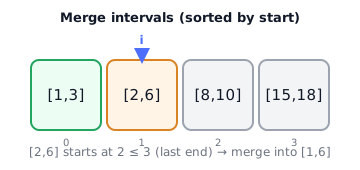
1Merge Intervals (LeetCode 56)
🟠 Medium. Merge all overlapping intervals and return the non-overlapping result.
[[1,3],[2,6],[8,10],[15,18]] → [[1,6],[8,10],[15,18]]Approach. Sort by start. Walk the intervals: if the current one starts before (or at) the end of the last merged interval, extend that interval's end; otherwise start a new one.
Complexity. O(n log n) time for sorting, O(n) for the output.
function merge(intervals: number[][]): number[][] {
  const sorted = [...intervals].sort((a, b) => a[0] - b[0]);
  const merged: number[][] = [];
  for (const [s, e] of sorted) {
    const last = merged[merged.length - 1];
    if (last && s <= last[1]) last[1] = Math.max(last[1], e);
    else merged.push([s, e]);
  }
  return merged;
}def merge(intervals):
intervals = sorted(intervals, key=lambda iv: iv[0])
merged = []
for s, e in intervals:
if merged and s <= merged[-1][1]:
merged[-1][1] = max(merged[-1][1], e)
else:
merged.append([s, e])
return merged2Insert Interval (LeetCode 57)
🟠 Medium. intervals is sorted and non-overlapping. Insert newInterval, merging where needed.
[[1,2],[3,5],[6,7],[8,10],[12,16]] + [4,8] → [[1,2],[3,10],[12,16]]Approach. Three phases in one pass: copy intervals that end before the new one starts; merge every interval that overlaps it (expand the new interval's start/end); copy the rest. No sort needed: O(n).
Complexity. O(n) time.
function insert(intervals: number[][], newInterval: number[]): number[][] {
  const res: number[][] = [];
  let i = 0;
  let [s, e] = newInterval;
  while (i < intervals.length && intervals[i][1] < s) res.push(intervals[i++]);
  while (i < intervals.length && intervals[i][0] <= e) {
    s = Math.min(s, intervals[i][0]);
    e = Math.max(e, intervals[i][1]);
    i++;
  }
  res.push([s, e]);
  while (i < intervals.length) res.push(intervals[i++]);
  return res;
}def insert(intervals, new):
res, i, n = [], 0, len(intervals)
s, e = new
while i < n and intervals[i][1] < s: # entirely before
res.append(intervals[i]); i += 1
while i < n and intervals[i][0] <= e: # overlapping: absorb
s, e = min(s, intervals[i][0]), max(e, intervals[i][1]); i += 1
res.append([s, e])
res.extend(intervals[i:]) # entirely after
return res3Non-overlapping Intervals (LeetCode 435)
🟠 Medium. Return the minimum number of intervals to remove so that the rest don't overlap (touching endpoints are fine).
[[1,2],[2,3],[3,4],[1,3]] → 1 (remove [1,3])Approach. Equivalent to keeping the maximum number of non-overlapping intervals. Sort by end; keep an interval if it starts at or after the end of the last kept one, otherwise remove it. Earliest-finishing first leaves the most room.
Complexity. O(n log n) time, O(1) extra space.
function eraseOverlapIntervals(intervals: number[][]): number {
  const sorted = [...intervals].sort((a, b) => a[1] - b[1]);
  let removed = 0, lastEnd = -Infinity;
  for (const [s, e] of sorted) {
    if (s >= lastEnd) lastEnd = e; else removed++;
  }
  return removed;
}def erase_overlap_intervals(intervals):
intervals = sorted(intervals, key=lambda iv: iv[1])
removed, last_end = 0, float("-inf")
for s, e in intervals:
if s >= last_end:
last_end = e # keep it
else:
removed += 1 # overlaps the kept one → remove
return removed4Meeting Rooms (LeetCode 252)
🟢 Easy. Can one person attend all meetings? (Intervals are half-open: a meeting ending at 10 doesn't conflict with one starting at 10.)
[[0,30],[5,10],[15,20]] → falseApproach. Sort by start; any meeting that starts before the previous one ends is a conflict.
Complexity. O(n log n) time.
function canAttendMeetings(intervals: number[][]): boolean {
  const sorted = [...intervals].sort((a, b) => a[0] - b[0]);
  for (let i = 1; i < sorted.length; i++) if (sorted[i][0] < sorted[i - 1][1]) return false;
  return true;
}def can_attend_meetings(intervals):
intervals = sorted(intervals)
for i in range(1, len(intervals)):
if intervals[i][0] < intervals[i - 1][1]:
return False
return True5Meeting Rooms II (LeetCode 253)
🟠 Medium. Return the minimum number of conference rooms needed for all meetings (half-open intervals).
[[0,30],[5,10],[15,20]] → 2Approach. Sort meetings by start and keep a min-heap of end times of rooms in use. For each meeting, if the earliest-ending room is free by its start, reuse it (pop); then push this meeting's end. The heap size is the number of rooms. (Equivalent: sweep over +1/−1 events and take the peak.)
Complexity. O(n log n) time, O(n) space.
function minMeetingRooms(intervals: number[][]): number {
  // sweep line: starts and ends sorted separately
  const starts = intervals.map((i) => i[0]).sort((a, b) => a - b);
  const ends = intervals.map((i) => i[1]).sort((a, b) => a - b);
  let rooms = 0, best = 0, j = 0;
  for (let i = 0; i < starts.length; i++) {
    while (j < ends.length && ends[j] <= starts[i]) { rooms--; j++; }   // free rooms first
    rooms++;
    best = Math.max(best, rooms);
  }
  return best;
}import heapq
def min_meeting_rooms(intervals):
ends = [] # end times of rooms in use
for s, e in sorted(intervals):
if ends and ends[0] <= s:
heapq.heappop(ends) # that room is free again
heapq.heappush(ends, e)
return len(ends)6Minimum Number of Arrows to Burst Balloons (LeetCode 452)
🟠 Medium. Balloons span [xstart, xend] (closed). An arrow at x bursts every balloon containing x. Return the minimum number of arrows.
[[10,16],[2,8],[1,6],[7,12]] → 2 (arrows at 6 and 12)Approach. Sort by end. Shoot the first arrow at the first balloon's end; it bursts every balloon starting at or before that point. When a balloon starts after the current arrow, shoot a new arrow at its end.
Complexity. O(n log n) time.
function findMinArrowShots(points: number[][]): number {
  const sorted = [...points].sort((a, b) => a[1] - b[1]);
  let arrows = 0, arrowX = -Infinity;
  for (const [s, e] of sorted) {
    if (s > arrowX) { arrows++; arrowX = e; }
  }
  return arrows;
}def find_min_arrow_shots(points):
points = sorted(points, key=lambda p: p[1])
arrows, arrow_x = 0, float("-inf")
for s, e in points:
if s > arrow_x: # not hit by the current arrow
arrows += 1
arrow_x = e
return arrows🧠 Key takeaways
- Two intervals overlap when each starts before the other ends; settle closed vs half-open first.
- Merge by sorting on start and extending the last interval (remember
max). - Greedy selection (fewest removals, arrows) sorts by end.
- Max overlap (rooms) = sweep line peak, or the size of a min-heap of end times.
🛠️ Practice exercises
Each exercise is a file in this topic folder. Code exercises are self-checking: run them and make the checks pass.
✅ Check yourself
Answer the questions — feedback is instant.