DP on Strings
String DP comes in two shapes: two-string prefix tables (LCS, edit distance, interleaving, regex) and single-string intervals (palindromes). Learn how to read the diagonal, up and left neighbours, the empty-prefix base row, centre expansion, and watch LCS, Edit Distance and palindrome expansion animated.
🎯 What you'll learn
- Two-string prefix tables and their base row/column
- What each neighbour means in LCS vs edit distance
- Palindromes: centre expansion vs interval DP
- Six LeetCode problems up to Regular Expression Matching
📚 Before you start
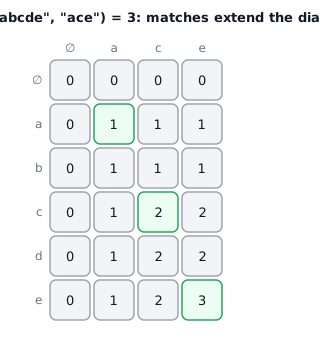
String DP problems come in two shapes. Two strings (LCS, edit distance, interleaving, regex): dp[i][j] describes the answer for the prefixes a[:i] and b[:j], and each cell looks at the cell above, to the left and diagonally up-left. One string, intervals (palindromes): dp[i][j] describes the substring s[i..j], built from shorter substrings inside it. Once you know which shape you're in, the recurrence almost writes itself.
1Two-String Template
function lcs(a: string, b: string): number {
  const m = a.length, n = b.length;
  const dp = Array.from({ length: m + 1 }, () => new Array(n + 1).fill(0));
  for (let i = 1; i <= m; i++)
    for (let j = 1; j <= n; j++)
      dp[i][j] = a[i - 1] === b[j - 1] ? dp[i - 1][j - 1] + 1 : Math.max(dp[i - 1][j], dp[i][j - 1]);
  return dp[m][n];
}

function editDistance(a: string, b: string): number {
  const m = a.length, n = b.length;
  const dp = Array.from({ length: m + 1 }, (_, i) => Array.from({ length: n + 1 }, (_, j) => (i === 0 ? j : j === 0 ? i : 0)));
  for (let i = 1; i <= m; i++)
    for (let j = 1; j <= n; j++)
      dp[i][j] = a[i - 1] === b[j - 1] ? dp[i - 1][j - 1] : 1 + Math.min(dp[i - 1][j], dp[i][j - 1], dp[i - 1][j - 1]);
  return dp[m][n];
}

function lcsEdit(a: string, b: string): number[] {
  return [lcs(a, b), editDistance(a, b)];
}def lcs(a, b):
m, n = len(a), len(b)
dp = [[0] * (n + 1) for _ in range(m + 1)] # dp[i][j]: answer for a[:i], b[:j]
for i in range(1, m + 1):
for j in range(1, n + 1):
if a[i - 1] == b[j - 1]:
dp[i][j] = dp[i - 1][j - 1] + 1 # match: extend the diagonal
else:
dp[i][j] = max(dp[i - 1][j], dp[i][j - 1]) # drop one character
return dp[m][n]
def edit_distance(a, b):
m, n = len(a), len(b)
dp = [[0] * (n + 1) for _ in range(m + 1)]
for i in range(m + 1): dp[i][0] = i # delete everything
for j in range(n + 1): dp[0][j] = j # insert everything
for i in range(1, m + 1):
for j in range(1, n + 1):
if a[i - 1] == b[j - 1]:
dp[i][j] = dp[i - 1][j - 1]
else:
dp[i][j] = 1 + min(dp[i - 1][j], # delete a[i-1]
dp[i][j - 1], # insert b[j-1]
dp[i - 1][j - 1]) # replace
return dp[m][n]
def lcs_edit(a, b):
return [lcs(a, b), edit_distance(a, b)]The extra row and column (index 0) represent the empty prefix, which makes base cases trivial: LCS with an empty string is 0; turning a prefix of length i into the empty string takes i deletions.
2Reading the Neighbours
Move into dp[i][j] from | Meaning in LCS | Meaning in edit distance |
|---|---|---|
diagonal dp[i−1][j−1] | characters match: extend by 1 | match (free) or replace (+1) |
above dp[i−1][j] | skip a[i−1] | delete a[i−1] (+1) |
left dp[i][j−1] | skip b[j−1] | insert b[j−1] (+1) |
3Palindromes: Expand Around Centres
For "longest palindromic substring" and "count palindromic substrings", an interval DP (pal[i][j] = s[i] == s[j] and pal[i+1][j−1]) works, but expanding around each of the 2n − 1 centres is simpler and uses O(1) space: grow outward while the characters match. Both are O(n²). (Manacher's algorithm is O(n) but rarely expected.)
4Subsequence vs Substring
- Substring = contiguous: palindromic substring, longest common substring (reset to 0 on mismatch).
- Subsequence = order-preserving, gaps allowed: LCS, longest palindromic subsequence (= LCS of s and reversed s), distinct subsequences.
Mixing them up is the most common error in string DP questions; ask if the problem doesn't say.
Under the HoodWhere Edit Distance Lives▾
git diff and diff compute a longest common subsequence of lines (Myers' algorithm, O((n + m)·D) for D differences) and print what isn't in it. Spell checkers rank suggestions by edit distance; DNA alignment (Needleman–Wunsch, Smith–Waterman) is edit distance with scoring matrices; fuzzy search (pg_trgm, Elasticsearch fuzziness) bounds it to keep queries fast.
⚠️ Common Pitfalls
- Off-by-one between dp indices and string indices:
dp[i][j]usesa[i−1],b[j−1]. - Forgetting the empty-prefix row/column and its base values (edit distance needs
iandj, not 0). - Substring vs subsequence confusion.
- Even-length palindromes: expand from both a single centre
(i, i)and a gap(i, i+1). - Memory: O(m · n) tables for long strings; two rolling rows suffice when only the value is needed.
📋 Quick Reference
two strings: dp[0][*], dp[*][0] = base; match → diagonal; else combine(above, left[, diagonal])
LCS: match +1 diag else max(up, left) · edit: match diag else 1 + min(up, left, diag)
palindromes: expand around 2n-1 centres, O(n^2) time, O(1) space
O(m · n) time; O(min(m, n)) space with rolling rowsSix problems: the two-string table family (LCS, edit distance, interleaving, regex) and centre expansion for palindromes.
1Longest Common Subsequence (LeetCode 1143)
🟠 Medium. Return the length of the longest subsequence common to text1 and text2.
"abcde", "ace" → 3Approach. dp[i][j] = LCS of text1[:i] and text2[:j]. Matching last characters extend the diagonal by 1; otherwise take the better of dropping one character from either string.
Complexity. O(m · n) time, O(min(m, n)) space with rolling rows.
function longestCommonSubsequence(a: string, b: string): number {
  let prev = new Array(b.length + 1).fill(0);
  for (let i = 1; i <= a.length; i++) {
    const cur = new Array(b.length + 1).fill(0);
    for (let j = 1; j <= b.length; j++) cur[j] = a[i - 1] === b[j - 1] ? prev[j - 1] + 1 : Math.max(prev[j], cur[j - 1]);
    prev = cur;
  }
  return prev[b.length];
}def longest_common_subsequence(a, b):
prev = [0] * (len(b) + 1)
for i in range(1, len(a) + 1):
cur = [0] * (len(b) + 1)
for j in range(1, len(b) + 1):
cur[j] = prev[j - 1] + 1 if a[i - 1] == b[j - 1] else max(prev[j], cur[j - 1])
prev = cur
return prev[-1]2Edit Distance (LeetCode 72)
🟠 Medium. Return the minimum number of insertions, deletions and replacements to turn word1 into word2.
"horse" → "ros" = 3 (replace h→r, delete r, delete e)Approach. dp[i][j] = edits to turn word1[:i] into word2[:j]. Base: dp[i][0] = i, dp[0][j] = j. If the last characters match, take the diagonal; otherwise 1 + the minimum of delete (above), insert (left) and replace (diagonal).
Complexity. O(m · n) time, O(n) space with rolling rows.
function minDistance(a: string, b: string): number {
  let prev = Array.from({ length: b.length + 1 }, (_, j) => j);
  for (let i = 1; i <= a.length; i++) {
    const cur = [i, ...new Array(b.length).fill(0)];
    for (let j = 1; j <= b.length; j++)
      cur[j] = a[i - 1] === b[j - 1] ? prev[j - 1] : 1 + Math.min(prev[j], cur[j - 1], prev[j - 1]);
    prev = cur;
  }
  return prev[b.length];
}def min_distance(a, b):
prev = list(range(len(b) + 1))
for i in range(1, len(a) + 1):
cur = [i] + [0] * len(b)
for j in range(1, len(b) + 1):
if a[i - 1] == b[j - 1]:
cur[j] = prev[j - 1]
else:
cur[j] = 1 + min(prev[j], cur[j - 1], prev[j - 1])
prev = cur
return prev[-1]3Longest Palindromic Substring (LeetCode 5)
🟠 Medium. Return the longest palindromic substring of s.
"babad" → "bab" (or "aba")Approach. Expand around every centre: each index (odd length) and each gap between neighbours (even length). Grow while the characters on both sides match and keep the longest span.
Complexity. O(n²) time, O(1) space.
function longestPalindrome(s: string): string {
  let bestL = 0, bestR = 0;
  const expand = (l: number, r: number): [number, number] => {
    while (l >= 0 && r < s.length && s[l] === s[r]) { l--; r++; }
    return [l + 1, r - 1];
  };
  for (let i = 0; i < s.length; i++) {
    for (const [l, r] of [expand(i, i), expand(i, i + 1)]) if (r - l > bestR - bestL) { bestL = l; bestR = r; }
  }
  return s.slice(bestL, bestR + 1);
}def longest_palindrome(s):
best_l, best_r = 0, 0
def expand(l, r):
while l >= 0 and r < len(s) and s[l] == s[r]:
l, r = l - 1, r + 1
return l + 1, r - 1 # last valid span
for i in range(len(s)):
for l, r in (expand(i, i), expand(i, i + 1)):
if r - l > best_r - best_l:
best_l, best_r = l, r
return s[best_l:best_r + 1]4Palindromic Substrings (LeetCode 647)
🟠 Medium. Count the palindromic substrings of s (different positions count separately).
"aaa" → 6Approach. Same centre expansion: every successful expansion step is one more palindrome.
Complexity. O(n²) time, O(1) space.
function countSubstrings(s: string): number {
  let count = 0;
  for (let centre = 0; centre < 2 * s.length - 1; centre++) {
    let l = centre >> 1, r = l + (centre % 2);
    while (l >= 0 && r < s.length && s[l] === s[r]) { count++; l--; r++; }
  }
  return count;
}def count_substrings(s):
count = 0
for centre in range(2 * len(s) - 1):
l = centre // 2
r = l + centre % 2
while l >= 0 and r < len(s) and s[l] == s[r]:
count += 1
l, r = l - 1, r + 1
return count5Interleaving String (LeetCode 97)
🟠 Medium. Is s3 formed by interleaving s1 and s2 (keeping each one's order)?
"aabcc", "dbbca", "aadbbcbcac" → trueApproach. dp[i][j] = whether s3[:i + j] is an interleaving of s1[:i] and s2[:j]. It's true if the last character came from s1 (dp[i−1][j] and s1[i−1] == s3[i+j−1]) or from s2 (dp[i][j−1] and s2[j−1] == s3[i+j−1]).
Complexity. O(m · n) time, O(n) space.
function isInterleave(s1: string, s2: string, s3: string): boolean {
  const m = s1.length, n = s2.length;
  if (m + n !== s3.length) return false;
  const dp = new Array(n + 1).fill(false);
  for (let i = 0; i <= m; i++) {
    for (let j = 0; j <= n; j++) {
      if (i === 0 && j === 0) { dp[0] = true; continue; }
      const fromS1 = i > 0 && dp[j] && s1[i - 1] === s3[i + j - 1];
      const fromS2 = j > 0 && dp[j - 1] && s2[j - 1] === s3[i + j - 1];
      dp[j] = fromS1 || fromS2;
    }
  }
  return dp[n];
}def is_interleave(s1, s2, s3):
m, n = len(s1), len(s2)
if m + n != len(s3):
return False
dp = [False] * (n + 1)
for i in range(m + 1):
for j in range(n + 1):
if i == 0 and j == 0:
dp[j] = True
continue
from_s1 = i > 0 and dp[j] and s1[i - 1] == s3[i + j - 1]
from_s2 = j > 0 and dp[j - 1] and s2[j - 1] == s3[i + j - 1]
dp[j] = from_s1 or from_s2
return dp[n]6Regular Expression Matching (LeetCode 10)
🔴 Hard. Implement matching with . (any single character) and * (zero or more of the preceding element) over the whole string.
"aab" matches "c*a*b" → trueApproach. dp[i][j] = whether s[:i] matches p[:j]. For p[j−1] == '*': either use zero copies (dp[i][j−2]) or, if s[i−1] matches the element before *, consume one character (dp[i−1][j]). Otherwise the characters must match and dp[i−1][j−1] must hold.
Complexity. O(m · n) time and space.
function isMatch(s: string, p: string): boolean {
  const m = s.length, n = p.length;
  const dp = Array.from({ length: m + 1 }, () => new Array(n + 1).fill(false));
  dp[0][0] = true;
  for (let j = 2; j <= n; j++) dp[0][j] = p[j - 1] === "*" && dp[0][j - 2];
  for (let i = 1; i <= m; i++) {
    for (let j = 1; j <= n; j++) {
      if (p[j - 1] === "*") {
        dp[i][j] = dp[i][j - 2] || ((p[j - 2] === s[i - 1] || p[j - 2] === ".") && dp[i - 1][j]);
      } else {
        dp[i][j] = (p[j - 1] === s[i - 1] || p[j - 1] === ".") && dp[i - 1][j - 1];
      }
    }
  }
  return dp[m][n];
}def is_match(s, p):
m, n = len(s), len(p)
dp = [[False] * (n + 1) for _ in range(m + 1)]
dp[0][0] = True
for j in range(2, n + 1): # patterns like a*b* match ""
dp[0][j] = p[j - 1] == "*" and dp[0][j - 2]
for i in range(1, m + 1):
for j in range(1, n + 1):
if p[j - 1] == "*":
zero = dp[i][j - 2]
one_more = p[j - 2] in (s[i - 1], ".") and dp[i - 1][j]
dp[i][j] = zero or one_more
else:
dp[i][j] = p[j - 1] in (s[i - 1], ".") and dp[i - 1][j - 1]
return dp[m][n]🧠 Key takeaways
- Two strings →
dp[i][j]over prefixes, with an empty-prefix row and column. - Diagonal = use both characters; up/left = skip (LCS) or delete/insert (edit distance).
- Palindromes: expand around 2n − 1 centres in O(n²) time and O(1) space.
- Know substring vs subsequence; roll rows to cut space to O(n).
🛠️ Practice exercises
Each exercise is a file in this topic folder. Code exercises are self-checking: run them and make the checks pass.
✅ Check yourself
Answer the questions — feedback is instant.