DP on Grids & Knapsack
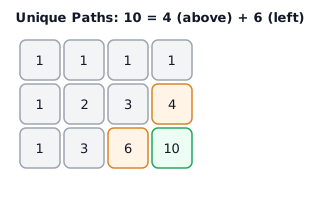
Grid DP and knapsack DP cover a huge share of medium interview problems. Learn the grid recurrences, the 0/1 vs unbounded knapsack loop directions, how partition and target-sum problems reduce to knapsack, and watch Unique Paths, Partition Equal Subset Sum and Maximal Square filled step by step.
🎯 What you'll learn
- Grid DP and single-row space optimization
- 0/1 vs unbounded knapsack and why loop direction matters
- Combinations vs permutations in counting problems
- Six LeetCode problems with animated tables
📚 Before you start
Two families cover a huge share of medium DP problems. Grid DP: the answer for cell (r, c) depends on its neighbours above and to the left (paths, path sums, squares). Knapsack DP: you pick items under a budget (capacity, target sum), and dp[w] is the best result achievable with budget w. Both use 2D tables that can usually be squeezed into a single row, and the direction you loop in is part of the solution.
1Grid DP
dp[r][c] = combine(dp[r-1][c], dp[r][c-1]) + cost(r, c)
first row / first column: only one way to arrive- Unique Paths: combine =
+(count paths). - Minimum Path Sum: combine =
min, plus the cell's cost. - Maximal Square:
dp[r][c] = 1 + min(top, left, top-left)when the cell is 1. - Obstacles: a blocked cell gets 0 paths / infinity cost.
Since row r only needs row r − 1, keep one row and update it left to right: row[c] = row[c] (from above) + row[c-1] (from the left).
2Knapsack Variants
| Variant | Example | Loop over budget |
|---|---|---|
| 0/1 (each item at most once) | Partition Equal Subset Sum, Target Sum, Last Stone Weight II | backwards (high → low) |
| Unbounded (reuse items) | Coin Change, Coin Change II, Perfect Squares | forwards (low → high) |
| counting vs optimizing | "how many ways" sums; "best value" takes max/min | — |
| combinations vs permutations | items outer loop = combinations; budget outer loop = permutations | — |
3Templates
function uniquePaths(m: number, n: number): number {
  const row = new Array(n).fill(1);
  for (let r = 1; r < m; r++) for (let c = 1; c < n; c++) row[c] += row[c - 1];
  return row[n - 1];
}

function knapsack01(weights: number[], values: number[], cap: number): number {
  const dp = new Array(cap + 1).fill(0);
  weights.forEach((wt, i) => {
    for (let w = cap; w >= wt; w--) dp[w] = Math.max(dp[w], dp[w - wt] + values[i]);
  });
  return dp[cap];
}

function unbounded(weights: number[], values: number[], cap: number): number {
  const dp = new Array(cap + 1).fill(0);
  weights.forEach((wt, i) => {
    for (let w = wt; w <= cap; w++) dp[w] = Math.max(dp[w], dp[w - wt] + values[i]);
  });
  return dp[cap];
}

function knapDemo(m: number, n: number, weights: number[], values: number[], cap: number): number[] {
  return [uniquePaths(m, n), knapsack01(weights, values, cap), unbounded(weights, values, cap)];
}def unique_paths(m, n): # grid DP: dp[r][c] = dp[r-1][c] + dp[r][c-1]
row = [1] * n # one row is enough
for _ in range(1, m):
for c in range(1, n):
row[c] += row[c - 1] # row[c] (from above) + row[c-1] (from left)
return row[-1]
def knapsack_01(weights, values, cap): # each item at most once
dp = [0] * (cap + 1) # dp[w] = best value with capacity w
for wt, val in zip(weights, values):
for w in range(cap, wt - 1, -1): # BACKWARDS: each item used once
dp[w] = max(dp[w], dp[w - wt] + val)
return dp[cap]
def unbounded(weights, values, cap): # unlimited copies of each item
dp = [0] * (cap + 1)
for wt, val in zip(weights, values):
for w in range(wt, cap + 1): # FORWARDS: item can be reused
dp[w] = max(dp[w], dp[w - wt] + val)
return dp[cap]
def knap_demo(m, n, weights, values, cap):
return [unique_paths(m, n), knapsack_01(weights, values, cap), unbounded(weights, values, cap)]Why the loop direction matters. With a single 1D array, dp[w − wt] must hold the value from before this item was considered (0/1) or possibly after (unbounded). Looping budget downward reads only old values, so each item is counted once; looping upward lets the item be used again in the same pass.
4Turning Problems Into Knapsack
- Partition Equal Subset Sum: can some subset sum to
total / 2? → 0/1 boolean knapsack. - Target Sum (+/− signs): a subset P with
sum(P) − (total − sum(P)) = target→sum(P) = (total + target) / 2→ count subsets with that sum. - Last Stone Weight II: split stones into two groups as equal as possible → best subset sum ≤ total / 2.
Recognizing this reduction is what interviewers are really testing.
⚠️ Common Pitfalls
- Wrong loop direction for 0/1 vs unbounded in 1D arrays.
- Swapping loops in counting problems (Coin Change II counts combinations only with coins in the outer loop).
- Forgetting first-row/first-column initialization in grid DP (or an obstacle cutting off the rest of the row).
- Odd totals in partition problems:
(total + target)must be even and non-negative. - Pseudo-polynomial complexity: O(n · capacity) is fine for capacity 10⁴, not for 10⁹.
📋 Quick Reference
grid: dp[r][c] = f(dp[r-1][c], dp[r][c-1]); 1-row: row[c] = f(row[c], row[c-1])
0/1 knapsack: for item: for w from cap down to wt: dp[w] = best(dp[w], dp[w-wt] + val)
unbounded: same with w from wt up to cap
count subsets with sum S: dp[0] = 1; dp[w] += dp[w - x] (backwards)
O(n · capacity) time, O(capacity) spaceSix problems: grid paths and costs, the three knapsack reductions (partition, signs, coin combinations), and the maximal square.
1Unique Paths (LeetCode 62)
🟠 Medium. A robot moves only right or down on an m × n grid. How many paths go from the top-left to the bottom-right?
m = 3, n = 7 → 28Approach. paths(r, c) = paths(r − 1, c) + paths(r, c − 1), with 1 along the first row and column. One row of length n suffices. (Combinatorics also works: C(m + n − 2, m − 1).)
Complexity. O(m · n) time, O(n) space.
function uniquePaths(m: number, n: number): number {
  const row = new Array(n).fill(1);
  for (let r = 1; r < m; r++) for (let c = 1; c < n; c++) row[c] += row[c - 1];
  return row[n - 1];
}def unique_paths(m, n):
row = [1] * n
for _ in range(1, m):
for c in range(1, n):
row[c] += row[c - 1]
return row[-1]2Minimum Path Sum (LeetCode 64)
🟠 Medium. Find a path from top-left to bottom-right (moving right or down) minimising the sum of cell values.
[[1,3,1],[1,5,1],[4,2,1]] → 7 (1→3→1→1→1)Approach. dp[r][c] = grid[r][c] + min(dp[r − 1][c], dp[r][c − 1]); the first row and column only have one predecessor. Update a single row in place.
Complexity. O(m · n) time, O(n) space.
function minPathSum(grid: number[][]): number {
  const n = grid[0].length;
  const row = new Array(n).fill(Infinity);
  row[0] = 0;
  for (const cells of grid) {
    row[0] += cells[0];
    for (let c = 1; c < n; c++) row[c] = cells[c] + Math.min(row[c], row[c - 1]);
  }
  return row[n - 1];
}def min_path_sum(grid):
m, n = len(grid), len(grid[0])
row = [float("inf")] * n
row[0] = 0
for r in range(m):
row[0] += grid[r][0]
for c in range(1, n):
row[c] = grid[r][c] + min(row[c], row[c - 1]) # above vs left
return row[-1]3Partition Equal Subset Sum (LeetCode 416)
🟠 Medium. Can the array be split into two subsets with equal sums?
[1,5,11,5] → true ([1,5,5] and [11])Approach. Only possible if the total is even; then ask whether some subset sums to total / 2. 0/1 boolean knapsack: can[s] |= can[s − x], iterating s downward so each number is used once. A bitset (bits |= bits << x) is a neat optimization.
Complexity. O(n · total) time, O(total) space.
function canPartition(nums: number[]): boolean {
  const total = nums.reduce((a, b) => a + b, 0);
  if (total % 2) return false;
  const target = total / 2;
  const can = new Array(target + 1).fill(false);
  can[0] = true;
  for (const x of nums) for (let s = target; s >= x; s--) can[s] = can[s] || can[s - x];
  return can[target];
}def can_partition(nums):
total = sum(nums)
if total % 2:
return False
target = total // 2
can = [True] + [False] * target
for x in nums:
for s in range(target, x - 1, -1): # backwards: use x at most once
can[s] = can[s] or can[s - x]
return can[target]4Target Sum (LeetCode 494)
🟠 Medium. Put + or − before each number. Count the expressions that evaluate to target.
[1,1,1,1,1], target 3 → 5Approach. Let P be the numbers with +. Then sum(P) − (total − sum(P)) = target, so sum(P) = (total + target) / 2. Count subsets with that sum (0/1 counting knapsack). If total + target is odd or negative, the answer is 0.
Complexity. O(n · total) time, O(total) space.
function findTargetSumWays(nums: number[], target: number): number {
  const total = nums.reduce((a, b) => a + b, 0);
  if ((total + target) % 2 !== 0 || Math.abs(target) > total) return 0;
  const goal = (total + target) / 2;
  const ways = new Array(goal + 1).fill(0);
  ways[0] = 1;
  for (const x of nums) for (let s = goal; s >= x; s--) ways[s] += ways[s - x];
  return ways[goal];
}def find_target_sum_ways(nums, target):
total = sum(nums)
if (total + target) % 2 or abs(target) > total:
return 0
goal = (total + target) // 2
ways = [1] + [0] * goal # ways[s] = subsets summing to s
for x in nums:
for s in range(goal, x - 1, -1):
ways[s] += ways[s - x]
return ways[goal]5Coin Change II (LeetCode 518)
🟠 Medium. Count the combinations of coins (unlimited supply) that make amount.
amount = 5, coins = [1,2,5] → 4Approach. Unbounded counting knapsack: ways[a] += ways[a − c]. Put coins in the outer loop so each combination is counted once in a fixed coin order; swapping the loops would count permutations (1+2 and 2+1 separately).
Complexity. O(amount · k) time, O(amount) space.
function change(amount: number, coins: number[]): number {
  const ways = new Array(amount + 1).fill(0);
  ways[0] = 1;
  for (const c of coins) for (let a = c; a <= amount; a++) ways[a] += ways[a - c];
  return ways[amount];
}def change(amount, coins):
ways = [1] + [0] * amount
for c in coins: # outer: coins → combinations
for a in range(c, amount + 1): # forwards: reuse allowed
ways[a] += ways[a - c]
return ways[amount]6Maximal Square (LeetCode 221)
🟠 Medium. In a 0/1 matrix, return the area of the largest square containing only 1s.
classic 4×5 matrix → 4 (a 2×2 square)Approach. side[r][c] = side of the largest all-1 square with bottom-right corner at (r, c) = 1 + min(top, left, top-left) when the cell is 1, else 0. The smallest neighbour limits how far the square extends.
Complexity. O(m · n) time, O(n) space with a rolling row.
function maximalSquare(matrix: string[][]): number {
  const m = matrix.length, n = matrix[0].length;
  const dp = Array.from({ length: m + 1 }, () => new Array(n + 1).fill(0));
  let best = 0;
  for (let r = 1; r <= m; r++)
    for (let c = 1; c <= n; c++)
      if (matrix[r - 1][c - 1] === "1") {
        dp[r][c] = 1 + Math.min(dp[r - 1][c], dp[r][c - 1], dp[r - 1][c - 1]);
        best = Math.max(best, dp[r][c]);
      }
  return best * best;
}def maximal_square(matrix):
m, n = len(matrix), len(matrix[0])
dp = [[0] * (n + 1) for _ in range(m + 1)]
best = 0
for r in range(1, m + 1):
for c in range(1, n + 1):
if matrix[r - 1][c - 1] == "1":
dp[r][c] = 1 + min(dp[r - 1][c], dp[r][c - 1], dp[r - 1][c - 1])
best = max(best, dp[r][c])
return best * best🧠 Key takeaways
- Grid DP:
dp[r][c]from above and left; keep one row. - 0/1 knapsack loops budget backwards; unbounded loops forwards.
- Counting combinations: items in the outer loop; permutations: budget outer.
- Partition / target sum / stone weight reduce to subset-sum knapsack.
🛠️ Practice exercises
Each exercise is a file in this topic folder. Code exercises are self-checking: run them and make the checks pass.
✅ Check yourself
Answer the questions — feedback is instant.