Dynamic Programming Fundamentals
Dynamic programming turns exponential recursion into polynomial time by solving each subproblem once. Learn the five-step recipe (state, transition, base, order, answer), top-down vs bottom-up, the common 1D families, and watch House Robber, Coin Change and LIS fill their tables step by step.
🎯 What you'll learn
- Recognizing optimal substructure and overlapping subproblems
- The five-step recipe and complexity = states × work
- Top-down memoization vs bottom-up tables
- Six classic 1D DP problems animated
📚 Before you start
Dynamic programming solves problems whose brute force recomputes the same subproblems again and again. You define the answer for a smaller state, express it through even smaller states (the transition), and store each result so it's computed once. Exponential recursion becomes polynomial. DP feels hard mostly because people skip the definition step; with a fixed recipe it becomes mechanical.
1When Is It DP?
Two properties:
- Optimal substructure: the best answer for the whole problem is built from best answers to subproblems.
- Overlapping subproblems: the recursion tree solves the same subproblem many times (Fibonacci's
f(3)appears repeatedly).
Wording cues: "number of ways", "minimum/maximum cost", "longest/shortest … subsequence", "can you reach/form …", choices at each step that affect future options.
2The Five-Step Recipe
- State: what does
dp[i](ordp[i][j]) mean, in one sentence? ("number of ways to reach step i") - Transition: how is
dp[i]computed from smaller states? (dp[i] = dp[i−1] + dp[i−2]) - Base cases: the smallest states with known answers (
dp[0] = dp[1] = 1). - Order: compute states so dependencies are ready (increasing i).
- Answer: which state is the final answer (
dp[n]), and can you reduce space?
3Top-Down vs Bottom-Up
function climbMemo(n: number, memo = new Map<number, number>()): number {
  if (n <= 1) return 1;
  if (memo.has(n)) return memo.get(n)!;
  const v = climbMemo(n - 1, memo) + climbMemo(n - 2, memo);
  memo.set(n, v);
  return v;
}

function climbTable(n: number): number {
  const dp = new Array(n + 1).fill(1);
  for (let i = 2; i <= n; i++) dp[i] = dp[i - 1] + dp[i - 2];
  return dp[n];
}

function climbO1(n: number): number {
  let a = 1, b = 1;
  for (let i = 1; i < n; i++) [a, b] = [b, a + b];
  return b;
}

function climbBoth(n: number): number[] {
  return [climbMemo(n), climbTable(n), climbO1(n)];
}from functools import lru_cache
def climb_memo(n): # top-down: recursion + cache
@lru_cache(maxsize=None)
def f(i):
if i <= 1:
return 1 # base cases
return f(i - 1) + f(i - 2) # transition
return f(n)
def climb_table(n): # bottom-up: fill a table in order
dp = [1] * (n + 1)
for i in range(2, n + 1):
dp[i] = dp[i - 1] + dp[i - 2]
return dp[n]
def climb_o1(n): # space-optimized: keep only what's needed
a, b = 1, 1
for _ in range(n - 1):
a, b = b, a + b
return b
def climb_both(n):
return [climb_memo(n), climb_table(n), climb_o1(n)]| Top-down (memoized recursion) | Bottom-up (tabulation) | |
|---|---|---|
| writing it | natural from the recurrence | needs an explicit order |
| computes | only reachable states | every state |
| risk | recursion depth limits (Python ~1,000) | none |
| space optimization | hard | easy: keep only the last row(s) |
A good interview flow: write the recurrence, code top-down quickly, then convert to bottom-up with O(1) or O(n) space if asked.
4Common 1D DP Families
| Family | State | Transition |
|---|---|---|
| counting paths (stairs, decode ways) | ways to reach i | sum over the last step choices |
| take / skip (house robber) | best up to i | max(skip: dp[i−1], take: dp[i−2] + a[i]) |
| unbounded choices (coin change) | best for amount a | min over coins c: dp[a − c] + 1 |
| subsequence ending at i (LIS) | best ending exactly at i | max over earlier j that can precede i |
| segmentation (word break) | can prefix of length i be built? | any j with dp[j] and s[j:i] a word |
Under the HoodWhy Memoization Changes Complexity▾
Complexity of a DP = (number of distinct states) × (work per state). Naive Fibonacci makes ~2ⁿ calls but has only n distinct states; with a cache each state is computed once, so it's O(n). Coin change has amount states × len(coins) choices = O(amount · k). Always state complexity in this form. Interviewers like hearing that you know where it comes from.
⚠️ Common Pitfalls
- Vague state definitions ("dp[i] is the answer for i"): say exactly what it represents, including whether i is included or ending at.
- Wrong base cases (
dp[0]for "zero amount needs zero coins", "empty string decodes in one way"). - Iterating in the wrong order so
dp[i]reads values not yet computed. - Using greedy where choices interact (coin change).
- Forgetting impossibility markers (
inffor unreachable amounts, then mapping back to −1).
📋 Quick Reference
Recipe: state → transition → base → order → answer (→ shrink space)
Complexity = #states × work per state
take/skip: dp[i] = max(dp[i-1], dp[i-2] + a[i])
unbounded: dp[a] = min(dp[a-c] + 1 for c in coins)
top-down = recursion + cache · bottom-up = table in dependency orderSix classic 1D DP problems, one for each common family: counting, take/skip, unbounded choices, subsequences, segmentation and decoding.
1Climbing Stairs (LeetCode 70)
🟢 Easy. You climb 1 or 2 steps at a time. How many distinct ways reach step n?
n = 3 → 3 (1+1+1, 1+2, 2+1)Approach. ways(n) = ways(n − 1) + ways(n − 2): the last move was a 1-step or a 2-step. Base cases ways(0) = ways(1) = 1. Keep only the last two values.
Complexity. O(n) time, O(1) space.
function climbStairs(n: number): number {
  let a = 1, b = 1;
  for (let i = 1; i < n; i++) [a, b] = [b, a + b];
  return b;
}def climb_stairs(n):
a, b = 1, 1 # ways(i-1), ways(i)
for _ in range(n - 1):
a, b = b, a + b
return b2House Robber (LeetCode 198)
🟠 Medium. Houses in a row hold money; you can't rob two adjacent houses. Return the maximum amount.
[2,7,9,3,1] → 12 (2 + 9 + 1)Approach. Take/skip: best(i) = max(best(i − 1), best(i − 2) + nums[i]). Two rolling variables are enough.
Complexity. O(n) time, O(1) space.
function rob(nums: number[]): number {
  let prev2 = 0, prev1 = 0;
  for (const x of nums) [prev2, prev1] = [prev1, Math.max(prev1, prev2 + x)];
  return prev1;
}def rob(nums):
prev2, prev1 = 0, 0 # best up to i-2, best up to i-1
for x in nums:
prev2, prev1 = prev1, max(prev1, prev2 + x)
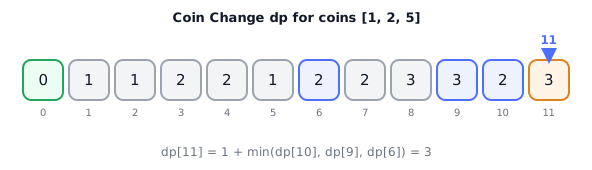
return prev13Coin Change (LeetCode 322)
🟠 Medium. Return the fewest coins (unlimited supply of each denomination) that make amount, or −1.
coins = [1,2,5], amount = 11 → 3 (5 + 5 + 1)Approach. dp[a] = fewest coins for amount a. dp[0] = 0; dp[a] = min(dp[a − c] + 1) over coins c ≤ a. Unreachable amounts stay infinite. Greedy fails here (coins [1,3,4], amount 6).
Complexity. O(amount · k) time, O(amount) space.
function coinChange(coins: number[], amount: number): number {
  const dp = new Array(amount + 1).fill(Infinity);
  dp[0] = 0;
  for (let a = 1; a <= amount; a++)
    for (const c of coins) if (c <= a && dp[a - c] + 1 < dp[a]) dp[a] = dp[a - c] + 1;
  return dp[amount] === Infinity ? -1 : dp[amount];
}def coin_change(coins, amount):
INF = float("inf")
dp = [0] + [INF] * amount
for a in range(1, amount + 1):
for c in coins:
if c <= a and dp[a - c] + 1 < dp[a]:
dp[a] = dp[a - c] + 1
return dp[amount] if dp[amount] != INF else -14Longest Increasing Subsequence (LeetCode 300)
🟠 Medium. Return the length of the longest strictly increasing subsequence.
[10,9,2,5,3,7,101,18] → 4 (2,3,7,18)Approach. dp[i] = length of the longest increasing subsequence ending at i = 1 + max(dp[j]) over j < i with nums[j] < nums[i]: O(n²). The O(n log n) version keeps tails[k] = the smallest possible tail of an increasing subsequence of length k + 1 and binary-searches where each number goes.
Complexity. O(n²) DP, or O(n log n) with tails + binary search.
function lengthOfLIS(nums: number[]): number {
  // O(n^2) DP: dp[i] = longest increasing subsequence ending at i
  const dp = new Array(nums.length).fill(1);
  let best = nums.length ? 1 : 0;
  for (let i = 1; i < nums.length; i++) {
    for (let j = 0; j < i; j++) if (nums[j] < nums[i]) dp[i] = Math.max(dp[i], dp[j] + 1);
    best = Math.max(best, dp[i]);
  }
  return best;
}from bisect import bisect_left
def length_of_lis(nums):
tails = [] # tails[k] = smallest tail of an IS of length k+1
for x in nums:
i = bisect_left(tails, x)
if i == len(tails):
tails.append(x) # extends the longest subsequence
else:
tails[i] = x # a smaller tail for length i+1
return len(tails)5Word Break (LeetCode 139)
🟠 Medium. Can s be segmented into a sequence of dictionary words?
s = "applepenapple", dict = ["apple","pen"] → trueApproach. dp[i] = whether the prefix s[:i] can be segmented; dp[0] = true. dp[i] is true if some j < i has dp[j] true and s[j:i] in the dictionary (only check word lengths that exist).
Complexity. O(n · L) checks for maximum word length L.
function wordBreak(s: string, wordDict: string[]): boolean {
  const words = new Set(wordDict), lengths = [...new Set(wordDict.map((w) => w.length))];
  const dp = new Array(s.length + 1).fill(false);
  dp[0] = true;
  for (let i = 1; i <= s.length; i++)
    dp[i] = lengths.some((L) => L <= i && dp[i - L] && words.has(s.slice(i - L, i)));
  return dp[s.length];
}def word_break(s, word_dict):
words = set(word_dict)
lengths = {len(w) for w in words}
dp = [True] + [False] * len(s)
for i in range(1, len(s) + 1):
dp[i] = any(L <= i and dp[i - L] and s[i - L:i] in words for L in lengths)
return dp[-1]6Decode Ways (LeetCode 91)
🟠 Medium. Letters map to 1…26. Count the ways to decode a digit string (a 0 can't start a code).
"226" → 3 (2 2 6, 22 6, 2 26)Approach. dp[i] = ways to decode the first i characters. A single digit s[i−1] ≠ '0' adds dp[i−1]; a two-digit code s[i−2:i] between 10 and 26 adds dp[i−2]. Base dp[0] = 1.
Complexity. O(n) time, O(1) space with two variables.
function numDecodings(s: string): number {
  if (!s) return 0;
  let prev2 = 1, prev1 = s[0] !== "0" ? 1 : 0;
  for (let i = 2; i <= s.length; i++) {
    let cur = 0;
    if (s[i - 1] !== "0") cur += prev1;
    const two = Number(s.slice(i - 2, i));
    if (two >= 10 && two <= 26) cur += prev2;
    [prev2, prev1] = [prev1, cur];
  }
  return prev1;
}def num_decodings(s):
prev2, prev1 = 1, 1 if s and s[0] != "0" else 0 # dp[0], dp[1]
for i in range(2, len(s) + 1):
cur = 0
if s[i - 1] != "0":
cur += prev1
if 10 <= int(s[i - 2:i]) <= 26:
cur += prev2
prev2, prev1 = prev1, cur
return prev1 if s else 0🧠 Key takeaways
- DP needs optimal substructure and overlapping subproblems.
- Recipe: state → transition → base cases → order → answer, then shrink space.
- Complexity = number of states × work per state.
- Families: counting, take/skip, unbounded choices, subsequence-ending-at-i, segmentation.
🛠️ Practice exercises
Each exercise is a file in this topic folder. Code exercises are self-checking: run them and make the checks pass.
✅ Check yourself
Answer the questions — feedback is instant.