Greedy
Greedy algorithms commit to the locally best choice and never look back: one pass, simple code, when they're correct. Learn the common greedy shapes, how to justify a greedy choice in an interview, how to spot when greedy fails, and watch Kadane, Jump Game and Gas Station animated.
🎯 What you'll learn
- Common greedy shapes: reset, reach, sort-and-sweep, balance
- Exchange and stays-ahead arguments
- Counterexamples that call for DP instead
- Six LeetCode problems with animated walkthroughs
📚 Before you start
A greedy algorithm builds a solution by making the locally best choice at each step and never reconsidering it. When it works, it's the simplest and fastest solution: usually one pass, or a sort plus one pass. The hard part is knowing when it works. Greedy is correct only if a locally optimal choice can always be extended to a globally optimal solution, and in interviews you're expected to justify that with a short argument, or to recognize that the problem needs dynamic programming instead.
1Typical Greedy Shapes
| Shape | Example | Greedy rule |
|---|---|---|
| running value, reset when it stops helping | Maximum Subarray (Kadane), stock profit | extend or restart |
| farthest reach | Jump Game I/II | keep the max index reachable so far |
| sort, then sweep | intervals, meeting rooms, assign cookies | earliest end first / smallest that fits |
| balance / deficit | Gas Station, Lemonade Change | if the running balance goes negative, restart after it |
| last occurrence | Partition Labels | extend the current part to the last occurrence of every letter in it |
| smallest available | Hand of Straights, task scheduling | always start from the smallest remaining item |
2Templates
function maxSubarrayTemplate(nums: number[]): number {
  let best = nums[0], cur = nums[0];
  for (let i = 1; i < nums.length; i++) {
    cur = Math.max(nums[i], cur + nums[i]);
    best = Math.max(best, cur);
  }
  return best;
}

function canReachEnd(nums: number[]): boolean {
  let reach = 0;
  for (let i = 0; i < nums.length; i++) {
    if (i > reach) return false;
    reach = Math.max(reach, i + nums[i]);
  }
  return true;
}def max_subarray_template(nums): # Kadane: extend or restart, keep the best
best = cur = nums[0]
for x in nums[1:]:
cur = max(x, cur + x) # a negative running sum only hurts → restart
best = max(best, cur)
return best
def can_reach_end(nums): # track the farthest reachable index
reach = 0
for i, step in enumerate(nums):
if i > reach:
return False
reach = max(reach, i + step)
return True3Proving a Greedy Choice (Briefly)
Interviewers accept a compact argument. Two standard ones:
- Exchange argument: take any optimal solution that differs from the greedy one at the first choice; swap in the greedy choice and show the solution is no worse. (Used for "earliest end first" in interval scheduling.)
- Stays ahead: show that after every step, the greedy solution is at least as good as any other on some measure (e.g. Jump Game: greedy reach is never smaller than any strategy's reach).
4When Greedy Fails
Coin change with coins [1, 3, 4] and amount 6: greedy takes 4 + 1 + 1 = 3 coins, but 3 + 3 = 2 coins is optimal. Whenever an early choice can block a better combination later, you need dynamic programming (02-dynamic_programming_fundamentals). A useful habit: before committing to greedy, try to construct a small counterexample.
⚠️ Common Pitfalls
- Assuming greedy works without a counterexample check (coin change, 0/1 knapsack).
- Sorting by the wrong key (start vs end, value vs value/weight ratio).
- Initializing Kadane with 0 when all numbers can be negative (start from
nums[0]). - Off-by-one in reach checks: you're stuck when the current index is greater than the reach.
- Not stating the justification ("why is this choice safe?").
📋 Quick Reference
Kadane: cur = max(x, cur + x); best = max(best, cur)
Jump Game: if i > reach: fail; reach = max(reach, i + a[i])
Gas Station: if total < 0 → -1; reset start when the tank goes negative
Justify: exchange argument or "stays ahead"; else → DPSix problems where a local rule provably leads to the global optimum: Kadane, farthest reach, balance resets, last occurrences and smallest-first grouping.
1Maximum Subarray (LeetCode 53)
🟠 Medium. Return the largest sum of a non-empty contiguous subarray.
[-2,1,-3,4,-1,2,1,-5,4] → 6 ([4,-1,2,1])Approach. Kadane's algorithm: the best subarray ending at i either extends the best one ending at i − 1 or starts fresh at i, whichever is larger. A negative running sum can only hurt what follows, so drop it.
Complexity. O(n) time, O(1) space.
function maxSubArray(nums: number[]): number {
  let best = nums[0], cur = nums[0];
  for (let i = 1; i < nums.length; i++) {
    cur = Math.max(nums[i], cur + nums[i]);
    best = Math.max(best, cur);
  }
  return best;
}def max_sub_array(nums):
best = cur = nums[0]
for x in nums[1:]:
cur = max(x, cur + x)
best = max(best, cur)
return best2Jump Game (LeetCode 55)
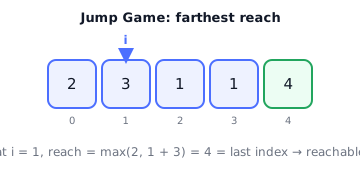
🟠 Medium. nums[i] is the maximum jump length from index i. Can you reach the last index from index 0?
[2,3,1,1,4] → true · [3,2,1,0,4] → falseApproach. Scan left to right keeping the farthest reachable index. If you ever stand on an index beyond it, you're stuck.
Complexity. O(n) time, O(1) space.
function canJump(nums: number[]): boolean {
  let reach = 0;
  for (let i = 0; i < nums.length; i++) {
    if (i > reach) return false;
    reach = Math.max(reach, i + nums[i]);
  }
  return true;
}def can_jump(nums):
reach = 0
for i, step in enumerate(nums):
if i > reach:
return False
reach = max(reach, i + step)
return True3Jump Game II (LeetCode 45)
🟠 Medium. Return the minimum number of jumps to reach the last index (always reachable).
[2,3,1,1,4] → 2 (0 → 1 → 4)Approach. BFS by levels without a queue: the current jump covers indices up to end; while scanning them, track the farthest index the next jump could reach. When you pass end, take a jump and set end to that farthest reach.
Complexity. O(n) time, O(1) space.
function jump(nums: number[]): number {
  let jumps = 0, end = 0, farthest = 0;
  for (let i = 0; i < nums.length - 1; i++) {
    farthest = Math.max(farthest, i + nums[i]);
    if (i === end) { jumps++; end = farthest; }
  }
  return jumps;
}def jump(nums):
jumps = end = farthest = 0
for i in range(len(nums) - 1):
farthest = max(farthest, i + nums[i])
if i == end: # current jump's range is exhausted
jumps += 1
end = farthest
return jumps4Gas Station (LeetCode 134)
🟠 Medium. Stations on a circle have gas[i]; driving to the next costs cost[i]. Return the starting station for a full loop, or −1.
gas = [1,2,3,4,5], cost = [3,4,5,1,2] → 3Approach. If total gas < total cost, it's impossible. Otherwise scan once with a running tank; whenever the tank goes negative at station i, no station from the current start through i can work (they'd arrive with even less), so restart from i + 1.
Complexity. O(n) time, O(1) space.
function canCompleteCircuit(gas: number[], cost: number[]): number {
  let total = 0, tank = 0, start = 0;
  for (let i = 0; i < gas.length; i++) {
    total += gas[i] - cost[i];
    tank += gas[i] - cost[i];
    if (tank < 0) { start = i + 1; tank = 0; }
  }
  return total < 0 ? -1 : start;
}def can_complete_circuit(gas, cost):
if sum(gas) < sum(cost):
return -1
start = tank = 0
for i in range(len(gas)):
tank += gas[i] - cost[i]
if tank < 0:
start, tank = i + 1, 0
return start5Partition Labels (LeetCode 763)
🟠 Medium. Split s into as many parts as possible so each letter appears in at most one part. Return the part sizes.
"ababcbacadefegdehijhklij" → [9,7,8]Approach. Record the last index of every letter. Scan, extending the current part's end to the last occurrence of each letter seen; when the index reaches the end, close the part.
Complexity. O(n) time, O(26) space.
function partitionLabels(s: string): number[] {
  const last = new Map<string, number>();
  for (let i = 0; i < s.length; i++) last.set(s[i], i);
  const sizes: number[] = [];
  let start = 0, end = 0;
  for (let i = 0; i < s.length; i++) {
    end = Math.max(end, last.get(s[i])!);
    if (i === end) { sizes.push(end - start + 1); start = i + 1; }
  }
  return sizes;
}def partition_labels(s):
last = {c: i for i, c in enumerate(s)}
sizes, start, end = [], 0, 0
for i, c in enumerate(s):
end = max(end, last[c])
if i == end:
sizes.append(end - start + 1)
start = i + 1
return sizes6Hand of Straights (LeetCode 846)
🟠 Medium. Can the cards be split into groups of groupSize consecutive values?
[1,2,3,6,2,3,4,7,8], groupSize 3 → true ([1,2,3],[2,3,4],[6,7,8])Approach. The smallest remaining card must start a group (nothing smaller can cover it). Count cards, iterate values in sorted order, and for each value with remaining count c, consume c copies of the next groupSize − 1 consecutive values; fail if any is short.
Complexity. O(n log n) time for sorting the distinct values.
function isNStraightHand(hand: number[], groupSize: number): boolean {
  if (hand.length % groupSize) return false;
  const count = new Map<number, number>();
  for (const x of hand) count.set(x, (count.get(x) ?? 0) + 1);
  for (const x of [...count.keys()].sort((a, b) => a - b)) {
    const c = count.get(x)!;
    if (c === 0) continue;
    for (let v = x; v < x + groupSize; v++) {
      if ((count.get(v) ?? 0) < c) return false;
      count.set(v, count.get(v)! - c);
    }
  }
  return true;
}def is_n_straight_hand(hand, group_size):
if len(hand) % group_size:
return False
count = {}
for x in hand:
count[x] = count.get(x, 0) + 1
for x in sorted(count):
c = count[x]
if c == 0:
continue
for v in range(x, x + group_size):
if count.get(v, 0) < c:
return False
count[v] -= c
return True🧠 Key takeaways
- Greedy = locally best choice, never revisited; usually O(n) or O(n log n).
- Justify it: exchange argument or stays ahead; otherwise suspect DP.
- Shapes: Kadane reset, farthest reach, sort + sweep, running balance, last occurrence.
- Always try a small counterexample (coin change [1,3,4] → 6) before committing.
🛠️ Practice exercises
Each exercise is a file in this topic folder. Code exercises are self-checking: run them and make the checks pass.
✅ Check yourself
Answer the questions — feedback is instant.