Shortest Paths
Which shortest-path algorithm to use depends on the edge weights. Learn when BFS, 0-1 BFS, Dijkstra, Bellman-Ford and Floyd–Warshall apply, why Dijkstra breaks with negative edges, the stale-entry trick, and watch Dijkstra settle a weighted graph and Bellman-Ford respect a stop limit.
🎯 What you'll learn
- Choosing BFS, 0-1 BFS, Dijkstra, Bellman-Ford or Floyd–Warshall
- Dijkstra with a min-heap and lazy deletion
- Bellman-Ford with a limited number of edges
- Six LeetCode problems with animated walkthroughs
📚 Before you start
"Shortest" depends on the edges. With no weights (every step costs 1), plain BFS is optimal. With non-negative weights, use Dijkstra's algorithm: always expand the closest unfinished node, using a min-heap. With negative weights or a limit on the number of edges, use Bellman-Ford (relax every edge repeatedly). For all pairs on small graphs, Floyd–Warshall. Picking the right one, and explaining why, is most of the interview.
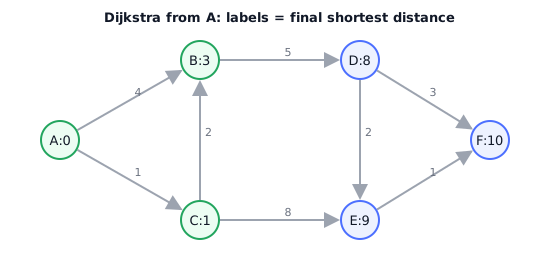
1Choosing an Algorithm
| Graph | Algorithm | Complexity |
|---|---|---|
| unweighted (or all weights equal) | BFS | O(V + E) |
| weights 0 or 1 | 0-1 BFS with a deque (0-edges to the front) | O(V + E) |
| non-negative weights | Dijkstra + min-heap | O((V + E) log V) |
| negative weights, or "at most k edges/stops" | Bellman-Ford (k + 1 rounds) | O(V · E) or O(k · E) |
| all pairs, V ≤ ~400 | Floyd–Warshall | O(V³) |
| "minimize the maximum edge on the path" | Dijkstra with max instead of +, or binary search + BFS, or union-find | O(E log V) |
2Dijkstra Template
class MinHeap<T> {
  private a: T[] = [];
  private less: (x: T, y: T) => boolean;
  constructor(less: (x: T, y: T) => boolean = (x: any, y: any) => x < y) { this.less = less; }
  get size(): number { return this.a.length; }
  peek(): T | undefined { return this.a[0]; }
  push(x: T): void {
    const a = this.a; a.push(x);
    let i = a.length - 1;
    while (i > 0) {                                   // sift up
      const p = (i - 1) >> 1;
      if (!this.less(a[i], a[p])) break;
      [a[i], a[p]] = [a[p], a[i]]; i = p;
    }
  }
  pop(): T | undefined {
    const a = this.a; if (!a.length) return undefined;
    const top = a[0], last = a.pop()!;
    if (a.length) {
      a[0] = last; let i = 0;
      while (true) {                                  // sift down
        const l = 2 * i + 1, r = l + 1; let m = i;
        if (l < a.length && this.less(a[l], a[m])) m = l;
        if (r < a.length && this.less(a[r], a[m])) m = r;
        if (m === i) break;
        [a[i], a[m]] = [a[m], a[i]]; i = m;
      }
    }
    return top;
  }
}

function dijkstra(n: number, edges: number[][], src: number): number[] {
  const adj: [number, number][][] = Array.from({ length: n }, () => []);
  for (const [u, v, w] of edges) adj[u].push([v, w]);
  const dist = new Array(n).fill(Infinity);
  dist[src] = 0;
  const heap = new MinHeap<[number, number]>((a, b) => a[0] < b[0]);
  heap.push([0, src]);
  while (heap.size) {
    const [d, u] = heap.pop()!;
    if (d > dist[u]) continue;
    for (const [v, w] of adj[u]) {
      if (d + w < dist[v]) { dist[v] = d + w; heap.push([dist[v], v]); }
    }
  }
  return dist.map((x) => (x === Infinity ? -1 : x));
}import heapq
def dijkstra(n, edges, src): # edges: (u, v, w) with w >= 0, directed
adj = [[] for _ in range(n)]
for u, v, w in edges:
adj[u].append((v, w))
dist = [float("inf")] * n
dist[src] = 0
heap = [(0, src)] # (distance, node)
while heap:
d, u = heapq.heappop(heap)
if d > dist[u]:
continue # stale entry: a shorter path was found already
for v, w in adj[u]:
nd = d + w
if nd < dist[v]: # relax
dist[v] = nd
heapq.heappush(heap, (nd, v))
return [x if x != float("inf") else -1 for x in dist]Relaxation: if going through u gives v a shorter distance, update dist[v] and push the new pair. The if d > dist[u]: continue line skips stale heap entries (lazy deletion), which is simpler than a decrease-key operation and is what interviewers expect.
3Why Dijkstra Fails With Negative Edges
Dijkstra assumes that once a node is popped with distance d, nothing can later offer a shorter path, because every remaining path is at least d and adding non-negative edges can't shrink it. A negative edge breaks that guarantee: a longer route through a negative edge can end up shorter than a distance already finalized. Bellman-Ford doesn't finalize anything; it simply relaxes all edges V − 1 times (one more round that still improves something reveals a negative cycle).
4Bellman-Ford With k Stops
To find the cheapest route using at most k + 1 edges, run k + 1 rounds of relaxing every edge, and in each round read distances from a copy of the previous round. That copy ensures each round extends paths by exactly one edge. This is Cheapest Flights Within K Stops.
Under the HoodReal Routing▾
Maps use Dijkstra variants with heuristics: A\* adds an admissible estimate of the remaining distance (straight-line distance) so the search heads toward the goal; production routers (OSRM, Google Maps) precompute contraction hierarchies so continent-scale queries take milliseconds. Network routing protocols are distributed versions: OSPF runs Dijkstra on each router's view of the topology, while RIP is distance-vector, essentially Bellman-Ford.
⚠️ Common Pitfalls
- Using Dijkstra with negative edges.
- Not skipping stale heap entries, which processes nodes many times (still correct but slow) or, with a naive "visited" check placed wrong, gives wrong answers.
- Bellman-Ford without copying the previous round when the number of edges is limited.
- Overflow:
INF + win C#/Javaint; uselongor check before adding. - Using DFS for shortest paths: DFS finds a path, not the shortest.
📋 Quick Reference
unweighted → BFS · 0/1 weights → deque · w ≥ 0 → Dijkstra · negatives / ≤k edges → Bellman-Ford
Dijkstra: heap (0, src); pop (d,u); skip if d > dist[u]; relax v: if d+w < dist[v] → update, push
Bellman-Ford k stops: repeat k+1: tmp = dist[:]; for u,v,w: tmp[v] = min(tmp[v], dist[u]+w); dist = tmpSix problems, each needing a different shortest-path tool: Dijkstra, minimax Dijkstra, Bellman-Ford with a stop limit, grid BFS, and Floyd–Warshall.
1Network Delay Time (LeetCode 743)
🟠 Medium. times[i] = (u, v, w): a signal takes w time from node u to v (nodes 1..n). Send a signal from k; return the time for all nodes to receive it, or −1.
times = [[2,1,1],[2,3,1],[3,4,1]], n = 4, k = 2 → 2Approach. Single-source shortest paths with non-negative weights: Dijkstra from k. The answer is the maximum finite distance (−1 if any node is unreachable).
Complexity. O((V + E) log V).
class MinHeap<T> {
  private a: T[] = [];
  private less: (x: T, y: T) => boolean;
  constructor(less: (x: T, y: T) => boolean = (x: any, y: any) => x < y) { this.less = less; }
  get size(): number { return this.a.length; }
  peek(): T | undefined { return this.a[0]; }
  push(x: T): void {
    const a = this.a; a.push(x);
    let i = a.length - 1;
    while (i > 0) {                                   // sift up
      const p = (i - 1) >> 1;
      if (!this.less(a[i], a[p])) break;
      [a[i], a[p]] = [a[p], a[i]]; i = p;
    }
  }
  pop(): T | undefined {
    const a = this.a; if (!a.length) return undefined;
    const top = a[0], last = a.pop()!;
    if (a.length) {
      a[0] = last; let i = 0;
      while (true) {                                  // sift down
        const l = 2 * i + 1, r = l + 1; let m = i;
        if (l < a.length && this.less(a[l], a[m])) m = l;
        if (r < a.length && this.less(a[r], a[m])) m = r;
        if (m === i) break;
        [a[i], a[m]] = [a[m], a[i]]; i = m;
      }
    }
    return top;
  }
}

function networkDelayTime(times: number[][], n: number, k: number): number {
  const adj: [number, number][][] = Array.from({ length: n + 1 }, () => []);
  for (const [u, v, w] of times) adj[u].push([v, w]);
  const dist = new Array(n + 1).fill(Infinity);
  dist[k] = 0;
  const heap = new MinHeap<[number, number]>((a, b) => a[0] < b[0]);
  heap.push([0, k]);
  while (heap.size) {
    const [d, u] = heap.pop()!;
    if (d > dist[u]) continue;
    for (const [v, w] of adj[u]) if (d + w < dist[v]) { dist[v] = d + w; heap.push([dist[v], v]); }
  }
  const best = Math.max(...dist.slice(1));
  return best === Infinity ? -1 : best;
}import heapq
def network_delay_time(times, n, k):
adj = [[] for _ in range(n + 1)]
for u, v, w in times:
adj[u].append((v, w))
dist = {k: 0}
heap = [(0, k)]
while heap:
d, u = heapq.heappop(heap)
if d > dist[u]:
continue
for v, w in adj[u]:
if d + w < dist.get(v, float("inf")):
dist[v] = d + w
heapq.heappush(heap, (d + w, v))
return max(dist.values()) if len(dist) == n else -12Path With Minimum Effort (LeetCode 1631)
🟠 Medium. Move through a height grid from top-left to bottom-right. A route's effort is its maximum absolute height difference between consecutive cells. Return the minimum effort.
[[1,2,2],[3,8,2],[5,3,5]] → 2Approach. Dijkstra where the path cost is the max edge so far instead of a sum: cost(v) = max(cost(u), |h[u] − h[v]|). The heap still pops cells in non-decreasing cost order, so the first time the target is popped, its cost is optimal.
Complexity. O(R · C · log(R · C)).
class MinHeap<T> {
  private a: T[] = [];
  private less: (x: T, y: T) => boolean;
  constructor(less: (x: T, y: T) => boolean = (x: any, y: any) => x < y) { this.less = less; }
  get size(): number { return this.a.length; }
  peek(): T | undefined { return this.a[0]; }
  push(x: T): void {
    const a = this.a; a.push(x);
    let i = a.length - 1;
    while (i > 0) {                                   // sift up
      const p = (i - 1) >> 1;
      if (!this.less(a[i], a[p])) break;
      [a[i], a[p]] = [a[p], a[i]]; i = p;
    }
  }
  pop(): T | undefined {
    const a = this.a; if (!a.length) return undefined;
    const top = a[0], last = a.pop()!;
    if (a.length) {
      a[0] = last; let i = 0;
      while (true) {                                  // sift down
        const l = 2 * i + 1, r = l + 1; let m = i;
        if (l < a.length && this.less(a[l], a[m])) m = l;
        if (r < a.length && this.less(a[r], a[m])) m = r;
        if (m === i) break;
        [a[i], a[m]] = [a[m], a[i]]; i = m;
      }
    }
    return top;
  }
}

function minimumEffortPath(heights: number[][]): number {
  const R = heights.length, C = heights[0].length;
  const best = Array.from({ length: R }, () => new Array(C).fill(Infinity));
  best[0][0] = 0;
  const heap = new MinHeap<[number, number, number]>((a, b) => a[0] < b[0]);
  heap.push([0, 0, 0]);
  while (heap.size) {
    const [e, r, c] = heap.pop()!;
    if (r === R - 1 && c === C - 1) return e;
    if (e > best[r][c]) continue;
    for (const [dr, dc] of [[1, 0], [-1, 0], [0, 1], [0, -1]]) {
      const nr = r + dr, nc = c + dc;
      if (nr < 0 || nc < 0 || nr >= R || nc >= C) continue;
      const ne = Math.max(e, Math.abs(heights[nr][nc] - heights[r][c]));
      if (ne < best[nr][nc]) { best[nr][nc] = ne; heap.push([ne, nr, nc]); }
    }
  }
  return 0;
}import heapq
def minimum_effort_path(heights):
R, C = len(heights), len(heights[0])
best = [[float("inf")] * C for _ in range(R)]
best[0][0] = 0
heap = [(0, 0, 0)]
while heap:
e, r, c = heapq.heappop(heap)
if (r, c) == (R - 1, C - 1):
return e
if e > best[r][c]:
continue
for dr, dc in ((1, 0), (-1, 0), (0, 1), (0, -1)):
nr, nc = r + dr, c + dc
if 0 <= nr < R and 0 <= nc < C:
ne = max(e, abs(heights[nr][nc] - heights[r][c]))
if ne < best[nr][nc]:
best[nr][nc] = ne
heapq.heappush(heap, (ne, nr, nc))
return 03Cheapest Flights Within K Stops (LeetCode 787)
🟠 Medium. flights[i] = (from, to, price). Return the cheapest price from src to dst with at most k stops (k + 1 flights), or −1.
0→1→3 costs 700 with k = 1 (0→1→2→3 = 400 needs 2 stops)Approach. Bellman-Ford limited to k + 1 rounds. Each round relaxes every flight using a copy of the previous round's prices, so a round extends routes by exactly one flight.
Complexity. O(k · E) time, O(V) space.
function findCheapestPrice(n: number, flights: number[][], src: number, dst: number, k: number): number {
  let price = new Array(n).fill(Infinity);
  price[src] = 0;
  for (let round = 0; round <= k; round++) {
    const next = [...price];
    for (const [u, v, w] of flights) if (price[u] + w < next[v]) next[v] = price[u] + w;
    price = next;
  }
  return price[dst] === Infinity ? -1 : price[dst];
}def find_cheapest_price(n, flights, src, dst, k):
INF = float("inf")
price = [INF] * n
price[src] = 0
for _ in range(k + 1):
nxt = price[:] # read from the previous round only
for u, v, w in flights:
if price[u] + w < nxt[v]:
nxt[v] = price[u] + w
price = nxt
return price[dst] if price[dst] != INF else -14Shortest Path in Binary Matrix (LeetCode 1091)
🟠 Medium. Return the length (in cells) of the shortest clear path (0s) from top-left to bottom-right moving in 8 directions, or −1.
[[0,0,0],[1,1,0],[1,1,0]] → 4Approach. Unweighted grid → BFS. Start at (0,0) if it's clear; each BFS level adds one cell to the path length.
Complexity. O(n²) time and space.
function shortestPathBinaryMatrix(grid: number[][]): number {
  const n = grid.length;
  if (grid[0][0] || grid[n - 1][n - 1]) return -1;
  const q: [number, number, number][] = [[0, 0, 1]];
  grid[0][0] = 1;
  for (let head = 0; head < q.length; head++) {
    const [r, c, d] = q[head];
    if (r === n - 1 && c === n - 1) return d;
    for (let dr = -1; dr <= 1; dr++) for (let dc = -1; dc <= 1; dc++) {
      const nr = r + dr, nc = c + dc;
      if (nr >= 0 && nc >= 0 && nr < n && nc < n && grid[nr][nc] === 0) { grid[nr][nc] = 1; q.push([nr, nc, d + 1]); }
    }
  }
  return -1;
}from collections import deque
def shortest_path_binary_matrix(grid):
n = len(grid)
if grid[0][0] or grid[n - 1][n - 1]:
return -1
q = deque([(0, 0, 1)])
grid[0][0] = 1 # visited
while q:
r, c, d = q.popleft()
if (r, c) == (n - 1, n - 1):
return d
for dr in (-1, 0, 1):
for dc in (-1, 0, 1):
nr, nc = r + dr, c + dc
if 0 <= nr < n and 0 <= nc < n and grid[nr][nc] == 0:
grid[nr][nc] = 1
q.append((nr, nc, d + 1))
return -15Swim in Rising Water (LeetCode 778)
🔴 Hard. At time t you can swim through cells with elevation ≤ t. Return the least time to go from top-left to bottom-right.
[[0,2],[1,3]] → 3Approach. Minimax path: the cost of a path is its maximum elevation. Dijkstra with max (like Path With Minimum Effort), popping the lowest reachable elevation first; the max seen when reaching the target is the answer.
Complexity. O(n² log n).
class MinHeap<T> {
  private a: T[] = [];
  private less: (x: T, y: T) => boolean;
  constructor(less: (x: T, y: T) => boolean = (x: any, y: any) => x < y) { this.less = less; }
  get size(): number { return this.a.length; }
  peek(): T | undefined { return this.a[0]; }
  push(x: T): void {
    const a = this.a; a.push(x);
    let i = a.length - 1;
    while (i > 0) {                                   // sift up
      const p = (i - 1) >> 1;
      if (!this.less(a[i], a[p])) break;
      [a[i], a[p]] = [a[p], a[i]]; i = p;
    }
  }
  pop(): T | undefined {
    const a = this.a; if (!a.length) return undefined;
    const top = a[0], last = a.pop()!;
    if (a.length) {
      a[0] = last; let i = 0;
      while (true) {                                  // sift down
        const l = 2 * i + 1, r = l + 1; let m = i;
        if (l < a.length && this.less(a[l], a[m])) m = l;
        if (r < a.length && this.less(a[r], a[m])) m = r;
        if (m === i) break;
        [a[i], a[m]] = [a[m], a[i]]; i = m;
      }
    }
    return top;
  }
}

function swimInWater(grid: number[][]): number {
  const n = grid.length;
  const seen = Array.from({ length: n }, () => new Array(n).fill(false));
  seen[0][0] = true;
  const heap = new MinHeap<[number, number, number]>((a, b) => a[0] < b[0]);
  heap.push([grid[0][0], 0, 0]);
  while (heap.size) {
    const [t, r, c] = heap.pop()!;
    if (r === n - 1 && c === n - 1) return t;
    for (const [dr, dc] of [[1, 0], [-1, 0], [0, 1], [0, -1]]) {
      const nr = r + dr, nc = c + dc;
      if (nr >= 0 && nc >= 0 && nr < n && nc < n && !seen[nr][nc]) {
        seen[nr][nc] = true;
        heap.push([Math.max(t, grid[nr][nc]), nr, nc]);
      }
    }
  }
  return -1;
}import heapq
def swim_in_water(grid):
n = len(grid)
seen = {(0, 0)}
heap = [(grid[0][0], 0, 0)]
while heap:
t, r, c = heapq.heappop(heap)
if (r, c) == (n - 1, n - 1):
return t
for dr, dc in ((1, 0), (-1, 0), (0, 1), (0, -1)):
nr, nc = r + dr, c + dc
if 0 <= nr < n and 0 <= nc < n and (nr, nc) not in seen:
seen.add((nr, nc))
heapq.heappush(heap, (max(t, grid[nr][nc]), nr, nc))
return -16Find the City With the Smallest Number of Neighbors at a Threshold Distance (LeetCode 1334)
🟠 Medium. Return the city with the fewest other cities reachable within distanceThreshold (ties: the largest index).
n = 4, threshold 4 → city 3Approach. All-pairs shortest paths with Floyd–Warshall (n ≤ 100): d[i][j] = min(d[i][j], d[i][k] + d[k][j]) for every intermediate k. Then count neighbours within the threshold for each city.
Complexity. O(n³) time, O(n²) space.
function findTheCity(n: number, edges: number[][], threshold: number): number {
  const d = Array.from({ length: n }, (_, i) => Array.from({ length: n }, (_, j) => (i === j ? 0 : Infinity)));
  for (const [u, v, w] of edges) d[u][v] = d[v][u] = Math.min(d[u][v], w);
  for (let k = 0; k < n; k++)
    for (let i = 0; i < n; i++)
      for (let j = 0; j < n; j++)
        if (d[i][k] + d[k][j] < d[i][j]) d[i][j] = d[i][k] + d[k][j];
  let bestCity = -1, bestCount = Infinity;
  for (let i = 0; i < n; i++) {
    const cnt = d[i].filter((x, j) => j !== i && x <= threshold).length;
    if (cnt <= bestCount) { bestCity = i; bestCount = cnt; }
  }
  return bestCity;
}def find_the_city(n, edges, threshold):
INF = float("inf")
d = [[0 if i == j else INF for j in range(n)] for i in range(n)]
for u, v, w in edges:
d[u][v] = d[v][u] = min(d[u][v], w)
for k in range(n): # allow k as an intermediate stop
for i in range(n):
for j in range(n):
if d[i][k] + d[k][j] < d[i][j]:
d[i][j] = d[i][k] + d[k][j]
best_city, best_count = -1, INF
for i in range(n):
cnt = sum(1 for j in range(n) if j != i and d[i][j] <= threshold)
if cnt <= best_count:
best_city, best_count = i, cnt
return best_city🧠 Key takeaways
- Unweighted → BFS; 0/1 weights → deque; non-negative → Dijkstra; negative or ≤ k edges → Bellman-Ford.
- Dijkstra: min-heap of (dist, node), skip stale entries, relax with
d + w < dist[v]. - Negative edges break Dijkstra's 'popped = final' guarantee.
- Minimax paths (max edge) use Dijkstra with
maxinstead of+; all pairs on small graphs → Floyd–Warshall.
🛠️ Practice exercises
Each exercise is a file in this topic folder. Code exercises are self-checking: run them and make the checks pass.
✅ Check yourself
Answer the questions — feedback is instant.