Heaps & Top-K
Heaps give the best remaining item in O(1) and update in O(log n). Learn heaps in Python, TypeScript (write your own) and C#, the four heap patterns (top-k, k-way merge, two heaps, greedy), how the array layout works, and watch a size-k heap and a running median animated.
🎯 What you'll learn
- Priority queues per language, including a TS MinHeap
- Top-k with a size-k min-heap
- k-way merge, two heaps for medians, greedy scheduling
- Six LeetCode problems up to Find Median from Data Stream
📚 Before you start
A heap (priority queue) gives you the smallest (or largest) element in O(1) and inserts or removes in O(log n). Reach for one whenever you repeatedly need "the best remaining item": top-k elements, merging k sorted streams, scheduling by priority, running medians, and Dijkstra's shortest paths.
1Heaps in Each Language
| Python | TypeScript / JavaScript | C# | |
|---|---|---|---|
| type | heapq functions on a list (min-heap) | no built-in: write a small class (below) | PriorityQueue<TElement, TPriority> (min by priority) |
| push / pop | heappush(h, x), heappop(h) | heap.push(x), heap.pop() | pq.Enqueue(x, p), pq.Dequeue() |
| peek | h[0] | heap.peek() | pq.Peek() |
| build from list | heapify(list) O(n) | push each, O(n log n) | new PriorityQueue<,>(items) |
| max-heap | push -x (or (-priority, item)) | pass a greater comparator | negate the priority, or a custom IComparer |
| tuples | (priority, tiebreak, item) | comparator on objects | priority type with a comparer |
In a JS/TS interview, say "JavaScript has no built-in heap, so I'll write a short one" and implement push with sift up and pop with sift down: about 25 lines, and interviewers expect you to be able to.
2Templates
class MinHeap<T> {
  private a: T[] = [];
  private less: (x: T, y: T) => boolean;
  constructor(less: (x: T, y: T) => boolean = (x: any, y: any) => x < y) { this.less = less; }
  get size(): number { return this.a.length; }
  peek(): T | undefined { return this.a[0]; }
  push(x: T): void {
    const a = this.a; a.push(x);
    let i = a.length - 1;
    while (i > 0) {                                   // sift up
      const p = (i - 1) >> 1;
      if (!this.less(a[i], a[p])) break;
      [a[i], a[p]] = [a[p], a[i]]; i = p;
    }
  }
  pop(): T | undefined {
    const a = this.a; if (!a.length) return undefined;
    const top = a[0], last = a.pop()!;
    if (a.length) {
      a[0] = last; let i = 0;
      while (true) {                                  // sift down
        const l = 2 * i + 1, r = l + 1; let m = i;
        if (l < a.length && this.less(a[l], a[m])) m = l;
        if (r < a.length && this.less(a[r], a[m])) m = r;
        if (m === i) break;
        [a[i], a[m]] = [a[m], a[i]]; i = m;
      }
    }
    return top;
  }
}

function kLargest(nums: number[], k: number): number[] {
  const heap = new MinHeap<number>();          // min-heap of the k largest so far
  for (const x of nums) {
    heap.push(x);
    if (heap.size > k) heap.pop();
  }
  const out: number[] = [];
  while (heap.size) out.push(heap.pop()!);
  return out.reverse();
}import heapq
def k_largest(nums, k):
heap = [] # min-heap of the k largest so far
for x in nums:
heapq.heappush(heap, x)
if len(heap) > k:
heapq.heappop(heap) # drop the smallest
return sorted(heap, reverse=True)
# max-heap in Python: push negated values
def max_heap_demo(nums):
h = [-x for x in nums]
heapq.heapify(h) # O(n)
return -h[0]3The Four Heap Patterns
| Pattern | Idea | Complexity |
|---|---|---|
| Top-k / k-th largest | keep a min-heap of size k; pop when it grows past k. The root is the k-th largest | O(n log k) |
| k-way merge | push the head of each list; pop the smallest, push its successor | O(N log k) |
| Two heaps | max-heap for the lower half, min-heap for the upper half; balance sizes | O(log n) insert, O(1) median |
| Greedy by priority | always process the most urgent/frequent/cheapest item next | O(n log n) |
Why a min-heap for the k largest? Its root is the smallest of the current top k, exactly the element to evict when something bigger arrives.
4Heap vs Sorting vs Quickselect
- Sort once: O(n log n), simplest when you need everything in order.
- Heap of size k: O(n log k) with O(k) memory, and works on streams (data arriving over time).
- Quickselect: O(n) average for a single k-th element, O(n²) worst case, modifies the array.
Under the HoodThe Array Layout▾
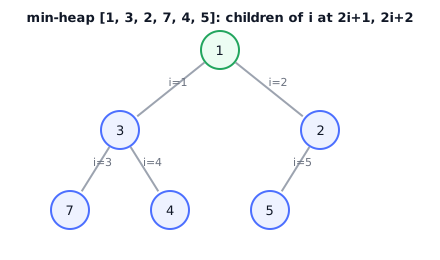
A binary heap is a complete binary tree stored in an array: node i has children at 2i + 1 and 2i + 2 and its parent at (i − 1) // 2. Push appends at the end and sifts up (swap with the parent while smaller): O(log n). Pop moves the last element to the root and sifts down (swap with the smaller child): O(log n). Heapify sifts down every non-leaf from the bottom up, which totals O(n) because most nodes are near the bottom and sift only a little. No pointers and great cache locality: that's why heaps are arrays, not node objects.
⚠️ Common Pitfalls
- Using a max-heap of all n elements for top-k: O(n log n) and O(n) memory instead of O(n log k).
- Forgetting Python's heapq is a min-heap; negate for max-heap behaviour.
- Comparing tuples with uncomparable items (
(priority, dict)with equal priorities fails in Python): add a tiebreak counter. - JS default comparator mistakes in a hand-written heap (compare numbers, not strings).
- Unbalanced two heaps: keep sizes within one after every insertion.
📋 Quick Reference
top-k largest: min-heap; push x; if size > k: pop → root = k-th largest
k-way merge: push (head, list); pop min; push next from same list
median: lo = max-heap (negated), hi = min-heap; |size diff| ≤ 1
children 2i+1, 2i+2 · parent (i-1)//2 · push/pop O(log n) · heapify O(n)Six problems covering the four heap patterns: top-k, simulation, k-way merge, two heaps, and greedy by frequency.
1Kth Largest Element in an Array (LeetCode 215)
🟠 Medium. Return the k-th largest element (in sorted order, not distinct) without fully sorting.
nums = [3,2,1,5,6,4], k = 2 → 5Approach. Keep a min-heap of size k. After processing all numbers, its root is the k-th largest. (Quickselect gives O(n) average if asked.)
Complexity. O(n log k) time, O(k) space.
class MinHeap<T> {
  private a: T[] = [];
  private less: (x: T, y: T) => boolean;
  constructor(less: (x: T, y: T) => boolean = (x: any, y: any) => x < y) { this.less = less; }
  get size(): number { return this.a.length; }
  peek(): T | undefined { return this.a[0]; }
  push(x: T): void {
    const a = this.a; a.push(x);
    let i = a.length - 1;
    while (i > 0) {                                   // sift up
      const p = (i - 1) >> 1;
      if (!this.less(a[i], a[p])) break;
      [a[i], a[p]] = [a[p], a[i]]; i = p;
    }
  }
  pop(): T | undefined {
    const a = this.a; if (!a.length) return undefined;
    const top = a[0], last = a.pop()!;
    if (a.length) {
      a[0] = last; let i = 0;
      while (true) {                                  // sift down
        const l = 2 * i + 1, r = l + 1; let m = i;
        if (l < a.length && this.less(a[l], a[m])) m = l;
        if (r < a.length && this.less(a[r], a[m])) m = r;
        if (m === i) break;
        [a[i], a[m]] = [a[m], a[i]]; i = m;
      }
    }
    return top;
  }
}

function findKthLargest(nums: number[], k: number): number {
  const heap = new MinHeap<number>();
  for (const x of nums) {
    heap.push(x);
    if (heap.size > k) heap.pop();
  }
  return heap.peek()!;
}import heapq
def find_kth_largest(nums, k):
heap = []
for x in nums:
heapq.heappush(heap, x)
if len(heap) > k:
heapq.heappop(heap)
return heap[0]2Last Stone Weight (LeetCode 1046)
🟢 Easy. Repeatedly smash the two heaviest stones: equal stones both vanish, otherwise the difference remains. Return the last stone's weight (0 if none).
[2,7,4,1,8,1] → 1Approach. Max-heap simulation: pop the two largest, push their difference if non-zero.
Complexity. O(n log n) time.
class MinHeap<T> {
  private a: T[] = [];
  private less: (x: T, y: T) => boolean;
  constructor(less: (x: T, y: T) => boolean = (x: any, y: any) => x < y) { this.less = less; }
  get size(): number { return this.a.length; }
  peek(): T | undefined { return this.a[0]; }
  push(x: T): void {
    const a = this.a; a.push(x);
    let i = a.length - 1;
    while (i > 0) {                                   // sift up
      const p = (i - 1) >> 1;
      if (!this.less(a[i], a[p])) break;
      [a[i], a[p]] = [a[p], a[i]]; i = p;
    }
  }
  pop(): T | undefined {
    const a = this.a; if (!a.length) return undefined;
    const top = a[0], last = a.pop()!;
    if (a.length) {
      a[0] = last; let i = 0;
      while (true) {                                  // sift down
        const l = 2 * i + 1, r = l + 1; let m = i;
        if (l < a.length && this.less(a[l], a[m])) m = l;
        if (r < a.length && this.less(a[r], a[m])) m = r;
        if (m === i) break;
        [a[i], a[m]] = [a[m], a[i]]; i = m;
      }
    }
    return top;
  }
}

function lastStoneWeight(stones: number[]): number {
  const heap = new MinHeap<number>((x, y) => x > y);   // max-heap via comparator
  for (const s of stones) heap.push(s);
  while (heap.size > 1) {
    const a = heap.pop()!, b = heap.pop()!;
    if (a !== b) heap.push(a - b);
  }
  return heap.peek() ?? 0;
}import heapq
def last_stone_weight(stones):
h = [-s for s in stones]
heapq.heapify(h)
while len(h) > 1:
a, b = -heapq.heappop(h), -heapq.heappop(h)
if a != b:
heapq.heappush(h, -(a - b))
return -h[0] if h else 03K Closest Points to Origin (LeetCode 973)
🟠 Medium. Return the k points closest to (0, 0). Any order.
points = [[3,3],[5,-1],[-2,4]], k = 2 → [[3,3],[-2,4]]Approach. Max-heap of size k keyed by squared distance (no square root needed): push each point; if the heap exceeds k, pop the farthest.
Complexity. O(n log k) time, O(k) space.
class MinHeap<T> {
  private a: T[] = [];
  private less: (x: T, y: T) => boolean;
  constructor(less: (x: T, y: T) => boolean = (x: any, y: any) => x < y) { this.less = less; }
  get size(): number { return this.a.length; }
  peek(): T | undefined { return this.a[0]; }
  push(x: T): void {
    const a = this.a; a.push(x);
    let i = a.length - 1;
    while (i > 0) {                                   // sift up
      const p = (i - 1) >> 1;
      if (!this.less(a[i], a[p])) break;
      [a[i], a[p]] = [a[p], a[i]]; i = p;
    }
  }
  pop(): T | undefined {
    const a = this.a; if (!a.length) return undefined;
    const top = a[0], last = a.pop()!;
    if (a.length) {
      a[0] = last; let i = 0;
      while (true) {                                  // sift down
        const l = 2 * i + 1, r = l + 1; let m = i;
        if (l < a.length && this.less(a[l], a[m])) m = l;
        if (r < a.length && this.less(a[r], a[m])) m = r;
        if (m === i) break;
        [a[i], a[m]] = [a[m], a[i]]; i = m;
      }
    }
    return top;
  }
}

function kClosest(points: number[][], k: number): number[][] {
  const d = (p: number[]) => p[0] * p[0] + p[1] * p[1];
  const heap = new MinHeap<number[]>((a, b) => d(a) > d(b));   // farthest on top
  for (const p of points) {
    heap.push(p);
    if (heap.size > k) heap.pop();
  }
  const out: number[][] = [];
  while (heap.size) out.push(heap.pop()!);
  return out;
}import heapq
def k_closest(points, k):
heap = [] # (-dist, x, y): a max-heap by distance
for x, y in points:
heapq.heappush(heap, (-(x * x + y * y), x, y))
if len(heap) > k:
heapq.heappop(heap)
return [[x, y] for _, x, y in heap]4Merge k Sorted Lists (LeetCode 23)
🔴 Hard. Merge k sorted linked lists into one sorted list.
[[1,4,5],[1,3,4],[2,6]] → [1,1,2,3,4,4,5,6]Approach. Push the head of every non-empty list into a min-heap (by value, with an index tiebreak). Pop the smallest, append it to the result, and push that node's successor.
Complexity. O(N log k) time for N total nodes, O(k) heap space.
class ListNode {
  val: number;
  next: ListNode | null;
  constructor(val = 0, next: ListNode | null = null) { this.val = val; this.next = next; }
}
function _build(vals: number[]): ListNode | null {
  const dummy = new ListNode(); let cur = dummy;
  for (const v of vals) { cur.next = new ListNode(v); cur = cur.next; }
  return dummy.next;
}
function _toList(node: ListNode | null): number[] {
  const out: number[] = [];
  while (node) { out.push(node.val); node = node.next; }
  return out;
}

class MinHeap<T> {
  private a: T[] = [];
  private less: (x: T, y: T) => boolean;
  constructor(less: (x: T, y: T) => boolean = (x: any, y: any) => x < y) { this.less = less; }
  get size(): number { return this.a.length; }
  peek(): T | undefined { return this.a[0]; }
  push(x: T): void {
    const a = this.a; a.push(x);
    let i = a.length - 1;
    while (i > 0) {                                   // sift up
      const p = (i - 1) >> 1;
      if (!this.less(a[i], a[p])) break;
      [a[i], a[p]] = [a[p], a[i]]; i = p;
    }
  }
  pop(): T | undefined {
    const a = this.a; if (!a.length) return undefined;
    const top = a[0], last = a.pop()!;
    if (a.length) {
      a[0] = last; let i = 0;
      while (true) {                                  // sift down
        const l = 2 * i + 1, r = l + 1; let m = i;
        if (l < a.length && this.less(a[l], a[m])) m = l;
        if (r < a.length && this.less(a[r], a[m])) m = r;
        if (m === i) break;
        [a[i], a[m]] = [a[m], a[i]]; i = m;
      }
    }
    return top;
  }
}

function mergeKLists(lists: (ListNode | null)[]): ListNode | null {
  const heap = new MinHeap<ListNode>((a, b) => a.val < b.val);
  for (const node of lists) if (node) heap.push(node);
  const dummy = new ListNode(); let tail = dummy;
  while (heap.size) {
    const node = heap.pop()!;
    tail.next = node; tail = node;
    if (node.next) heap.push(node.next);
  }
  return dummy.next;
}class ListNode:
def __init__(self, val=0, next=None):
self.val = val
self.next = next
def _build(vals):
dummy = cur = ListNode()
for v in vals:
cur.next = ListNode(v); cur = cur.next
return dummy.next
def _to_list(node):
out = []
while node:
out.append(node.val); node = node.next
return out
import heapq
def merge_k_lists(lists):
heap = [(node.val, i, node) for i, node in enumerate(lists) if node]
heapq.heapify(heap)
dummy = tail = ListNode()
while heap:
val, i, node = heapq.heappop(heap) # i breaks ties (nodes aren't comparable)
tail.next = node; tail = node
if node.next:
heapq.heappush(heap, (node.next.val, i, node.next))
return dummy.next5Find Median from Data Stream (LeetCode 295)
🔴 Hard. Design addNum(num) and findMedian() for a stream of numbers.
addNum(1), addNum(2), findMedian() → 1.5, addNum(3), findMedian() → 2Approach. Two heaps: a max-heap lo for the smaller half and a min-heap hi for the larger half. Push into lo, move its max to hi (keeps every lo ≤ every hi), then rebalance so lo has at most one extra element. The median is lo's top, or the average of both tops.
Complexity. O(log n) per add, O(1) per median.
class MinHeap<T> {
  private a: T[] = [];
  private less: (x: T, y: T) => boolean;
  constructor(less: (x: T, y: T) => boolean = (x: any, y: any) => x < y) { this.less = less; }
  get size(): number { return this.a.length; }
  peek(): T | undefined { return this.a[0]; }
  push(x: T): void {
    const a = this.a; a.push(x);
    let i = a.length - 1;
    while (i > 0) {                                   // sift up
      const p = (i - 1) >> 1;
      if (!this.less(a[i], a[p])) break;
      [a[i], a[p]] = [a[p], a[i]]; i = p;
    }
  }
  pop(): T | undefined {
    const a = this.a; if (!a.length) return undefined;
    const top = a[0], last = a.pop()!;
    if (a.length) {
      a[0] = last; let i = 0;
      while (true) {                                  // sift down
        const l = 2 * i + 1, r = l + 1; let m = i;
        if (l < a.length && this.less(a[l], a[m])) m = l;
        if (r < a.length && this.less(a[r], a[m])) m = r;
        if (m === i) break;
        [a[i], a[m]] = [a[m], a[i]]; i = m;
      }
    }
    return top;
  }
}

class MedianFinder {
  private lo = new MinHeap<number>((a, b) => a > b);   // max-heap: smaller half
  private hi = new MinHeap<number>();                   // min-heap: larger half
  addNum(num: number): void {
    this.lo.push(num);
    this.hi.push(this.lo.pop()!);
    if (this.hi.size > this.lo.size) this.lo.push(this.hi.pop()!);
  }
  findMedian(): number {
    return this.lo.size > this.hi.size ? this.lo.peek()! : (this.lo.peek()! + this.hi.peek()!) / 2;
  }
}import heapq
class MedianFinder:
def __init__(self):
self.lo = [] # max-heap (negated): smaller half
self.hi = [] # min-heap: larger half
def add_num(self, num):
heapq.heappush(self.lo, -num)
heapq.heappush(self.hi, -heapq.heappop(self.lo)) # move lo's max to hi
if len(self.hi) > len(self.lo):
heapq.heappush(self.lo, -heapq.heappop(self.hi)) # keep lo the bigger half
def find_median(self):
if len(self.lo) > len(self.hi):
return float(-self.lo[0])
return (-self.lo[0] + self.hi[0]) / 26Reorganize String (LeetCode 767)
🟠 Medium. Rearrange s so no two adjacent characters are equal; return any valid arrangement or "" if impossible.
"aab" → "aba" · "aaab" → ""Approach. Greedy with a max-heap by remaining count: repeatedly take the most frequent character that differs from the one just placed (hold the previous character out of the heap for one step). Impossible exactly when some count exceeds (n + 1) / 2.
Complexity. O(n log 26) = O(n) time.
class MinHeap<T> {
  private a: T[] = [];
  private less: (x: T, y: T) => boolean;
  constructor(less: (x: T, y: T) => boolean = (x: any, y: any) => x < y) { this.less = less; }
  get size(): number { return this.a.length; }
  peek(): T | undefined { return this.a[0]; }
  push(x: T): void {
    const a = this.a; a.push(x);
    let i = a.length - 1;
    while (i > 0) {                                   // sift up
      const p = (i - 1) >> 1;
      if (!this.less(a[i], a[p])) break;
      [a[i], a[p]] = [a[p], a[i]]; i = p;
    }
  }
  pop(): T | undefined {
    const a = this.a; if (!a.length) return undefined;
    const top = a[0], last = a.pop()!;
    if (a.length) {
      a[0] = last; let i = 0;
      while (true) {                                  // sift down
        const l = 2 * i + 1, r = l + 1; let m = i;
        if (l < a.length && this.less(a[l], a[m])) m = l;
        if (r < a.length && this.less(a[r], a[m])) m = r;
        if (m === i) break;
        [a[i], a[m]] = [a[m], a[i]]; i = m;
      }
    }
    return top;
  }
}

function reorganizeString(s: string): string {
  const counts = new Map<string, number>();
  for (const c of s) counts.set(c, (counts.get(c) ?? 0) + 1);
  const heap = new MinHeap<[number, string]>((a, b) => a[0] > b[0]);   // max by count
  for (const [c, n] of counts) heap.push([n, c]);
  const out: string[] = [];
  let prev: [number, string] | null = null;
  while (heap.size) {
    const [n, c] = heap.pop()!;
    out.push(c);
    if (prev && prev[0] > 0) heap.push(prev);
    prev = [n - 1, c];
  }
  return out.length === s.length ? out.join("") : "";
}import heapq
def reorganize_string(s):
counts = {}
for c in s:
counts[c] = counts.get(c, 0) + 1
heap = [(-n, c) for c, n in counts.items()]
heapq.heapify(heap)
out, prev = [], None # prev = (negcount, char) waiting to re-enter
while heap:
n, c = heapq.heappop(heap)
out.append(c)
if prev and prev[0] < 0:
heapq.heappush(heap, prev)
prev = (n + 1, c) # one fewer of c remaining
return "".join(out) if len(out) == len(s) else ""🧠 Key takeaways
- Heap = O(1) peek, O(log n) push/pop; Python
heapqis a min-heap, JS has none, C# hasPriorityQueue. - Top-k largest → min-heap of size k: O(n log k), works on streams.
- k-way merge, two heaps (median) and greedy by priority cover most heap problems.
- Array layout: children at 2i+1, 2i+2; heapify is O(n).
🛠️ Practice exercises
Each exercise is a file in this topic folder. Code exercises are self-checking: run them and make the checks pass.
✅ Check yourself
Answer the questions — feedback is instant.