Tree Traversals
Most binary-tree interview problems are DFS or BFS plus a small twist. Learn the four traversal orders, recursive and iterative templates, and the top-down vs bottom-up split, then watch traversal order, level-order BFS and Maximum Path Sum animated on real trees.
🎯 What you'll learn
- Preorder, inorder, postorder and level order
- Recursive and iterative DFS, queue-based BFS
- Top-down state vs bottom-up summaries (and both at once)
- Six LeetCode problems up to Maximum Path Sum
📚 Before you start
Trees are where recursion feels most natural: a tree is a root plus two smaller trees. Almost every binary-tree interview problem is one of two traversals with a small twist: depth-first search (DFS: preorder, inorder, postorder), usually written recursively, or breadth-first search (BFS: level by level), written with a queue. The real skill is deciding what each recursive call returns and what information flows down vs up.
1The Node
class TreeNode:
    def __init__(self, val=0, left=None, right=None):
self.val, self.left, self.right = val, left, rightclass TreeNode {
val: number;
left: TreeNode | null;
right: TreeNode | null;
constructor(val = 0, left: TreeNode | null = null, right: TreeNode | null = null) {
this.val = val; this.left = left; this.right = right;
}
}LeetCode serializes trees in level order with nulls: [3,9,20,null,null,15,7] is a root 3 with children 9 and 20, and 20 has children 15 and 7.
2The Four Orders
| Order | Visit | Typical use |
|---|---|---|
| Preorder | node → left → right | copy/serialize a tree, pass state down (path sums, depth) |
| Inorder | left → node → right | BST in sorted order, k-th smallest, validate BST |
| Postorder | left → right → node | compute from children up (height, diameter, subtree sums), delete a tree |
| Level order (BFS) | level by level | per-level answers (averages, right side view), shortest depth |
3Templates
class TreeNode {
  val: number;
  left: TreeNode | null;
  right: TreeNode | null;
  constructor(val = 0, left: TreeNode | null = null, right: TreeNode | null = null) {
    this.val = val; this.left = left; this.right = right;
  }
}
function _tree(level: (number | null)[]): TreeNode | null {
if (!level.length || level[0] === null) return null;
const root = new TreeNode(level[0]); const q: TreeNode[] = [root]; let i = 1;
while (q.length && i < level.length) {
const node = q.shift()!;
if (i < level.length && level[i] !== null) { node.left = new TreeNode(level[i]!); q.push(node.left); }
i++;
if (i < level.length && level[i] !== null) { node.right = new TreeNode(level[i]!); q.push(node.right); }
i++;
}
return root;
}
function _level(root: TreeNode | null): (number | null)[] {
const out: (number | null)[] = []; const q: (TreeNode | null)[] = [root];
while (q.length) { const n = q.shift()!; if (n) { out.push(n.val); q.push(n.left, n.right); } else out.push(null); }
while (out.length && out[out.length - 1] === null) out.pop();
return out;
}
function maxDepth(root: TreeNode | null): number {
return root ? 1 + Math.max(maxDepth(root.left), maxDepth(root.right)) : 0;
}
function inorder(root: TreeNode | null): number[] {
const out: number[] = [], stack: TreeNode[] = [];
let node = root;
while (stack.length || node) {
while (node) { stack.push(node); node = node.left; }
node = stack.pop()!;
out.push(node.val);
node = node.right;
}
return out;
}
function levelOrder(root: TreeNode | null): number[][] {
if (!root) return [];
const res: number[][] = [];
let q: TreeNode[] = [root];
while (q.length) {
res.push(q.map((n) => n.val));
q = q.flatMap((n) => [n.left, n.right].filter((c): c is TreeNode => c !== null));
}
return res;
}
function traversals(level: (number | null)[]): any[] {
const root = _tree(level);
return [maxDepth(root), inorder(root), levelOrder(root)];
}class TreeNode:
def __init__(self, val=0, left=None, right=None):
self.val = val
self.left = left
self.right = right
def _tree(level):
if not level or level[0] is None:
return None
root = TreeNode(level[0]); q = [root]; i = 1
while q and i < len(level):
node = q.pop(0)
if i < len(level) and level[i] is not None:
node.left = TreeNode(level[i]); q.append(node.left)
i += 1
if i < len(level) and level[i] is not None:
node.right = TreeNode(level[i]); q.append(node.right)
i += 1
return root
def _level(root):
out, q = [], [root]
while q:
n = q.pop(0)
if n:
out.append(n.val); q.append(n.left); q.append(n.right)
else:
out.append(None)
while out and out[-1] is None:
out.pop()
return out
from collections import deque
def max_depth(root): # bottom-up: children report, parent combines
if not root:
return 0
return 1 + max(max_depth(root.left), max_depth(root.right))
def inorder(root): # iterative DFS with an explicit stack
out, stack, node = [], [], root
while stack or node:
while node:
stack.append(node); node = node.left
node = stack.pop()
out.append(node.val)
node = node.right
return out
def level_order(root): # BFS, one level per loop iteration
if not root:
return []
res, q = [], deque([root])
while q:
level = []
for _ in range(len(q)):
node = q.popleft()
level.append(node.val)
if node.left: q.append(node.left)
if node.right: q.append(node.right)
res.append(level)
return res
def traversals(level):
root = _tree(level)
return [max_depth(root), inorder(root), level_order(root)]4Top-Down vs Bottom-Up
- Top-down (preorder): pass information down as parameters: current depth, path sum so far, the allowed
(low, high)range for BST validation. Answers are often collected in an outer variable at the leaves. - Bottom-up (postorder): each call returns a summary of its subtree (height, sum, "is balanced"), and the parent combines its children's summaries.
Some problems need both: Diameter and Maximum Path Sum return the best one-sided path upward, while updating a global answer with the best two-sided path through the current node. Recognizing that split is the key insight interviewers look for.
5Recursive vs Iterative
Recursion is shorter and clearer, but uses the call stack (O(h) for tree height h, which is O(n) for a skewed tree). Iterative DFS uses an explicit stack; iterative BFS uses a queue. Be ready to write the iterative inorder (the "go left as far as possible" loop above), as it's a common follow-up.
⚠️ Common Pitfalls
- Missing the null check at the start of a recursive function.
- Confusing height and depth (edges vs nodes; check what the problem counts).
- BFS without fixing the level size: use
for _ in range(len(q))so you process exactly one level per iteration. - Returning the wrong thing in "global answer + return value" problems (return the one-sided path, store the two-sided one).
- Using
queue.shift()in JS inside BFS on big trees: O(n) per shift (swap queues per level instead).
📋 Quick Reference
DFS: if not node: return base; left = f(node.left); right = f(node.right); return combine(node, left, right)
BFS: q = [root]; while q: for _ in range(len(q)): node = q.popleft(); push children
Pre = state down · Post = summaries up · In = sorted order in a BST
O(n) time · O(h) stack for DFS · O(width) queue for BFSSix problems: bottom-up summaries (depth, diameter, max path sum), structural changes, BFS by level, and the classic LCA search.
1Maximum Depth of Binary Tree (LeetCode 104)
🟢 Easy. Return the number of nodes along the longest root-to-leaf path.
[3,9,20,null,null,15,7] → 3Approach. Bottom-up: depth(node) = 1 + max(depth(left), depth(right)); an empty tree has depth 0.
Complexity. O(n) time, O(h) stack.
class TreeNode {
  val: number;
  left: TreeNode | null;
  right: TreeNode | null;
  constructor(val = 0, left: TreeNode | null = null, right: TreeNode | null = null) {
    this.val = val;
    this.left = left;
    this.right = right;
  }
}
function _tree(level: (number | null)[]): TreeNode | null {
  if (!level.length || level[0] === null) return null;
  const root = new TreeNode(level[0]); const q: TreeNode[] = [root]; let i = 1;
  while (q.length && i < level.length) {
    const node = q.shift()!;
    if (i < level.length && level[i] !== null) { node.left = new TreeNode(level[i]!); q.push(node.left); }
    i++;
    if (i < level.length && level[i] !== null) { node.right = new TreeNode(level[i]!); q.push(node.right); }
    i++;
  }
  return root;
}
function _level(root: TreeNode | null): (number | null)[] {
  const out: (number | null)[] = []; const q: (TreeNode | null)[] = [root];
  while (q.length) { const n = q.shift()!; if (n) { out.push(n.val); q.push(n.left, n.right); } else out.push(null); }
  while (out.length && out[out.length - 1] === null) out.pop();
  return out;
}

function maxDepth(root: TreeNode | null): number {
  if (!root) return 0;
  return 1 + Math.max(maxDepth(root.left), maxDepth(root.right));
}class TreeNode:
def __init__(self, val=0, left=None, right=None):
self.val = val
self.left = left
self.right = right
def _tree(level):
if not level or level[0] is None:
return None
root = TreeNode(level[0]); q = [root]; i = 1
while q and i < len(level):
node = q.pop(0)
if i < len(level) and level[i] is not None:
node.left = TreeNode(level[i]); q.append(node.left)
i += 1
if i < len(level) and level[i] is not None:
node.right = TreeNode(level[i]); q.append(node.right)
i += 1
return root
def _level(root):
out, q = [], [root]
while q:
n = q.pop(0)
if n:
out.append(n.val); q.append(n.left); q.append(n.right)
else:
out.append(None)
while out and out[-1] is None:
out.pop()
return out
def max_depth(root):
if not root:
return 0
return 1 + max(max_depth(root.left), max_depth(root.right))2Invert Binary Tree (LeetCode 226)
🟢 Easy. Mirror a binary tree (swap every node's left and right children) and return its root.
[4,2,7,1,3,6,9] → [4,7,2,9,6,3,1]Approach. Swap the children of the current node and recurse into both (any traversal order works).
Complexity. O(n) time, O(h) stack.
class TreeNode {
  val: number;
  left: TreeNode | null;
  right: TreeNode | null;
  constructor(val = 0, left: TreeNode | null = null, right: TreeNode | null = null) {
    this.val = val;
    this.left = left;
    this.right = right;
  }
}
function _tree(level: (number | null)[]): TreeNode | null {
  if (!level.length || level[0] === null) return null;
  const root = new TreeNode(level[0]); const q: TreeNode[] = [root]; let i = 1;
  while (q.length && i < level.length) {
    const node = q.shift()!;
    if (i < level.length && level[i] !== null) { node.left = new TreeNode(level[i]!); q.push(node.left); }
    i++;
    if (i < level.length && level[i] !== null) { node.right = new TreeNode(level[i]!); q.push(node.right); }
    i++;
  }
  return root;
}
function _level(root: TreeNode | null): (number | null)[] {
  const out: (number | null)[] = []; const q: (TreeNode | null)[] = [root];
  while (q.length) { const n = q.shift()!; if (n) { out.push(n.val); q.push(n.left, n.right); } else out.push(null); }
  while (out.length && out[out.length - 1] === null) out.pop();
  return out;
}

function invertTree(root: TreeNode | null): TreeNode | null {
  if (root) [root.left, root.right] = [invertTree(root.right), invertTree(root.left)];
  return root;
}class TreeNode:
def __init__(self, val=0, left=None, right=None):
self.val = val
self.left = left
self.right = right
def _tree(level):
if not level or level[0] is None:
return None
root = TreeNode(level[0]); q = [root]; i = 1
while q and i < len(level):
node = q.pop(0)
if i < len(level) and level[i] is not None:
node.left = TreeNode(level[i]); q.append(node.left)
i += 1
if i < len(level) and level[i] is not None:
node.right = TreeNode(level[i]); q.append(node.right)
i += 1
return root
def _level(root):
out, q = [], [root]
while q:
n = q.pop(0)
if n:
out.append(n.val); q.append(n.left); q.append(n.right)
else:
out.append(None)
while out and out[-1] is None:
out.pop()
return out
def invert_tree(root):
if root:
root.left, root.right = invert_tree(root.right), invert_tree(root.left)
return root3Binary Tree Level Order Traversal (LeetCode 102)
🟠 Medium. Return the node values level by level, left to right.
[3,9,20,null,null,15,7] → [[3],[9,20],[15,7]]Approach. BFS with a queue. Each outer iteration processes exactly the nodes currently in the queue (one level), collecting their values and enqueueing their children.
Complexity. O(n) time, O(width) space.
class TreeNode {
  val: number;
  left: TreeNode | null;
  right: TreeNode | null;
  constructor(val = 0, left: TreeNode | null = null, right: TreeNode | null = null) {
    this.val = val;
    this.left = left;
    this.right = right;
  }
}
function _tree(level: (number | null)[]): TreeNode | null {
  if (!level.length || level[0] === null) return null;
  const root = new TreeNode(level[0]); const q: TreeNode[] = [root]; let i = 1;
  while (q.length && i < level.length) {
    const node = q.shift()!;
    if (i < level.length && level[i] !== null) { node.left = new TreeNode(level[i]!); q.push(node.left); }
    i++;
    if (i < level.length && level[i] !== null) { node.right = new TreeNode(level[i]!); q.push(node.right); }
    i++;
  }
  return root;
}
function _level(root: TreeNode | null): (number | null)[] {
  const out: (number | null)[] = []; const q: (TreeNode | null)[] = [root];
  while (q.length) { const n = q.shift()!; if (n) { out.push(n.val); q.push(n.left, n.right); } else out.push(null); }
  while (out.length && out[out.length - 1] === null) out.pop();
  return out;
}

function levelOrder(root: TreeNode | null): number[][] {
  if (!root) return [];
  const res: number[][] = [];
  let level: TreeNode[] = [root];
  while (level.length) {
    res.push(level.map((n) => n.val));
    const next: TreeNode[] = [];
    for (const n of level) {
      if (n.left) next.push(n.left);
      if (n.right) next.push(n.right);
    }
    level = next;
  }
  return res;
}class TreeNode:
def __init__(self, val=0, left=None, right=None):
self.val = val
self.left = left
self.right = right
def _tree(level):
if not level or level[0] is None:
return None
root = TreeNode(level[0]); q = [root]; i = 1
while q and i < len(level):
node = q.pop(0)
if i < len(level) and level[i] is not None:
node.left = TreeNode(level[i]); q.append(node.left)
i += 1
if i < len(level) and level[i] is not None:
node.right = TreeNode(level[i]); q.append(node.right)
i += 1
return root
def _level(root):
out, q = [], [root]
while q:
n = q.pop(0)
if n:
out.append(n.val); q.append(n.left); q.append(n.right)
else:
out.append(None)
while out and out[-1] is None:
out.pop()
return out
from collections import deque
def level_order(root):
if not root:
return []
res, q = [], deque([root])
while q:
level = []
for _ in range(len(q)):
node = q.popleft()
level.append(node.val)
if node.left: q.append(node.left)
if node.right: q.append(node.right)
res.append(level)
return res4Diameter of Binary Tree (LeetCode 543)
🟢 Easy. Return the length (in edges) of the longest path between any two nodes.
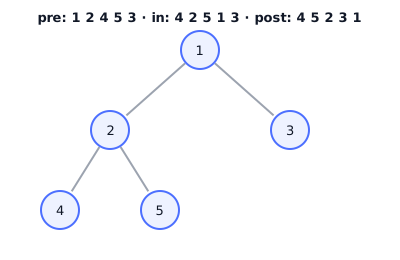
[1,2,3,4,5] → 3 (path 4-2-1-3 or 5-2-1-3)Approach. Postorder: each call returns its height; at each node, the longest path through it is leftHeight + rightHeight, which updates a global maximum. The path doesn't have to pass through the root.
Complexity. O(n) time, O(h) stack.
class TreeNode {
  val: number;
  left: TreeNode | null;
  right: TreeNode | null;
  constructor(val = 0, left: TreeNode | null = null, right: TreeNode | null = null) {
    this.val = val;
    this.left = left;
    this.right = right;
  }
}
function _tree(level: (number | null)[]): TreeNode | null {
  if (!level.length || level[0] === null) return null;
  const root = new TreeNode(level[0]); const q: TreeNode[] = [root]; let i = 1;
  while (q.length && i < level.length) {
    const node = q.shift()!;
    if (i < level.length && level[i] !== null) { node.left = new TreeNode(level[i]!); q.push(node.left); }
    i++;
    if (i < level.length && level[i] !== null) { node.right = new TreeNode(level[i]!); q.push(node.right); }
    i++;
  }
  return root;
}
function _level(root: TreeNode | null): (number | null)[] {
  const out: (number | null)[] = []; const q: (TreeNode | null)[] = [root];
  while (q.length) { const n = q.shift()!; if (n) { out.push(n.val); q.push(n.left, n.right); } else out.push(null); }
  while (out.length && out[out.length - 1] === null) out.pop();
  return out;
}

function diameterOfBinaryTree(root: TreeNode | null): number {
  let best = 0;
  const height = (node: TreeNode | null): number => {
    if (!node) return 0;
    const lh = height(node.left), rh = height(node.right);
    best = Math.max(best, lh + rh);
    return 1 + Math.max(lh, rh);
  };
  height(root);
  return best;
}class TreeNode:
def __init__(self, val=0, left=None, right=None):
self.val = val
self.left = left
self.right = right
def _tree(level):
if not level or level[0] is None:
return None
root = TreeNode(level[0]); q = [root]; i = 1
while q and i < len(level):
node = q.pop(0)
if i < len(level) and level[i] is not None:
node.left = TreeNode(level[i]); q.append(node.left)
i += 1
if i < len(level) and level[i] is not None:
node.right = TreeNode(level[i]); q.append(node.right)
i += 1
return root
def _level(root):
out, q = [], [root]
while q:
n = q.pop(0)
if n:
out.append(n.val); q.append(n.left); q.append(n.right)
else:
out.append(None)
while out and out[-1] is None:
out.pop()
return out
def diameter_of_binary_tree(root):
best = 0
def height(node):
nonlocal best
if not node:
return 0
lh, rh = height(node.left), height(node.right)
best = max(best, lh + rh) # path through this node
return 1 + max(lh, rh) # height reported to the parent
height(root)
return best5Lowest Common Ancestor of a Binary Tree (LeetCode 236)
🟠 Medium. Given two nodes p and q in a binary tree, return their lowest common ancestor (a node can be its own ancestor).
root = [3,5,1,6,2,0,8,null,null,7,4], p = 5, q = 1 → 3Approach. Postorder search: return the node if it is p or q; otherwise recurse left and right. If both sides return something, the current node is the LCA; if only one side does, pass that result up.
Complexity. O(n) time, O(h) stack.
class TreeNode {
  val: number;
  left: TreeNode | null;
  right: TreeNode | null;
  constructor(val = 0, left: TreeNode | null = null, right: TreeNode | null = null) {
    this.val = val;
    this.left = left;
    this.right = right;
  }
}
function _tree(level: (number | null)[]): TreeNode | null {
  if (!level.length || level[0] === null) return null;
  const root = new TreeNode(level[0]); const q: TreeNode[] = [root]; let i = 1;
  while (q.length && i < level.length) {
    const node = q.shift()!;
    if (i < level.length && level[i] !== null) { node.left = new TreeNode(level[i]!); q.push(node.left); }
    i++;
    if (i < level.length && level[i] !== null) { node.right = new TreeNode(level[i]!); q.push(node.right); }
    i++;
  }
  return root;
}
function _level(root: TreeNode | null): (number | null)[] {
  const out: (number | null)[] = []; const q: (TreeNode | null)[] = [root];
  while (q.length) { const n = q.shift()!; if (n) { out.push(n.val); q.push(n.left, n.right); } else out.push(null); }
  while (out.length && out[out.length - 1] === null) out.pop();
  return out;
}

function lowestCommonAncestor(root: TreeNode | null, p: TreeNode, q: TreeNode): TreeNode | null {
  if (!root || root === p || root === q) return root;
  const left = lowestCommonAncestor(root.left, p, q);
  const right = lowestCommonAncestor(root.right, p, q);
  if (left && right) return root;
  return left ?? right;
}class TreeNode:
def __init__(self, val=0, left=None, right=None):
self.val = val
self.left = left
self.right = right
def _tree(level):
if not level or level[0] is None:
return None
root = TreeNode(level[0]); q = [root]; i = 1
while q and i < len(level):
node = q.pop(0)
if i < len(level) and level[i] is not None:
node.left = TreeNode(level[i]); q.append(node.left)
i += 1
if i < len(level) and level[i] is not None:
node.right = TreeNode(level[i]); q.append(node.right)
i += 1
return root
def _level(root):
out, q = [], [root]
while q:
n = q.pop(0)
if n:
out.append(n.val); q.append(n.left); q.append(n.right)
else:
out.append(None)
while out and out[-1] is None:
out.pop()
return out
def lowest_common_ancestor(root, p, q):
if not root or root is p or root is q:
return root
left = lowest_common_ancestor(root.left, p, q)
right = lowest_common_ancestor(root.right, p, q)
if left and right:
return root # p and q are on different sides
return left or right6Binary Tree Maximum Path Sum (LeetCode 124)
🔴 Hard. A path is any sequence of connected nodes (each used once, not necessarily through the root). Return the maximum path sum. Values may be negative.
[-10,9,20,null,null,15,7] → 42 (15 → 20 → 7)Approach. Postorder. gain(node) returns the best sum of a path that starts at node and goes down one side: node.val + max(0, gain(left), gain(right)) (negative branches are dropped with max(0, …)). At each node, the best path through it is node.val + max(0, gainL) + max(0, gainR), which updates the global answer.
Complexity. O(n) time, O(h) stack.
class TreeNode {
  val: number;
  left: TreeNode | null;
  right: TreeNode | null;
  constructor(val = 0, left: TreeNode | null = null, right: TreeNode | null = null) {
    this.val = val;
    this.left = left;
    this.right = right;
  }
}
function _tree(level: (number | null)[]): TreeNode | null {
  if (!level.length || level[0] === null) return null;
  const root = new TreeNode(level[0]); const q: TreeNode[] = [root]; let i = 1;
  while (q.length && i < level.length) {
    const node = q.shift()!;
    if (i < level.length && level[i] !== null) { node.left = new TreeNode(level[i]!); q.push(node.left); }
    i++;
    if (i < level.length && level[i] !== null) { node.right = new TreeNode(level[i]!); q.push(node.right); }
    i++;
  }
  return root;
}
function _level(root: TreeNode | null): (number | null)[] {
  const out: (number | null)[] = []; const q: (TreeNode | null)[] = [root];
  while (q.length) { const n = q.shift()!; if (n) { out.push(n.val); q.push(n.left, n.right); } else out.push(null); }
  while (out.length && out[out.length - 1] === null) out.pop();
  return out;
}

function maxPathSum(root: TreeNode | null): number {
  let best = -Infinity;
  const gain = (node: TreeNode | null): number => {
    if (!node) return 0;
    const left = Math.max(0, gain(node.left)), right = Math.max(0, gain(node.right));
    best = Math.max(best, node.val + left + right);
    return node.val + Math.max(left, right);
  };
  gain(root);
  return best;
}class TreeNode:
def __init__(self, val=0, left=None, right=None):
self.val = val
self.left = left
self.right = right
def _tree(level):
if not level or level[0] is None:
return None
root = TreeNode(level[0]); q = [root]; i = 1
while q and i < len(level):
node = q.pop(0)
if i < len(level) and level[i] is not None:
node.left = TreeNode(level[i]); q.append(node.left)
i += 1
if i < len(level) and level[i] is not None:
node.right = TreeNode(level[i]); q.append(node.right)
i += 1
return root
def _level(root):
out, q = [], [root]
while q:
n = q.pop(0)
if n:
out.append(n.val); q.append(n.left); q.append(n.right)
else:
out.append(None)
while out and out[-1] is None:
out.pop()
return out
def max_path_sum(root):
best = float("-inf")
def gain(node):
nonlocal best
if not node:
return 0
left = max(0, gain(node.left))
right = max(0, gain(node.right))
best = max(best, node.val + left + right) # path bending at this node
return node.val + max(left, right) # one side only, for the parent
gain(root)
return best🧠 Key takeaways
- DFS (pre/in/post) by recursion; BFS by queue, one level per iteration.
- Top-down passes state down as parameters; bottom-up returns subtree summaries.
- Diameter / max path sum: return one side, record both sides in a global answer.
- DFS uses O(h) stack (O(n) when skewed); know the iterative inorder as a follow-up.
🛠️ Practice exercises
Each exercise is a file in this topic folder. Code exercises are self-checking: run them and make the checks pass.
✅ Check yourself
Answer the questions — feedback is instant.