Graph BFS, DFS & Grids
BFS and DFS solve most graph problems in O(V + E). Learn graph representations, when to choose BFS (shortest unweighted paths, multi-source spreading) or DFS (components, flood fill), how to treat grids as graphs, and watch BFS distances, Number of Islands and Rotting Oranges animated.
🎯 What you'll learn
- Adjacency lists, matrices, edge lists and implicit grids
- BFS for shortest unweighted paths; DFS for components
- Multi-source BFS and reverse searches
- Six LeetCode problems up to Word Ladder
📚 Before you start
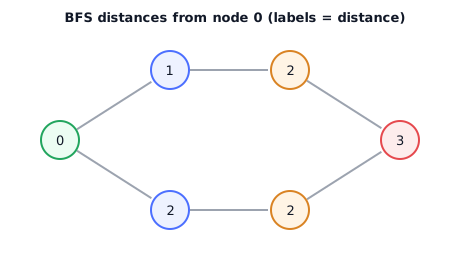
A graph is a set of nodes connected by edges: cities and roads, users and friendships, services and calls, cells in a grid. Two traversals solve most graph interview problems: BFS explores level by level and finds shortest paths in unweighted graphs; DFS goes deep first and is the natural tool for connected components, flood fill, cycle detection and exhaustive search. Both visit each node and edge once: O(V + E).
1Representing a Graph
| Representation | Space | Neighbour iteration | Use when |
|---|---|---|---|
Adjacency list adj[u] = [v, …] | O(V + E) | O(deg u) | almost always (sparse graphs) |
Adjacency matrix m[u][v] | O(V²) | O(V) | dense graphs, O(1) edge checks |
Edge list [(u, v, w)] | O(E) | n/a | Kruskal, Bellman-Ford, input format |
| Implicit grid | none | 4 (or 8) neighbours | islands, mazes, flood fill |
Interview inputs usually arrive as an edge list or a grid; converting to an adjacency list is your first line of code. Ask whether edges are directed and whether the graph may be disconnected (then loop over all nodes as start points).
2Templates
function buildGraph(n: number, edges: number[][]): number[][] {
  const adj: number[][] = Array.from({ length: n }, () => []);
  for (const [a, b] of edges) { adj[a].push(b); adj[b].push(a); }
  return adj;
}

function bfsDist(adj: number[][], src: number): number[] {
  const dist = new Array(adj.length).fill(-1);
  dist[src] = 0;
  const q = [src];
  for (let head = 0; head < q.length; head++) {        // head index: O(1) dequeue
    const u = q[head];
    for (const v of adj[u]) if (dist[v] === -1) { dist[v] = dist[u] + 1; q.push(v); }
  }
  return dist;
}

function countComponents(adj: number[][]): number {
  const seen = new Set<number>();
  let comps = 0;
  for (let s = 0; s < adj.length; s++) {
    if (seen.has(s)) continue;
    comps++;
    const stack = [s]; seen.add(s);
    while (stack.length) {
      const u = stack.pop()!;
      for (const v of adj[u]) if (!seen.has(v)) { seen.add(v); stack.push(v); }
    }
  }
  return comps;
}

function graphDemo(n: number, edges: number[][]): any[] {
  const adj = buildGraph(n, edges);
  return [bfsDist(adj, 0), countComponents(adj)];
}from collections import deque
def build_graph(n, edges): # undirected adjacency list
adj = [[] for _ in range(n)]
for a, b in edges:
adj[a].append(b)
adj[b].append(a)
return adj
def bfs_dist(adj, src): # shortest #edges from src (unweighted)
dist = [-1] * len(adj)
dist[src] = 0
q = deque([src])
while q:
u = q.popleft()
for v in adj[u]:
if dist[v] == -1: # mark when ENQUEUED, not when popped
dist[v] = dist[u] + 1
q.append(v)
return dist
def count_components(adj): # DFS with an explicit stack
seen, comps = set(), 0
for s in range(len(adj)):
if s in seen:
continue
comps += 1
stack = [s]; seen.add(s)
while stack:
u = stack.pop()
for v in adj[u]:
if v not in seen:
seen.add(v); stack.append(v)
return comps
def graph_demo(n, edges):
adj = build_graph(n, edges)
return [bfs_dist(adj, 0), count_components(adj)]3BFS or DFS?
| Question | Use |
|---|---|
| fewest steps / edges, nearest exit, minimum moves | BFS (first time you reach a node is the shortest) |
| spreading from many sources at once (rotting oranges, distance to nearest 0) | multi-source BFS: enqueue all sources first |
| count/label regions, flood fill, does a path exist | DFS or BFS (DFS is shorter to write) |
| detect a cycle, topological order, explore all paths | DFS |
| weighted shortest path | neither alone: Dijkstra (04-shortest_paths) |
4Grids as Graphs
Each cell (r, c) is a node with up to four neighbours. Use a direction list and a bounds check; mark visited cells either in a seen set or by overwriting the grid (e.g. turning land "1" into water "0"), which saves memory but mutates the input (say so).
DIRS = ((1, 0), (-1, 0), (0, 1), (0, -1))
for dr, dc in DIRS:
    nr, nc = r + dr, c + dc
    if 0 <= nr < R and 0 <= nc < C and grid[nr][nc] == "1":
        ...
Under the HoodWhy BFS Finds Shortest Paths▾
BFS processes nodes in non-decreasing distance order: the queue always contains nodes at distance d followed by nodes at distance d + 1, never more than two layers. So the first time a node is discovered, it's via a shortest path. That's also why you mark nodes as visited when enqueuing: marking at pop time lets the same node enter the queue many times (still correct, but O(E) queue entries and slower). DFS has no such ordering, so a DFS path to a node is generally not the shortest.
⚠️ Common Pitfalls
- Forgetting disconnected components: start a traversal from every unvisited node.
- Marking visited too late in BFS (duplicate queue entries) or not at all (infinite loops on cycles).
- Recursion depth in DFS on large grids (10⁶ cells): use an explicit stack in Python.
queue.shift()in JS: O(n) per dequeue; use a head index.- Mutating input grids without saying so.
📋 Quick Reference
adj = [[] for _ in range(n)]; for a,b in edges: adj[a].append(b); adj[b].append(a)
BFS: q=[src]; dist[src]=0; pop u; for v in adj[u]: if unseen: mark, dist, push
DFS: stack/recursion; mark on push; count components by starting from each unseen node
grid: 4 directions + bounds check · multi-source BFS: push all sources first
O(V + E) time · O(V) spaceSix problems: flood fills and region counting on grids, multi-source BFS, deep-copying graphs, reverse searches from the borders, and BFS over an implicit word graph.
1Number of Islands (LeetCode 200)
🟠 Medium. Count islands in a grid of "1" (land) and "0" (water); land connects horizontally and vertically.
4×5 grid with three separate land groups → 3Approach. Scan every cell; when you find unvisited land, it's a new island: increment the count and flood-fill (DFS/BFS) all connected land, marking it visited (here by sinking it to "0").
Complexity. O(R · C) time, O(R · C) worst-case stack/queue.
function numIslands(grid: string[][]): number {
  const R = grid.length, C = grid[0].length;
  let count = 0;
  for (let r = 0; r < R; r++) {
    for (let c = 0; c < C; c++) {
      if (grid[r][c] !== "1") continue;
      count++;
      const stack: [number, number][] = [[r, c]];
      grid[r][c] = "0";
      while (stack.length) {
        const [i, j] = stack.pop()!;
        for (const [di, dj] of [[1, 0], [-1, 0], [0, 1], [0, -1]]) {
          const ni = i + di, nj = j + dj;
          if (ni >= 0 && nj >= 0 && ni < R && nj < C && grid[ni][nj] === "1") {
            grid[ni][nj] = "0";
            stack.push([ni, nj]);
          }
        }
      }
    }
  }
  return count;
}def num_islands(grid):
R, C = len(grid), len(grid[0])
count = 0
for r in range(R):
for c in range(C):
if grid[r][c] != "1":
continue
count += 1
stack = [(r, c)]
grid[r][c] = "0" # sink as we go
while stack:
i, j = stack.pop()
for di, dj in ((1, 0), (-1, 0), (0, 1), (0, -1)):
ni, nj = i + di, j + dj
if 0 <= ni < R and 0 <= nj < C and grid[ni][nj] == "1":
grid[ni][nj] = "0"
stack.append((ni, nj))
return count2Flood Fill (LeetCode 733)
🟢 Easy. Starting at (sr, sc), repaint the connected region of the starting colour with color.
[[1,1,1],[1,1,0],[1,0,1]], start (1,1), color 2 → [[2,2,2],[2,2,0],[2,0,1]]Approach. DFS from the start, recolouring cells that still have the original colour. If the new colour equals the original, return immediately (otherwise the DFS would never terminate).
Complexity. O(R · C) time.
function floodFill(image: number[][], sr: number, sc: number, color: number): number[][] {
  const orig = image[sr][sc];
  if (orig === color) return image;
  const R = image.length, C = image[0].length;
  const stack: [number, number][] = [[sr, sc]];
  while (stack.length) {
    const [r, c] = stack.pop()!;
    if (r < 0 || c < 0 || r >= R || c >= C || image[r][c] !== orig) continue;
    image[r][c] = color;
    stack.push([r + 1, c], [r - 1, c], [r, c + 1], [r, c - 1]);
  }
  return image;
}def flood_fill(image, sr, sc, color):
orig = image[sr][sc]
if orig == color:
return image
R, C = len(image), len(image[0])
stack = [(sr, sc)]
while stack:
r, c = stack.pop()
if 0 <= r < R and 0 <= c < C and image[r][c] == orig:
image[r][c] = color
stack.extend(((r + 1, c), (r - 1, c), (r, c + 1), (r, c - 1)))
return image3Rotting Oranges (LeetCode 994)
🟠 Medium. Each minute, rotten oranges (2) rot their fresh (1) neighbours. Return the minutes until no fresh orange remains, or −1 if impossible.
[[2,1,1],[1,1,0],[0,1,1]] → 4Approach. Multi-source BFS: enqueue every rotten orange at time 0 and count fresh ones. Process the queue level by level; each level is one minute. At the end, any remaining fresh orange means −1.
Complexity. O(R · C) time and space.
function orangesRotting(grid: number[][]): number {
  const R = grid.length, C = grid[0].length;
  let level: [number, number][] = [], fresh = 0;
  for (let r = 0; r < R; r++) for (let c = 0; c < C; c++) {
    if (grid[r][c] === 2) level.push([r, c]);
    else if (grid[r][c] === 1) fresh++;
  }
  let minutes = 0;
  while (level.length && fresh) {
    const next: [number, number][] = [];
    for (const [r, c] of level) {
      for (const [dr, dc] of [[1, 0], [-1, 0], [0, 1], [0, -1]]) {
        const nr = r + dr, nc = c + dc;
        if (nr >= 0 && nc >= 0 && nr < R && nc < C && grid[nr][nc] === 1) {
          grid[nr][nc] = 2; fresh--; next.push([nr, nc]);
        }
      }
    }
    level = next;
    minutes++;
  }
  return fresh === 0 ? minutes : -1;
}from collections import deque
def oranges_rotting(grid):
R, C = len(grid), len(grid[0])
q, fresh = deque(), 0
for r in range(R):
for c in range(C):
if grid[r][c] == 2:
q.append((r, c))
elif grid[r][c] == 1:
fresh += 1
minutes = 0
while q and fresh:
for _ in range(len(q)): # one minute = one BFS level
r, c = q.popleft()
for dr, dc in ((1, 0), (-1, 0), (0, 1), (0, -1)):
nr, nc = r + dr, c + dc
if 0 <= nr < R and 0 <= nc < C and grid[nr][nc] == 1:
grid[nr][nc] = 2
fresh -= 1
q.append((nr, nc))
minutes += 1
return minutes if fresh == 0 else -14Clone Graph (LeetCode 133)
🟠 Medium. Return a deep copy of a connected undirected graph given a reference to one node (each node has a value and a list of neighbours).
adjacency [[2,4],[1,3],[2,4],[1,3]] → an identical, separate graphApproach. DFS/BFS with a map from original node to its clone. When visiting a node, create its clone if missing, then connect the clone to the clones of all neighbours. The map doubles as the visited set and handles cycles.
Complexity. O(V + E) time and space.
class GNode {
  val: number;
  neighbors: GNode[];
  constructor(val = 0, neighbors: GNode[] = []) { this.val = val; this.neighbors = neighbors; }
}

function cloneGraph(node: GNode | null): GNode | null {
  if (!node) return null;
  const clones = new Map<GNode, GNode>([[node, new GNode(node.val)]]);
  const stack = [node];
  while (stack.length) {
    const cur = stack.pop()!;
    for (const nb of cur.neighbors) {
      if (!clones.has(nb)) { clones.set(nb, new GNode(nb.val)); stack.push(nb); }
      clones.get(cur)!.neighbors.push(clones.get(nb)!);
    }
  }
  return clones.get(node)!;
}class Node:
def __init__(self, val=0, neighbors=None):
self.val = val
self.neighbors = neighbors or []
def clone_graph(node):
if not node:
return None
clones = {node: Node(node.val)}
stack = [node]
while stack:
cur = stack.pop()
for nb in cur.neighbors:
if nb not in clones:
clones[nb] = Node(nb.val)
stack.append(nb)
clones[cur].neighbors.append(clones[nb])
return clones[node]5Pacific Atlantic Water Flow (LeetCode 417)
🟠 Medium. Water flows from a cell to neighbours of equal or lower height. Return cells from which water can reach both the Pacific (top/left edges) and the Atlantic (bottom/right edges).
5×5 heights → [[0,4],[1,3],[1,4],[2,2],[3,0],[3,1],[4,0]]Approach. Reverse the flow: run a DFS/BFS from each ocean's border cells uphill (to neighbours with height ≥ current). Cells reached by both searches are the answer. Two traversals instead of one search per cell.
Complexity. O(R · C) time and space.
function pacificAtlantic(heights: number[][]): number[][] {
  const R = heights.length, C = heights[0].length;
  const reach = (starts: [number, number][]): boolean[][] => {
    const seen = Array.from({ length: R }, () => new Array(C).fill(false));
    const stack = [...starts];
    for (const [r, c] of starts) seen[r][c] = true;
    while (stack.length) {
      const [r, c] = stack.pop()!;
      for (const [dr, dc] of [[1, 0], [-1, 0], [0, 1], [0, -1]]) {
        const nr = r + dr, nc = c + dc;
        if (nr >= 0 && nc >= 0 && nr < R && nc < C && !seen[nr][nc] && heights[nr][nc] >= heights[r][c]) {
          seen[nr][nc] = true; stack.push([nr, nc]);
        }
      }
    }
    return seen;
  };
  const border = (top: boolean): [number, number][] => {
    const s: [number, number][] = [];
    for (let c = 0; c < C; c++) s.push([top ? 0 : R - 1, c]);
    for (let r = 0; r < R; r++) s.push([r, top ? 0 : C - 1]);
    return s;
  };
  const pac = reach(border(true)), atl = reach(border(false));
  const res: number[][] = [];
  for (let r = 0; r < R; r++) for (let c = 0; c < C; c++) if (pac[r][c] && atl[r][c]) res.push([r, c]);
  return res;
}def pacific_atlantic(heights):
R, C = len(heights), len(heights[0])
def reach(starts):
seen = set(starts)
stack = list(starts)
while stack:
r, c = stack.pop()
for dr, dc in ((1, 0), (-1, 0), (0, 1), (0, -1)):
nr, nc = r + dr, c + dc
if 0 <= nr < R and 0 <= nc < C and (nr, nc) not in seen and heights[nr][nc] >= heights[r][c]:
seen.add((nr, nc))
stack.append((nr, nc))
return seen
pac = reach([(0, c) for c in range(C)] + [(r, 0) for r in range(R)])
atl = reach([(R - 1, c) for c in range(C)] + [(r, C - 1) for r in range(R)])
return [[r, c] for r, c in pac & atl]6Word Ladder (LeetCode 127)
🔴 Hard. Return the number of words in the shortest transformation sequence from beginWord to endWord, changing one letter at a time, where every intermediate word is in wordList (0 if impossible).
"hit" → "cog" with [hot,dot,dog,lot,log,cog] → 5 (hit → hot → dot → dog → cog)Approach. BFS over words: neighbours differ by one letter. Generate neighbours by trying all 26 letters at each position and keeping those in the word set (remove them when enqueued, as the visited mark). The BFS level when endWord is reached is the answer.
Complexity. O(N · L · 26) time for N words of length L.
function ladderLength(begin: string, end: string, wordList: string[]): number {
  const words = new Set(wordList);
  if (!words.has(end)) return 0;
  let level = [begin], steps = 1;
  while (level.length) {
    const next: string[] = [];
    for (const word of level) {
      if (word === end) return steps;
      for (let i = 0; i < word.length; i++) {
        for (let k = 0; k < 26; k++) {
          const nxt = word.slice(0, i) + String.fromCharCode(97 + k) + word.slice(i + 1);
          if (words.has(nxt)) { words.delete(nxt); next.push(nxt); }
        }
      }
    }
    level = next;
    steps++;
  }
  return 0;
}from collections import deque
def ladder_length(begin, end, word_list):
words = set(word_list)
if end not in words:
return 0
q = deque([(begin, 1)])
while q:
word, steps = q.popleft()
if word == end:
return steps
for i in range(len(word)):
for ch in "abcdefghijklmnopqrstuvwxyz":
nxt = word[:i] + ch + word[i + 1:]
if nxt in words:
words.remove(nxt) # visited
q.append((nxt, steps + 1))
return 0🧠 Key takeaways
- Convert inputs to an adjacency list; grids are graphs with 4 implicit neighbours.
- BFS = shortest path in unweighted graphs (mark visited when enqueuing).
- DFS = components, flood fill, cycles; use an explicit stack for big inputs.
- Multi-source BFS spreads from all sources at once; reverse searches start from the goal.
🛠️ Practice exercises
Each exercise is a file in this topic folder. Code exercises are self-checking: run them and make the checks pass.
✅ Check yourself
Answer the questions — feedback is instant.