Idempotency
Networks fail after the server has done the work, and clients retry. See a retried POST double-charge a customer, then fix it with idempotency keys that replay the original response and reject concurrent duplicates.
🎯 What you'll learn
- What idempotency means (same effect, not same response)
- Which methods are idempotent by spec; why PATCH is tricky
- Idempotency keys: storage, scope and expiry
- Natural vs enforced idempotency and client retry strategy
📚 Before you start
1What Idempotency Actually Means
An operation is idempotent if performing it multiple times has the same effect as performing it once. This is a statement about effect on state, not about the response body being identical byte-for-byte.
DELETE /orders/42   -> first call: order deleted, 204
                    -> second call: order already gone, 404 (or 204 again)
                    -> EITHER response is fine — the STATE is identical after 1 or N calls
Idempotency matters because networks are unreliable: a client sends a request, the server processes it successfully, but the response is lost (timeout, connection reset, proxy hiccup) before the client sees it. The client, unable to distinguish "my request never arrived" from "it arrived and succeeded but the reply got lost," has exactly one safe move: retry. Idempotency is what makes that retry harmless instead of catastrophic.
2Which HTTP Methods Are Idempotent by Specification
| Method | Idempotent? | Why |
|---|---|---|
GET | Yes | Read-only, no state change |
PUT | Yes | Replaces a resource with a given representation — replacing it again with the same representation is a no-op |
DELETE | Yes | Deleting an already-deleted resource leaves the same end state |
HEAD, OPTIONS | Yes | Read-only |
PATCH | Not guaranteed | Depends entirely on the patch semantics — see section 3 |
POST | Not idempotent | Conventionally creates a new resource each time — this is the entire problem this topic addresses |
This table is a specification promise, not an automatic property of your code — see Under the Hood for exactly how a naive PUT handler can quietly violate it.
3Why PATCH Is the Dangerous Middle Case
// Idempotent PATCH — absolute assignment
PATCH /accounts/1  { "status": "active" }
// running this 1 time or 100 times leaves status="active" either way

// NON-idempotent PATCH — relative operation disguised as a patch
PATCH /accounts/1  { "balance_delta": +50 }
// running this once: balance += 50
// running this twice (a retried request): balance += 100 — DOUBLE CHARGED
The syntax looks the same (a PATCH with a JSON body); the semantics are opposite. This is precisely the case idempotency keys (section 4) exist to fix — you cannot make balance_delta idempotent by construction without changing the API, but you can make retrying the same balance_delta request safe.
4Idempotency Keys
For POST (and any operation with delta/relative semantics), the client generates a unique key — typically a UUID — and sends it with the request:
POST /payments
Idempotency-Key: 7b9e6e2c-3f1a-4c9a-9e2b-1a2b3c4d5e6f
Content-Type: application/json

{ "amount_cents": 4999, "account_id": "acct_88" }
Server-side contract:
1. Look up the key in an idempotency store.
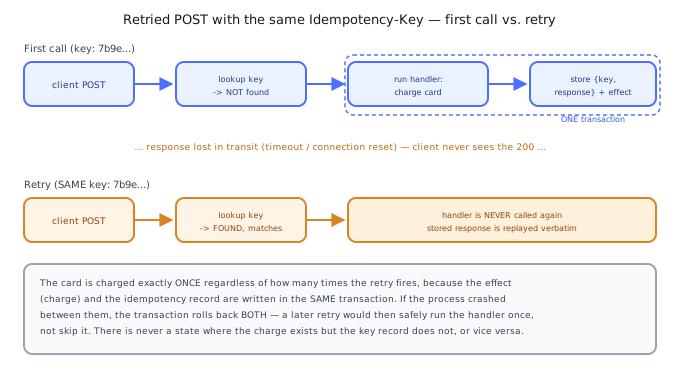
2. If found AND the stored request matches this one -> return the STORED response. Do not re-run the handler.
3. If found AND the stored request does NOT match (same key, different body) -> 422/409, this is a client bug (key reuse).
4. If not found -> run the handler, store {key, request_fingerprint, response, status} atomically with the effect, THEN return the response.async function handleWithIdempotency(key: string, body: unknown, handler: () => Promise<Response>) {
const existing = await store.get(key);
if (existing) {
if (existing.fingerprint !== fingerprint(body)) {
throw new ConflictError("idempotency key reused with a different request body");
}
return existing.response; // replay — handler never runs again
}
return await runInTransaction(async (tx) => {
const response = await handler(); // the actual side effect: charge card, create order, etc.
await store.put(tx, key, fingerprint(body), response); // SAME transaction — see Under the Hood
return response;
});
}The retried request never reaches the "real" logic a second time — it's intercepted and answered from the store. This is the mechanism that turns a non-idempotent POST /payments into something safe to retry blindly.
5Where the Key Comes From and Its Scope
- Client-generated, not server-generated — the whole point is the client can retry with the same key without a round trip to obtain one first.
- Scoped, usually per API credential/account — the same UUID from two different customers must not collide.
- Given an expiry — stores typically retain keys for 24 hours to a few days, not forever; a legitimate new payment with an accidentally-reused key from a week ago should succeed, not be replayed as ancient stale state.
Idempotency-Key: <uuid>              -- client generates, sends verbatim
Store key = hash(account_id + ":" + idempotency_key)
Store TTL = 24h (typical; document your own)6Natural Idempotency vs. Enforced Idempotency
Two different techniques solve two different shapes of the problem:
Natural idempotency — design the operation itself so repeating it is a no-op, no key needed:
PUT /users/42/roles/admin     -- "ensure user 42 has role admin" — repeat freely
DELETE /users/42/roles/admin  -- "ensure user 42 lacks role admin" — repeat freely
Enforced idempotency (idempotency keys) — the operation is inherently a delta or a creation event (POST /payments, POST /orders) and cannot be redesigned as a "set" operation without losing meaning (you cannot "PUT the state of having charged $50" — the charge is the event).
Prefer natural idempotency wherever the domain allows it — it needs no store, no key management, no TTL policy, and works for every client automatically instead of only clients disciplined enough to send keys.
7Client-Side Retry Strategy
Idempotency keys only pay off paired with a sane client retry policy:
async function postWithRetry(body: unknown, maxAttempts = 3): Promise<Response> {
  const key = crypto.randomUUID(); // ONE key for the whole retry sequence
  for (let attempt = 1; attempt <= maxAttempts; attempt++) {
    try {
      return await fetch("/payments", {
        method: "POST",
        headers: { "Idempotency-Key": key },
        body: JSON.stringify(body),
      });
    } catch (e) {
      if (attempt === maxAttempts) throw e;
      await sleep(backoff(attempt)); // exponential backoff, not immediate retry
    }
  }
  throw new Error("unreachable");
}
The key is generated once outside the loop, not per attempt — generating a fresh key on each retry defeats the entire mechanism, because the server sees each attempt as a brand-new, never-seen request.
Under the HoodHow it works internally▾
The idempotency record must be written in the SAME transaction as the effect
The single most common bug in a real idempotency implementation is a race between "perform the effect" and "record that the key was used" as two separate operations:
BROKEN (two separate steps):
  1. charge the card                     <-- succeeds
  2. crash / process killed / network blip
  3. idempotency record never written
  4. client, having gotten no response, retries with the SAME key
  5. lookup finds nothing (step 3 never happened) -> handler runs AGAIN -> double charge
The fix is to make the effect and the idempotency-store write one atomic unit — either both commit or neither does:
BEGIN;
  INSERT INTO charges (id, account_id, amount_cents) VALUES ($1, $2, $3);
  INSERT INTO idempotency_keys (key, account_id, fingerprint, response_body, status_code)
    VALUES ($4, $2, $5, $6, $7);
COMMIT;
If the process crashes between the charge insert and the idempotency_keys insert, the transaction rolls back both — there is never a state where the charge exists but the key record doesn't (or vice versa). A retry after a crash at any point before COMMIT sees no record and safely re-runs the whole thing exactly once; a retry after COMMIT sees the record and replays. This is the entire reason idempotency keys must live in the same datastore/transaction boundary as the business effect — a separate cache (Redis, an in-memory map) that isn't part of the same transaction reintroduces exactly the race it was meant to close, because "write the charge" and "write the key" become two independent points of failure again.
Distributed/two-phase variant: reserve-then-commit
When the effect and the key store genuinely can't share one transaction (e.g. the charge happens via a third-party payment processor's API call, which cannot be transactional with your own database), the pattern splits into two phases with the key row as the source of truth for which phase you're in:
1. INSERT idempotency_keys(key, status='processing') -- reserve the key FIRST, before the side effect
2. call the external payment processor                -- the actual non-transactional effect
3. UPDATE idempotency_keys SET status='completed', response=... WHERE key=$1
A retry that finds status='processing' (not yet 'completed') means a previous attempt is still in flight or crashed mid-flight — the safe response is typically to poll/wait briefly rather than either replaying a response that doesn't exist yet or re-calling the external processor and risking a real double charge.
Fingerprinting the request, not just the key
Storing only the key (not a fingerprint/hash of the request body) opens a subtle hole: a client bug that reuses a key across two different logical requests (e.g. a UUID generator seeded incorrectly, or the key hardcoded during testing) causes the second request to silently receive the first request's response instead of an error. Hashing the meaningful part of the request body and comparing it on every lookup converts that class of client bug from silent data corruption into a loud, immediate 409/422 — exactly the guard shown in section 4's step 3.
Idempotency vs. HTTP caching — a common confusion
Idempotency and caching solve different problems and are sometimes conflated because both involve "the same request returning the same thing." A GET is idempotent by specification regardless of caching — caching decides whether the server is even asked again; idempotency decides what happens to state if it is asked again. An idempotency-key store on a POST is not a cache in the HTTP sense (no Cache-Control, no shared/public semantics) — it's a private, per-credential replay guard.
⚠️ Common Pitfalls
- Generating a new idempotency key on every retry attempt. As shown in section 7, this defeats the mechanism completely — each "retry" looks like a fresh, unique request to the server.
- Writing the idempotency record in a separate transaction (or a different datastore) from the effect. This is the exact race condition detailed in Under the Hood — the two can get out of sync under a crash.
- Treating
PATCHas automatically idempotent. As section 3 shows, a delta-stylePATCHbody is exactly as dangerous to retry blindly asPOST— it needs the same key-based protection. - No fingerprint check on key reuse. Silently replaying a stored response for a different request body (because only the key was checked) hides real client bugs as successful-looking responses.
- No TTL on stored keys — or too short a TTL. Forever-retained keys grow the store unboundedly; too-short a TTL lets a legitimately delayed retry (a mobile client reconnecting after being offline for an hour) fall through and double-execute.
- Assuming natural idempotency where the domain doesn't have it.
POST /orderscannot be made naturally idempotent by wishing — creating "the same order" twice by definition creates two orders unless a key (or a natural dedup field, like a client-supplied order UUID used as the primary key) makes the second attempt a no-op. - Only documenting idempotency keys for payment endpoints. Any
POSTwith a real-world side effect that's expensive or irreversible to duplicate (sending an email, provisioning a resource, charging a card) benefits from the same pattern — payments are just the case everyone remembers.
📋 Quick Reference
Idempotent by spec        GET, PUT, DELETE, HEAD, OPTIONS
Not idempotent by spec    POST         -- and PATCH, conditionally (see below)
PATCH is idempotent       IFF it's an absolute assignment ({"status":"active"})
PATCH is NOT idempotent   IFF it's a delta/relative op ({"balance_delta": +50})

Idempotency-Key: <client-generated UUID>, ONE key per logical retry sequence
Server contract:
  found + fingerprint matches    -> replay stored response, don't re-run handler
  found + fingerprint mismatches -> 409/422, key reuse is a client bug
  not found                      -> run handler; write {key, fingerprint, response}
                                     in the SAME transaction as the effect

Natural idempotency   PUT/DELETE on a well-designed resource — no store needed, prefer this
Enforced idempotency  idempotency-key store — needed for POST / delta PATCH

Distributed effect    reserve key (status=processing) -> call external system -> mark completed
Client retry          generate key ONCE outside the retry loop; exponential backoff
🧠 Key takeaways
- Idempotent = repeating a request has the same effect as doing it once.
- GET/PUT/DELETE are idempotent by spec; POST and PATCH need help.
- Idempotency keys: client-generated UUID, unique insert, store response, replay; scope per account/endpoint; expire after ~24h.
- Prefer natural idempotency (PUT by ID, upserts, unique constraints) where possible; retry with backoff.
🎤 Interview Q&A
Q1What is idempotency and why does it matter for APIs?core▾
An operation is idempotent if repeating it has the same effect as doing it once. Networks fail and clients retry, so idempotency ensures retries don't create duplicate orders or charges.
- Which HTTP methods are idempotent? GET, HEAD, PUT, DELETE, OPTIONS; POST isn't by default.
Q2How do you implement idempotency keys for POST?core▾
The client sends Idempotency-Key: <uuid>. The server stores the key with a hash of the request and the response. A repeat with the same key returns the stored response; same key with a different body returns 422; concurrent duplicates wait or get 409 while the first is in progress.
- Where is the key stored? In the database, ideally in the same transaction as the business write.
Q3How long should idempotency keys be kept?core▾
Longer than clients' retry windows, commonly 24 hours to a few days, then expire them to bound storage.
- Scope? Per client/account, so different customers can't collide.
Q4How do you make consumers of messages idempotent?senior▾
Record processed message IDs in a dedupe table in the same transaction as the side effect, use upserts and conditional updates, and design state-setting operations rather than increments.
- Natural idempotency example?
SET status = 'paid'vsbalance = balance + 10.
Q5Is PUT always safe to retry?core▾
Semantically yes, but with concurrent writers a retried PUT can overwrite someone else's newer change. Combine with ETags/If-Match for optimistic concurrency.
- What does the server return when the ETag doesn't match? 412 Precondition Failed.
🛠️ Practice exercises
Each exercise is a file in this topic folder. Code exercises are self-checking: run them and make the checks pass.
✅ Check yourself
Answer the questions — feedback is instant.