Scalability Patterns
The standard toolbox for growing a system: stateless horizontal scaling, read replicas, sharding, caching and queue-based load leveling. See what each pattern scales (and what it doesn't), then watch them compose into one architecture.
🎯 What you'll learn
- Vertical vs horizontal scaling and why statelessness matters
- Read replicas (reads) vs sharding (writes)
- Caching layers and queue-based load leveling
- How the patterns compose, and their failure modes
📚 Before you start
1Vertical vs Horizontal Scaling
Vertical scaling (scaling up) means giving one instance more resources — more CPU, more RAM, a faster disk. Horizontal scaling (scaling out) means adding more instances and spreading load across them.
Vertical:    [1 server: 4 CPU, 16GB]  ->  [1 server: 32 CPU, 128GB]
Horizontal:  [1 server]  ->  [1 server] [server] [server] [server]  (load balanced)
Vertical scaling is simpler (no distribution logic needed, nothing about the application has to change) but has a hard ceiling — there's a largest machine you can buy, at rapidly increasing cost per unit of additional capacity — and it does nothing for fault tolerance: one bigger server is still one server, still a single point of failure (see the previous topic). Horizontal scaling has no comparable hard ceiling (add another instance) and directly buys redundancy alongside capacity, but it only works cleanly if the thing being scaled can actually be split across multiple instances — which is precisely where the next section matters.
2Statelessness: The Precondition for Horizontal Scaling
A stateless service instance holds no data in memory that would be lost, or would differ from another instance, between requests — every request carries (or looks up externally) everything needed to handle it. This is what makes horizontal scaling trivial for the application tier: any instance can handle any request, so a load balancer can distribute traffic however it wants, and adding/removing instances is just a capacity change, not a data-migration problem.
// STATEFUL (bad for horizontal scaling): session stored in this process's memory
const sessions = new Map<string, UserSession>(); // lives ONLY on this one instance
app.get("/profile", (req, res) => {
  const session = sessions.get(req.cookies.sessionId); // a DIFFERENT instance has no idea this session exists
  res.json(session.user);
});

// STATELESS: session stored in a shared store every instance can reach
app.get("/profile", async (req, res) => {
  const session = await redisClient.get(req.cookies.sessionId); // any instance gets the same answer
  res.json(JSON.parse(session).user);
});
The stateful version breaks the moment a load balancer routes two requests from the same user to two different instances — one has their session, the other doesn't. The stateless version works identically no matter which instance handles the request, which is exactly the property that makes "just add more instances" a safe, mechanical scaling move rather than a data-consistency problem. This is why real systems push state out of the application tier entirely — into a database, a cache like Redis, or a dedicated session store — keeping the application instances themselves freely, cheaply horizontally scalable.
3Scaling the Data Layer: Read Replicas
The application tier being stateless doesn't automatically solve scaling for the database itself, which by definition DOES hold state. A common first step: read replicas — copies of the primary database that stay continuously updated (via replication) and serve read-only queries, while writes still go to the single primary:
                    writes
Application  ────────────────────▶  [Primary DB]
                                          │ replication (continuous)
                    reads                ▼
Application  ─────────────────▶  [Read Replica 1] [Read Replica 2] [Read Replica 3]
This works well when a system is read-heavy (true of most web applications — far more page views than writes), letting read capacity scale horizontally (add more replicas) while writes remain centralized and simple. The tradeoff: replicas usually lag the primary by some small amount (replication isn't instantaneous), so a read immediately after a write can return stale data unless the application specifically routes that read to the primary — an eventual-consistency tradeoff, conceptually the same shape as the CAP theorem topic's AP choice, applied specifically to read-replica lag.
Every replica applies every write the primary makes. If the primary is write-bound, adding replicas adds load to it (more replication streams) and fixes nothing. That's sharding's job.
4Scaling the Data Layer: Sharding/Partitioning
Read replicas don't help with write throughput — every replica still receives the same writes from the one primary, so the primary's write capacity is still a ceiling. Sharding (partitioning) splits the data itself across multiple independent database instances, each owning a subset of the data, so writes for different shards can happen in parallel on entirely separate machines:
Shard by user_id range:
  [Shard A: users 1-1,000,000]     [Shard B: users 1,000,001-2,000,000]     [Shard C: ...]

A write for user 500,000 only touches Shard A's database -- it never contends
with a write for user 1,500,000 on Shard B. Total write throughput scales
with the NUMBER of shards, not the capacity of one machine.
Sharding buys real horizontal write scalability, at real cost: queries that need to span multiple shards (e.g. "find all users across the whole system matching X") become significantly harder, and choosing a shard key that distributes load evenly (avoiding a "hot shard" that gets disproportionate traffic) is a real design problem, not an afterthought.
5Caching Layers
Adding a cache in front of a database (or an expensive computation) absorbs read traffic before it ever reaches the underlying data store, which is often the cheapest, highest-leverage scaling move available for read-heavy workloads — a cache hit costs a fraction of a full database query, and every cache hit is one query the database never has to handle at all. The full mechanics (invalidation strategies, TTLs, cache-aside vs write-through) belong to the dedicated caching topics in this curriculum (databases/caching/) — the scaling-relevant point here is narrower: caching doesn't just make individual requests faster, it directly reduces the load the data layer itself needs to scale to handle, which is often a cheaper lever to pull than scaling the database horizontally at all.
6Queue-Based Load Leveling
For work that doesn't need to happen synchronously within a request/response cycle, putting a queue between the producer of work and the thing that processes it decouples the rate work arrives from the rate it's processed, letting the processing side scale independently and absorb bursts without the producer-facing request ever slowing down:
Request arrives -> API enqueues a job (fast, returns immediately) -> responds to caller
                                    │
                                    ▼
                            [Job Queue]  <- absorbs bursts; this is exactly the
                                    │        earlier Backpressure topic's bounded
                                    ▼        queue, applied here as a scaling tool
                        [N worker instances, scaled independently of the API tier]
This is the same queue-based decoupling from the Backpressure topic, viewed from a scaling angle rather than a stability angle: because the API tier's job is now just "accept work and enqueue it" (fast, cheap, stateless), it can be scaled independently of the worker tier, and the worker tier's instance count can be scaled based on queue depth (more backlog -> spin up more workers) rather than needing to match the API tier's instance count at all.
7How These Patterns Compose
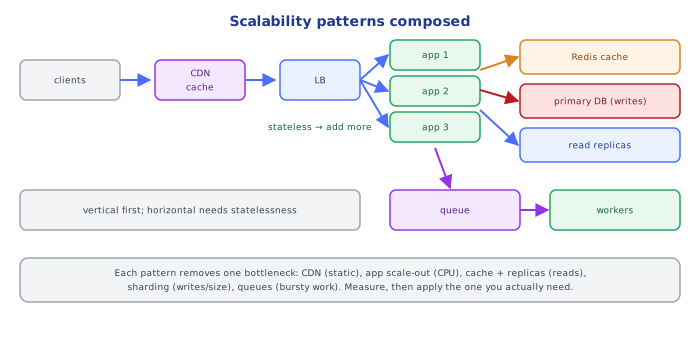
None of these patterns are mutually exclusive — a mature, scaled system typically layers several together: a stateless, horizontally-scaled API tier, sitting behind a cache that absorbs most read traffic, backed by a primary database with read replicas for the remaining read load, sharded if write volume demands it, with a queue decoupling any asynchronous/bursty work into an independently-scaled worker tier — with circuit breakers and bulkheads (previous topics) protecting each of those layers from cascading failures in the others, and backpressure (an earlier topic) governing what happens when even that scaled-out capacity is temporarily exceeded.
⚠️ Common Pitfalls
- Relying on vertical scaling indefinitely — it has a real ceiling, rapidly worsening cost-per-unit-capacity as you approach it, and buys zero fault tolerance no matter how large the single machine gets.
- Keeping state in application-instance memory "just for this one feature" — silently breaks horizontal scaling for exactly that feature the moment a load balancer routes two related requests to two different instances.
- Adding read replicas to fix a WRITE throughput problem — replicas only scale reads; a write-bottlenecked system needs sharding (or a fundamentally different write path), not more replicas.
- Sharding on a key that produces a hot shard — e.g. sharding by signup date when a huge fraction of active users signed up recently concentrates load on one shard, defeating the purpose of splitting the data at all.
- Treating a queue as a magic scaling fix without addressing what happens when the queue itself backs up — a queue absorbs bursts, but an under-scaled worker tier behind it still needs the same backpressure discipline from the earlier topic; a queue with no bound and no worker autoscaling just relocates the overload problem, it doesn't solve it.
📋 Quick Reference
Vertical scaling: bigger machine -- simple, hard ceiling, zero fault-tolerance benefit
Horizontal scaling: more machines -- requires statelessness, no comparable ceiling, buys redundancy

Statelessness = precondition for horizontal app-tier scaling: no per-instance memory state,
                shared external store (DB/cache/session store) instead

Read replicas: scale READS, not writes; replicas lag the primary (eventual consistency)
Sharding: scale WRITES by splitting data across independent DBs; cross-shard queries get harder
Caching: absorbs read load before it reaches the data layer at all -- often the cheapest lever
Queue-based load leveling: decouples work arrival rate from processing rate, scales independently

Real systems LAYER these together, with backpressure/circuit-breaking/bulkheading protecting
the seams between layers
🧠 Key takeaways
- Horizontal scaling needs stateless services; vertical scaling hits a ceiling and gives no redundancy.
- Read replicas scale reads (with lag); sharding scales writes (cross-shard queries get hard).
- Caching is often the cheapest lever; queues decouple arrival rate from processing rate.
- Real systems layer these patterns, protected by backpressure, circuit breakers and bulkheads.
🎤 Interview Q&A
Q1What are the main scalability patterns?core▾
Horizontal scaling of stateless services, caching (CDN, application, database), read replicas, sharding/partitioning, asynchronous processing with queues, CQRS (separate read and write models), and denormalization or precomputation of expensive reads.
- Which do you reach for first? Caching and stateless horizontal scaling: biggest win for least complexity.
Q2What is CQRS and when is it worth it?core▾
Command Query Responsibility Segregation separates the write model (commands, validation, normalized data) from read models optimized for queries (denormalized views, search indexes), kept in sync by events. Worth it when read and write workloads differ greatly or reads need many different shapes; overkill for simple CRUD.
- Cost? Eventual consistency between write and read sides, and more moving parts.
Q3How do you scale a write-heavy workload?senior▾
Partition writes (sharding by key), use write-optimized storage (LSM-based stores), batch writes, buffer through a log (Kafka) and process asynchronously, and avoid hot keys (e.g. split counters).
- What's a split counter? A counter spread over N sub-keys incremented randomly and summed on read, to avoid one hot row.
Q4What is the thundering herd / cache stampede problem?core▾
When a popular cache entry expires, many requests miss simultaneously and hit the database at once. Mitigations: request coalescing (single flight), locks so one request refreshes, early probabilistic refresh, and staggered TTLs with jitter.
- What's single flight? Concurrent requests for the same key wait for one in-flight load and share its result.
Q5How do you scale reads for data that changes often?core▾
Short-TTL caching with explicit invalidation on writes, read replicas with read-your-writes routing, materialized views updated by events, and edge caching with stale-while-revalidate where slight staleness is acceptable.
- When is caching a bad idea? When data must be strongly consistent and is read rarely.
🛠️ Practice exercises
Each exercise is a file in this topic folder. Code exercises are self-checking: run them and make the checks pass.
✅ Check yourself
Answer the questions — feedback is instant.