Message Broker Concepts
Direct calls couple services in time, location and load. A message broker sits in between: producers publish once, consumers receive at their own pace. See decoupling in action, including a consumer outage that nobody upstream notices.
🎯 What you'll learn
- Why direct calls don't scale organizationally or operationally
- What a broker does: accept, store, route, deliver, track acks
- The four benefits: asynchrony, buffering, independent scaling, fault isolation
- Costs, patterns (work queue, pub/sub, request/reply) and pitfalls
📚 Before you start
1The Problem: Direct Calls Don't Scale
When Service A needs Service B to do something, the simplest option is a direct call — A sends an HTTP request straight to B and waits for a response. This works fine for small systems, but it couples A and B tightly together in ways that hurt as a system grows:
- A blocks until B replies. If B is slow, A is slow. If B is down, A fails.
- A must know where B lives. Every new consumer of A's events needs A to add another outbound call.
- A and B must be up at the same time. There is no way to "queue up" work for B to do later.
- Traffic spikes hit B directly, with nothing absorbing the burst.
Direct call (tight coupling):

  Service A ──HTTP request──▶ Service B
      ▲                            │
      └────────response───────────┘

  If B is down or slow, A is stuck. If a Service C also
  needs to know what A did, A must be changed to call C too.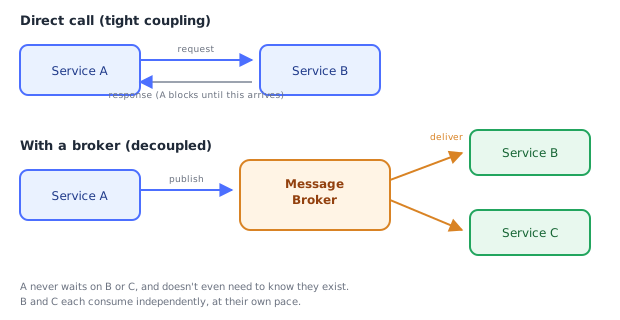
A message broker breaks this direct link. Instead of A calling B, A publishes a message — a small, self-contained record of "something happened" or "please do this" — to the broker. The broker stores it and delivers it to whichever consumer(s) are subscribed, whenever they're ready.
With a broker (decoupled):

  Service A ──▶ [ Message Broker ] ──▶ Service B
                        │
                        └──────────▶ Service C

  A doesn't know B or C exist. A doesn't wait for either.
B and C each consume at their own pace.2What a Message Broker Actually Is
A message broker is a piece of infrastructure — a standalone server or cluster — whose entire job is to accept messages from producers, store them durably (usually to disk), and deliver them to consumers, tracking who has received or acknowledged what. It sits in the middle of a system as shared infrastructure, the same way a database or a load balancer does.
Two mechanically different families dominate real-world use, covered as their own topics in this group:
- RabbitMQ — a traditional message queue broker built on the AMQP protocol. Messages are routed through exchanges into queues, then handed to consumers and removed once acknowledged.
- Kafka — a distributed, log-structured event streaming platform. Messages are appended to a durable log and consumers track their own position (offset) into that log; nothing is removed on read.
Both solve the same underlying problem — decoupling producers from consumers — with genuinely different internal models, which is why later topics dig into each one's actual mechanics rather than treating "message broker" as one interchangeable thing.
3Core Vocabulary
| Term | Meaning |
|---|---|
| Producer | A service or process that sends (publishes) messages into the broker. |
| Consumer | A service or process that receives (consumes) messages from the broker. |
| Message | The unit of data sent — a payload plus metadata (headers, timestamp, routing info). |
| Queue / Topic | Where messages live inside the broker before/while being delivered — see the dedicated Queues and Topics topic for the distinction. |
| Broker | The server(s) that receive, store, and route messages. |
| Acknowledgement (ack) | A signal from the consumer back to the broker: "I successfully processed this message." |
| Delivery guarantee | The broker's contract about whether a message might be lost, duplicated, or delivered exactly once. |
4Why Decoupling Matters: Four Concrete Benefits
Asynchrony. The producer doesn't wait for the consumer to finish work. A checkout service can publish OrderPlaced and return a response to the user immediately, while inventory, email, and analytics services process that event independently, on their own schedules.
Buffering against load spikes. If 10,000 orders arrive in one minute but the email service can only send 200/minute, the queue simply holds the backlog. Without a broker, that burst either overwhelms the email service directly or gets dropped.
Independent scaling. Each consumer can be scaled up or down based on its own workload, without touching the producer or other consumers. Add more inventory-service instances during a flash sale without redeploying checkout at all.
Fault isolation. If the email service crashes, orders keep flowing into checkout and inventory unaffected — the messages destined for email simply wait in the broker until the service recovers, instead of the whole checkout flow failing.
5The Cost of Decoupling
Brokers aren't free. Introducing one adds:
- Operational overhead — another piece of infrastructure to deploy, monitor, and keep highly available.
- Eventual consistency — the consumer processes the message sometime after the producer sent it, not instantly. Systems that need an immediate, synchronous answer (e.g., "is this credit card valid, right now") are usually still built as direct calls, not through a broker.
- New failure modes — messages can be delayed, duplicated, or (depending on configuration) lost; see the Delivery Guarantees and Dead Letter Queues topics for how brokers handle this.
- Debugging is harder — a request's effects are now spread across multiple asynchronous consumers instead of one visible call stack.
The rule of thumb: reach for a broker when work can happen later and independently; keep a direct call when the caller genuinely needs an answer now.
Reach for a broker when work can happen later and independently. Keep a direct call when the caller needs an answer now ("is this card valid?").
6Common Messaging Patterns
| Pattern | What it does |
|---|---|
| Point-to-point (work queue) | One message is consumed by exactly one consumer out of a pool — used to distribute a batch of jobs across workers. |
| Publish/subscribe (fan-out) | One message is delivered to every subscriber independently — used to broadcast an event to multiple interested services. |
| Request/reply over a broker | The producer includes a "reply-to" location; the consumer processes the message and publishes a response back — async request/response without a direct call. |
Under the HoodHow it works internally▾
At the transport level, a broker is just a network service that terminates a protocol (AMQP for RabbitMQ, Kafka's own binary protocol, or others like MQTT and STOMP) and mutates durable state on disk in response to producer/consumer actions. The two big architectural choices every broker makes are:
- Does a message get deleted after being consumed, or does it persist as an append-only record that consumers navigate? This is the queue-model vs. log-model split explored fully in the Kafka and RabbitMQ topics — it changes everything about replay, ordering, and scaling.
- How does the broker decide which consumer(s) get which message? Routing rules (RabbitMQ's exchanges) vs. partition assignment (Kafka's consumer groups) — both are mechanisms for the same underlying question, solved differently.
Every other topic in this group is really an elaboration of these two decisions.
⚠️ Common Pitfalls
- Treating a broker as a database. Brokers are optimized for transient/streaming delivery, not for arbitrary querying of historical data — even Kafka, which retains data far longer than RabbitMQ, is not a substitute for a queryable datastore.
- Assuming "decoupled" means "no contract." Producers and consumers still agree on a message schema; changing that schema without a plan (versioning, backward compatibility) breaks every consumer at once, just less visibly than a broken API call.
- Adding a broker before there's asynchronous work to justify it. A broker used purely to shuttle a value between two services that both need a synchronous answer just adds latency and failure surface for no benefit.
- Forgetting the broker itself is a single point of failure unless clustered. A non-clustered broker reintroduces the exact coupling problem you added it to avoid — if it goes down, everything depending on it stalls.
📋 Quick Reference
Direct call:  A --request--> B --response--> A     (sync, tightly coupled)
Broker:       A --publish--> [Broker] --deliver--> B, C, ...   (async, decoupled)

Producer  -> sends messages in
Consumer  -> receives messages out
Broker    -> stores + routes + tracks delivery state
Ack       -> consumer's "I'm done with this" signal

Use a broker when: work can happen later, consumers can scale independently,
                    spikes need absorbing, one event needs many subscribers.
Skip a broker when: caller needs a synchronous answer right now.
🧠 Key takeaways
- Direct calls couple services in time (both up), location (know each other) and load (spikes hit directly).
- A broker accepts, stores durably, routes and delivers messages, and tracks acknowledgements.
- Benefits: asynchrony, buffering, independent scaling, fault isolation; costs: ops overhead, eventual consistency, new failure modes.
- Patterns: work queue (one consumer), pub/sub (every subscriber), request/reply. Run the broker clustered.
🎤 Interview Q&A
Q1Why use a message broker?core▾
To decouple producers and consumers in time and availability: producers publish without waiting for consumers, the broker buffers spikes, consumers process at their own pace and can be added without changing producers. It also enables fan-out to multiple consumers.
- What do you give up? Immediate results, simplicity, and you take on delivery semantics and broker operations.
Q2Queue vs topic (pub/sub): what's the difference?core▾
Queue (point-to-point): each message is processed by one consumer among many competing workers; used for task distribution. Topic (pub/sub): each message is delivered to every subscriber (each subscription gets a copy); used for events that several services care about.
- How does Kafka do both? Consumer groups: within a group, partitions are split among consumers (queue); different groups each get all messages (pub/sub).
Q3What delivery guarantees exist?core▾
At-most-once (may lose messages, no duplicates), at-least-once (no loss, possible duplicates; the common default), and exactly-once (expensive; in practice at-least-once plus idempotent processing or transactional processing within one system like Kafka).
- Which do you design for? At-least-once with idempotent consumers.
Q4How do you handle message ordering?senior▾
Most brokers only guarantee order within a partition or queue, and parallel consumers break it. Route related messages to the same partition by key (e.g. order ID), process each partition sequentially, and design consumers to tolerate reordering using versions or timestamps.
- Do you need global ordering? Rarely; it limits throughput to one partition.
Q5What's a dead-letter queue?core▾
A separate queue where messages go after repeated processing failures (poison messages), so they don't block the main queue or retry forever. Engineers inspect them, fix the cause and replay.
- What should a DLQ message contain? The original payload plus error details, attempt count and timestamps.
🛠️ Practice exercises
Each exercise is a file in this topic folder. Code exercises are self-checking: run them and make the checks pass.
✅ Check yourself
Answer the questions — feedback is instant.