Conflict and Disagreement
Conflict questions test whether you can disagree on substance without damaging relationships, change your mind with evidence, and commit once a decision is made. Learn what interviewers listen for, a resolution playbook, and how to pick the right story.
🎯 What you'll learn
- The common conflict questions
- Signals of healthy disagreement
- A step-by-step resolution playbook
- How to choose and frame a conflict story
📚 Before you start
Every team disagrees. Interviewers ask about conflict to learn whether you can disagree on substance without damaging relationships, change your mind when the evidence says so, and commit once a decision is made. Seniors are also expected to resolve conflict between others.
1Typical Questions
- "Tell me about a time you disagreed with your manager."
- "Tell me about a conflict with a teammate. How was it resolved?"
- "Tell me about a time you disagreed with a decision but went ahead with it."
- "Describe a time you received pushback on your design."
- "Have you ever had to deal with a difficult stakeholder?"
2What a Strong Answer Shows
| Signal | Sounds like |
|---|---|
| Curiosity first | "I asked what they were optimizing for; it turned out they were worried about on-call load." |
| Shared goal | "We both wanted fewer incidents; we disagreed on how." |
| Evidence over opinion | "I proposed a one-day spike so we could compare with real numbers." |
| Private and respectful | "I raised it 1:1 first, not in the review meeting." |
| Willing to be wrong | "Their benchmark showed my approach was slower, so I dropped it." |
| Disagree and commit | "We went with their design; I helped make it succeed." |
| Relationship intact | "We still pair regularly." |
Weak answer
"My teammate wanted to use MongoDB, which was obviously wrong for our data. I escalated to our manager, who agreed with me, so we used Postgres."
Strong answer
"A teammate proposed MongoDB for the new catalog. I was worried about our joins, but first asked what drove the proposal: schema changes were blocking them weekly. We agreed the real goal was fast iteration. I suggested Postgres with JSONB for the flexible attributes, and we spent a day prototyping both with real queries. Postgres handled both needs, they led the implementation, and we still review each other's designs."
3A Resolution Playbook
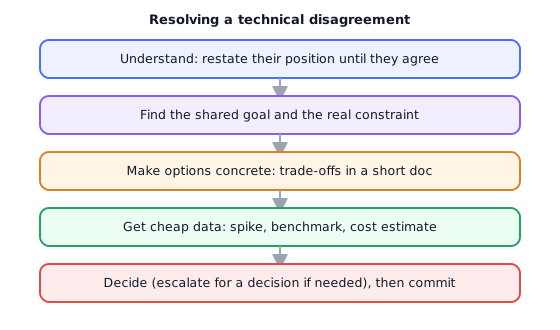
- Understand: restate their position until they agree you got it right.
- Find the shared goal and the real constraint behind each position.
- Make options concrete: a short doc or table with the trade-offs of each.
- Get data cheaply: a spike, a benchmark, a user test, a cost estimate.
- Decide with the right decision-maker (owner, tech lead, manager) if you can't agree. Escalation is fine when it's framed as "we need a decision", not "they're wrong".
- Commit fully, and agree on a signal that would make you revisit it.
4Choosing the Story
The best conflict stories have real stakes (a design, a deadline, a quality bar), a reasonable counterpart (not a villain), and an outcome where you learned something. Stories where you were partly wrong are often the strongest.
Avoid: interpersonal drama, stories where the other person was simply incompetent, or "I've never had a conflict" (it reads as either conflict-avoidant or lacking self-awareness).
⚠️ Common Pitfalls
- Villain stories: making the other person look bad makes you look bad.
- Winning as the goal: the story ends with "and I was right". Interviewers want to see the relationship and the outcome.
- Escalating as a first step instead of talking directly.
- Silent compliance: "I disagreed but said nothing" fails the courage test.
- No resolution: the story stops at the argument.
📋 Quick Reference
Understand → shared goal → concrete options → cheap data → decide → commit
Be curious, private, evidence-driven and willing to be wrong
Escalate as "we need a decision", never as "they're wrong"
Best stories: real stakes, reasonable counterpart, you learned something
🧠 Key takeaways
- Disagree on substance, respectfully and privately first.
- Find the shared goal, then settle it with evidence, not seniority.
- Disagree and commit: once decided, help the decision succeed.
- Pick stories with a reasonable counterpart and something you learned.
🛠️ Practice exercises
Each exercise is a file in this topic folder. Code exercises are self-checking: run them and make the checks pass.
✅ Check yourself
Answer the questions — feedback is instant.