Leadership and Ownership
Ownership questions test whether you act on problems nobody owns, see work through to the outcome, and think long term. For seniors, leadership means leading without the title. Learn the ownership spectrum, what leading a project looks like, and how to talk about decisions under uncertainty.
🎯 What you'll learn
- The questions behind ownership and leadership
- The four levels of ownership
- Leading a project without authority
- Explaining decisions under uncertainty
📚 Before you start
"Ownership" questions test whether you take responsibility beyond your assigned tasks: noticing problems nobody owns, seeing work through to the outcome (not just the merge), and making decisions for the long term. For seniors, "leadership" means leading without the title: technical direction, projects and people you don't manage.
1What Interviewers Probe
| Question | What they're checking |
|---|---|
| "Tell me about a time you went beyond your job description." | Initiative: do you act on problems you notice? |
| "Tell me about a project you led end to end." | Can you drive delivery: planning, risks, stakeholders, launch? |
| "Describe a time you made a decision without all the data." | Judgment and bias for action, with risk awareness |
| "Tell me about a time you had to make a long-term vs short-term trade-off." | Thinking about the system and the team, not just the sprint |
| "What's something you own that nobody asked you to?" | Sustained ownership (on-call tooling, docs, onboarding) |
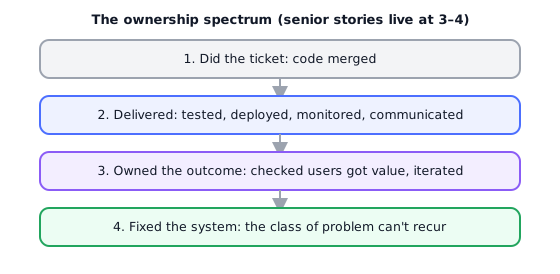
2The Ownership Spectrum
- Did the ticket: the code merged.
- Delivered the feature: tested, deployed, monitored, communicated.
- Owned the outcome: checked that users actually got value; iterated when they didn't.
- Fixed the system: changed the process, tool or architecture so the class of problem doesn't recur.
Senior stories should live at levels 3–4.
3Leading a Project Without Authority
Typical actions that show leadership:
- Wrote the plan: a design doc or one-pager with goals, non-goals, milestones and risks.
- Made the trade-offs explicit and got the right people to agree (product on scope, other teams on interfaces).
- De-risked early: spikes, prototypes, shadow traffic, feature flags.
- Ran the cadence: weekly status, a visible tracker, escalating early when slipping.
- Unblocked others rather than doing everything yourself; delegated with context.
- Closed the loop: launch, metrics review, retrospective.
Hero story
"The release was slipping, so I worked every night for two weeks and rewrote most of it myself. We shipped on time."
Leadership story
"Two weeks out we were 40% behind. I re-planned with product to cut two non-critical reports, split the remaining work so the two juniors owned the export path with me reviewing daily, and flagged the risk to our director early. We shipped the core on time and the cut reports a week later."
4Decisions Under Uncertainty
Strong answers show you separate reversible decisions (decide fast, roll back if wrong) from irreversible ones (gather more data, get review). Mention how you limited risk: a flag, a canary, a time-boxed experiment, a clear rollback plan.
⚠️ Common Pitfalls
- Hero stories: "I stayed up three nights and fixed it all alone" signals poor delegation and planning, not leadership.
- Ownership as overreach: rewriting another team's system without asking. Show you collaborated with the owners.
- Stopping at the merge: no evidence you checked the outcome.
- No trade-off: the long-term choice is presented as free; interviewers want to hear what it cost.
📋 Quick Reference
Ownership = notice → act → see it through to the outcome → fix the system
Leadership without authority: plan, trade-offs, de-risk, cadence, unblock others, close the loop
Decisions: reversible → fast, with rollback · irreversible → data and review
Avoid hero stories and overreach; name what the long-term choice cost
🧠 Key takeaways
- Ownership means seeing work through to the outcome and fixing the system.
- Leading without authority: plan, trade-offs, de-risk, cadence, unblock, close the loop.
- Separate reversible from irreversible decisions, and say how you limited risk.
- Avoid hero stories and overreach; show collaboration with owners.
🛠️ Practice exercises
Each exercise is a file in this topic folder. Code exercises are self-checking: run them and make the checks pass.
✅ Check yourself
Answer the questions — feedback is instant.