Call Stack
The call stack is the mechanism JavaScript uses to track which function is currently running, and what to return to when it finishes. It's a LIFO (last in, first out) structure: every function call pushes a new frame on top; every return (or the function ending) pops that frame off.
🎯 What you'll learn
- What the Call Stack Is
- Reading a Stack Trace
- Stack Overflow
- The Call Stack Is Why JavaScript Is Single-Threaded
- Async Functions and the Call Stack
1What the Call Stack Is
The call stack is the mechanism JavaScript uses to track which function is currently running, and what to return to when it finishes. It's a LIFO (last in, first out) structure: every function call pushes a new frame on top; every return (or the function ending) pops that frame off.
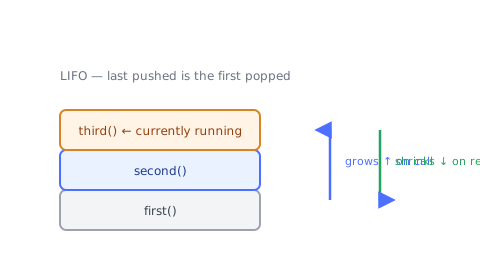
function third() { console.log("in third"); }
function second() { third(); }
function first() { second(); }
first();

// Stack grows:      Stack shrinks (after each return):
// [first]            [first, second, third] -> logs "in third"
// [first, second]     [first, second]         -> third() returns
// [first, second, third] [first]                -> second() returns
// [] -> first() returns2Reading a Stack Trace
When an error is thrown, its .stack property (and what you see printed to the console) shows the call stack at the moment of the throw, most recent call first:
function level3() { throw new Error("boom"); }
function level2() { level3(); }
function level1() { level2(); }

try {
  level1();
} catch (e) {
  console.log(e.stack);
  // Error: boom
  //   at level3 (...)
  //   at level2 (...)
  //   at level1 (...)
  //   at <top level> (...)
}
Reading a stack trace bottom-to-top (in this printed order, top-to-bottom) tells you the exact chain of calls that led to the error — the most valuable piece of information when debugging.
3Stack Overflow
The call stack has a finite size. Recursion without a proper base case (or simply too deep) exhausts it:
function recurse() {
  return recurse(); // no base case — never stops
}
recurse(); // RangeError: Maximum call stack size exceeded
This directly connects to the Time and Space Complexity topic: recursive call depth is the space cost of a recursive algorithm, and the call stack is the concrete structure that cost is measured against.
4The Call Stack Is Why JavaScript Is Single-Threaded
Only one call stack exists per JavaScript execution context (per thread). While any frame is on the stack, nothing else can run — this is exactly why asynchronous operations must be deferred and later resumed via the event loop, rather than blocking the stack (fully explored in the Event Loop topic).
function longSyncWork() {
  for (let i = 0; i < 1e9; i++) {} // stays on the call stack the entire time
}
longSyncWork(); // NOTHING else — no timers, no events, no rendering — can happen until this returns5Async Functions and the Call Stack
An async function or a .then() callback is not on the call stack while it's "waiting" — the call stack only holds it during the synchronous portions of its execution. This is precisely why awaiting something doesn't block other code from running (previewed here, covered fully in the Async/Await topic).
async function example() {
  console.log("A: on the stack");
  await new Promise(resolve => setTimeout(resolve, 100)); // stack frame is POPPED here while waiting
  console.log("B: back on the stack after resuming");
}
example();
console.log("C: runs immediately — the stack was freed during the await");
// order: A, C, B
Under the HoodWhat's Actually Inside a Stack Frame, and Why the Limit Exists▾
A frame is a real, fixed-size chunk of memory
Each pushed frame isn't just an abstract bookkeeping entry — it's a concrete block of memory holding everything needed to resume the caller once the callee returns: the return address (where to jump back to), the function's local variables that weren't promoted to a heap Context (see the Scope topic — only captured variables go to the heap; everything else lives right here on the stack frame), and space for any temporary values mid-computation.
Why the stack has a hard limit at all
Unlike the heap (which can keep growing, subject only to total available memory and triggering garbage collection as needed), the call stack is typically allocated as a single, fixed-size, contiguous region of memory per thread when that thread starts — commonly a few megabytes by default. This fixed sizing is a deliberate, practical trade-off: stack allocation/deallocation (push/pop) needs to be extremely fast — just adjusting a pointer — and a contiguous fixed region is what makes that possible. A dynamically-growable stack would lose that speed advantage.
// Node: you can raise this limit (within OS limits) via a CLI flag:
// node --stack-size=8000 script.js
Why JavaScript doesn't have tail-call optimization in practice
The ECMAScript spec technically permits tail-call optimization (reusing the current frame instead of pushing a new one, when a function's very last action is calling another function) — but most engines, including V8, have never shipped it for standard function calls, due to real-world complications around debugging (stack traces becoming misleading) and compatibility. This means recursive JavaScript code — even when written in a textbook "tail-recursive" style that would be optimized away in languages like Scheme — still consumes one real stack frame per call in practice, and can still overflow. This is why the Time and Space Complexity topic's iterative rewrites of recursive functions are a genuinely necessary technique in JS, not just a style preference — the language does not rescue you from deep recursion's stack cost automatically, regardless of how the recursion is written.
⚠️ Common Pitfalls
- Assuming deep recursion is "free" — every recursive call consumes real stack space; very deep recursion (commonly tens of thousands of frames, engine-dependent) throws
RangeError. - Misreading stack trace order — the topmost line is the innermost (most recent) call, not the outermost/entry point.
- Believing the call stack "pauses" during
await— the current async function's remaining work is suspended and rescheduled; the call stack frame for that function is actually removed and later re-created when execution resumes, not literally frozen in place. - Long synchronous loops freezing everything — because only one call stack exists, a long-running synchronous function (even without recursion) blocks timers, UI updates, and all other async callbacks until it finishes.
📋 Quick Reference
function call    → push a frame
function returns  → pop a frame
stack too deep     → RangeError: Maximum call stack size exceeded
stack trace         → read top-to-bottom = innermost call to outermost
single stack         → single-threaded → sync code always blocks everything else
🎤 Interview Q&A
Q1What is the call stack?core▾
A LIFO stack of execution contexts: calling a function pushes a frame, returning pops it. JavaScript executes only what's on top; the event loop processes queued callbacks only when the stack is empty.
- What's in a frame? Local variables, arguments, this, and the return address.
Q2What causes 'Maximum call stack size exceeded'?core▾
Too-deep or infinite recursion (missing base case), or accidental mutual recursion (getter calling itself). Fix the base case or convert to iteration with an explicit stack.
- Does JS have tail call optimization? Only Safari implements proper tail calls in practice.
Q3How do stack traces help debugging?senior▾
They show the chain of calls leading to an error. Async stack traces in modern engines stitch together frames across await.
- Why do minified traces look odd? Use source maps to map them back.
Q4How does the call stack relate to the event loop?core▾
Async callbacks wait in queues until the stack is empty; then the event loop pushes the next callback onto the stack.
- Why does long sync code delay timers? Timers can't run until the stack clears.
Q5Convert a recursive DFS to avoid stack overflow.core▾
Use an explicit array as a stack: push the root, then loop: pop a node, process it, push its children, until the stack is empty.
- Trade-off? Slightly more code; handles very deep structures.
🛠️ Practice exercises
Each exercise is a file in this topic folder. Code exercises are self-checking: run them and make the checks pass.