Deadlocks
Deadlocks need four conditions at once: mutual exclusion, hold-and-wait, no preemption and circular wait. Watch a circular wait form between two locks, break it with lock ordering, and see how databases detect and resolve deadlocks.
🎯 What you'll learn
- What a deadlock is
- The four Coffman conditions
- Lock ordering and timeouts
- Deadlocks beyond mutexes, detection and recovery
📚 Before you start
1What a Deadlock Is
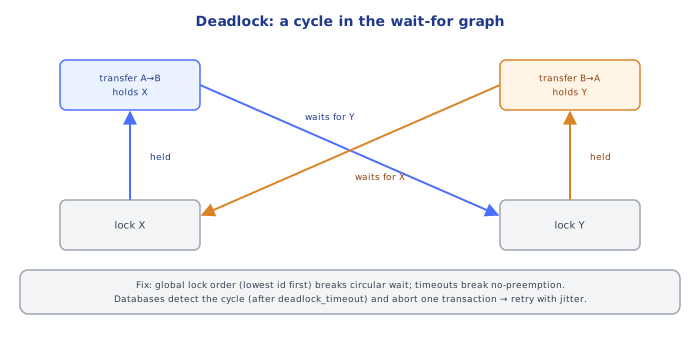
A deadlock is a state where a set of tasks each wait for a resource held by another task in the set — forever. Nothing crashes; nothing progresses. Requests hang until timeouts fire, thread pools fill up, and the system degrades without an obvious error.
Task A holds lock X, waits for lock Y
Task B holds lock Y, waits for lock X        → neither can ever continue
Related failure modes:
- Livelock: tasks keep changing state in response to each other (both back off and retry in lockstep) but make no progress.
- Starvation: a task never gets the resource because others keep winning.
2The Four Coffman Conditions
A deadlock requires all four at once — so preventing any one prevents deadlock:
| Condition | Meaning | Break it by… |
|---|---|---|
| mutual exclusion | a resource can be held by one task at a time | lock-free structures, immutable data, read-sharing |
| hold and wait | a task holds one resource while waiting for another | acquire all needed resources at once, or release before waiting |
| no preemption | resources can't be forcibly taken | timeouts (tryLock(timeout)), lock leases, transaction aborts |
| circular wait | a cycle in the wait-for graph | global lock ordering — the most practical fix |
3Lock Ordering
Assign every lock a rank and always acquire in ascending order:
// transfer between two accounts: lock the lower id first, regardless of direction
async function transfer(a: Account, b: Account, amount: number) {
  const [first, second] = a.id < b.id ? [a, b] : [b, a];
  await first.lock.acquire();
  try {
    await second.lock.acquire();
    try { a.balance -= amount; b.balance += amount; }
    finally { second.lock.release(); }
  } finally { first.lock.release(); }
}
Without ordering, transfer(A→B) and transfer(B→A) running together is the textbook deadlock.
4Deadlocks Beyond Mutexes
- Databases: two transactions update the same rows in opposite order (
UPDATE accounts SET … WHERE id = 1thenid = 2, vs2then1). PostgreSQL/MySQL detect the cycle and abort one transaction with a deadlock error → the application must retry it. Mitigate by touching rows in a consistent order (ORDER BY id … FOR UPDATE), keeping transactions short, and avoiding user interaction or network calls inside transactions. - Connection pools: a request holds connection #1 and, inside the same request, asks the pool for connection #2 while every connection is held by requests doing the same thing → pool exhaustion deadlock. Never acquire a second connection while holding one (pass the transaction/connection down).
- Async code: awaiting a promise that can only resolve after the current task finishes (e.g. a task that waits on a queue it alone feeds); in .NET, blocking
.Resulton async code under a synchronization context (languages/csharp/06-async_await). - Distributed locks: service A holds a Redis lock and calls service B, which waits for a lock A holds in another store. Use lease timeouts and avoid nested distributed locks.
- Thread pool starvation: all pool threads block waiting for work that needs a pool thread to run.
5Detection and Recovery
- Timeouts on every lock and wait (
tryAcquire(timeout),lock_timeout,statement_timeout), turning a hang into an error you can retry or alert on. - Wait-for graph cycle detection (databases do this; you can for in-process lock managers).
- Thread dumps (
jstack,dotnet-dump,py-spy dump) show which thread holds what and waits on what; databases expose lock views (pg_locks,pg_stat_activity, deadlock logs). - Recovery: abort one participant (the "victim"), release its resources, retry with backoff + jitter (to avoid livelock).
Under the HoodHow PostgreSQL Detects Deadlocks▾
When a backend waits for a lock longer than deadlock_timeout (default 1 s), it runs a deadlock check: it builds the wait-for graph from the shared lock table — an edge from each waiting transaction to every transaction holding (or queued ahead for) a conflicting lock — and searches for a cycle that includes itself. If it finds one, it aborts its own transaction with ERROR: deadlock detected (SQLSTATE 40P01), logging both statements. The check is deferred by deadlock_timeout because it's relatively expensive and most lock waits resolve quickly on their own. The cost of a deadlock is therefore at least ~1 s of blocking plus a failed transaction — which is why ordering row locks consistently is far better than relying on detection.
⚠️ Common Pitfalls
- Inconsistent lock order across code paths.
- Calling out (network, user callbacks, other locks) while holding a lock.
- Long transactions that hold row locks across slow operations.
- No timeouts — deadlocks look like mysterious hangs.
- Not retrying database deadlock errors.
- Retry without jitter — two victims retry in lockstep → livelock.
📋 Quick Reference
deadlock needs: mutual exclusion + hold-and-wait + no preemption + circular wait
fix: global lock ordering · acquire all at once · timeouts/tryLock · short critical sections
DB: consistent row order (ORDER BY id FOR UPDATE) · short txns · retry 40P01 with jitter
diagnose: thread dumps · pg_locks / deadlock logs · wait-for graph
🧠 Key takeaways
- Deadlock requires mutual exclusion, hold-and-wait, no preemption and circular wait; break any one.
- The practical fix: a global lock order (e.g. by ID), plus timeouts (tryLock).
- Deadlocks occur with DB rows, connection pools, async awaits, and services waiting on each other.
- Databases detect cycles in the wait-for graph and abort a victim; apps must retry.
🎤 Interview Q&A
Q1What is a deadlock and what conditions cause it?core▾
Two or more threads/transactions waiting on each other forever. The four Coffman conditions: mutual exclusion, hold and wait, no preemption, and circular wait. Breaking any one prevents deadlock.
- Simplest example? T1 locks A then waits for B; T2 locks B then waits for A.
Q2How do you prevent deadlocks?core▾
Acquire locks in a consistent global order, hold locks briefly, avoid holding a lock while calling external code, use timeouts (tryLock), and prefer lock-free or message-passing designs.
- How does ordering help? It makes circular wait impossible.
Q3How do databases handle deadlocks?core▾
They detect cycles in the wait-for graph and abort one transaction (the victim) with an error. Applications should retry the aborted transaction, and reduce deadlocks by touching rows in a consistent order and keeping transactions short.
- Postgres error code? 40P01 (deadlock_detected).
Q4What's the difference between deadlock, livelock and starvation?senior▾
Deadlock: threads blocked forever. Livelock: threads keep changing state in response to each other but make no progress (like two people stepping aside repeatedly). Starvation: a thread never gets resources because others keep winning.
- Fix for livelock? Randomized backoff.
Q5How do async/await deadlocks happen in .NET?core▾
Blocking on async code (.Result/.Wait()) in a context with a single-threaded SynchronizationContext (classic ASP.NET, UI threads): the continuation needs the blocked thread. Fix: async all the way, or ConfigureAwait(false) in libraries.
- Does ASP.NET Core have this issue? No SynchronizationContext, but sync-over-async still causes thread-pool starvation.
🛠️ Practice exercises
Each exercise is a file in this topic folder. Code exercises are self-checking: run them and make the checks pass.
✅ Check yourself
Answer the questions — feedback is instant.