Relational vs NoSQL
Relational and NoSQL databases make different bets about your data: schema-on-write vs schema-on-read, joins vs embedding, strong vs tunable consistency. Compare them honestly and pick with the decision helper.
🎯 What you'll learn
- Two bets about data: relational vs NoSQL families
- Schema-on-write vs schema-on-read
- Relationships: joins vs embedding
- Consistency models as the real divide
📚 Before you start
1Two Different Bets About Your Data
A relational database (Postgres, MySQL, SQL Server) bets that your data has a stable, well-understood shape that's worth declaring up front, and that relationships between entities (customers who place orders which contain line items) are first-class things you'll query across constantly. A NoSQL database bets the opposite: that the shape will keep changing, that you'll mostly fetch data by a single key or a narrow access pattern, and that horizontal scale-out matters more than cross-entity querying.
"NoSQL" is not one thing — it's an umbrella over several different data models:
| Model | Example systems | Shape |
|---|---|---|
| Document | MongoDB, Couchbase | nested JSON-like documents, self-contained |
| Key-value | Redis, DynamoDB | opaque value behind a key, no query into structure (mostly) |
| Wide-column | Cassandra, HBase, Bigtable | rows with dynamic, sparse sets of columns, partitioned by row key |
| Graph | Neo4j | nodes and edges, optimized for traversal |
This topic focuses mainly on relational vs document stores, since that's the most common head-to-head comparison in application design.
2Schema-on-Write vs Schema-on-Read
-- Relational: the shape is declared once, enforced on every write
CREATE TABLE users (
  id BIGSERIAL PRIMARY KEY,
  email TEXT NOT NULL UNIQUE,
  age INT CHECK (age >= 0),
  created_at TIMESTAMPTZ NOT NULL DEFAULT now()
);

INSERT INTO users (email, age) VALUES ('bad', -5);
-- ERROR: new row for relation "users" violates check constraint "users_age_check"// Document store: the shape is whatever you insert. Nothing stops
// two "users" documents from having wildly different fields.
db.users.insertOne({ email: "a@x.com", age: 30 });
db.users.insertOne({ email: "b@x.com", age: -5, favoriteColor: "teal" }); // succeedsRelational engines reject the invalid row at write time, inside the same transaction, before it ever lands on disk. Document stores typically accept whatever you send them; if you want validation, you either enforce it in application code or configure an optional schema validator the engine checks per-write — but the default posture is schema-on-read: the shape is whatever the reading application decides to interpret it as.
3Relationships and Joins
-- Relational: relationships are foreign keys, joined at query time
SELECT o.id, o.total, c.name
FROM orders o
JOIN customers c ON c.id = o.customer_id
WHERE c.id = 42;// Document: relationships are usually either embedded (denormalized copy)
// or referenced by an ID with no engine-enforced join
db.orders.find({ customerId: 42 }); // app code fetches customer 42 separately, or...
{
_id: 501,
customerId: 42,
customerNameSnapshot: "Ana Petrova", // embedded copy, avoids a second lookup
total: 129.99
}Document databases generally don't offer a real cross-collection JOIN (some, like MongoDB, offer $lookup, but it's not optimized the way a relational planner optimizes joins). The standard document-model answer to "avoid the second query" is to embed the data you'll need together, accepting duplication.
Embedding everything (document)
{ "_id": "order-9",
  "customer": { "id": 42, "name": "Ana", "email": "a@x.io" },
  "items": [ { "sku": "tree-1", "price": 45 } ] }
Great for reading one order. Ana changes her email → update every order document.
Normalized tables (relational)
customers(id, name, email)
orders(id, customer_id → customers.id)
order_items(order_id, sku, price)
SELECT … FROM orders JOIN customers …
One source of truth per fact; joins assemble views.
4Consistency Models Are the Real Divide
The deeper difference isn't "tables vs documents" — it's what each system guarantees when data is replicated across multiple nodes. That's covered precisely below.
Under the HoodHow it works internally▾
CAP, with the actual math instead of the buzzword
CAP theorem says a distributed system can't simultaneously guarantee Consistency (every read sees the latest write), Availability (every request gets a response), and Partition tolerance (the system keeps working when nodes can't talk to each other) — and since network partitions will happen, you're really choosing between C and A during a partition.
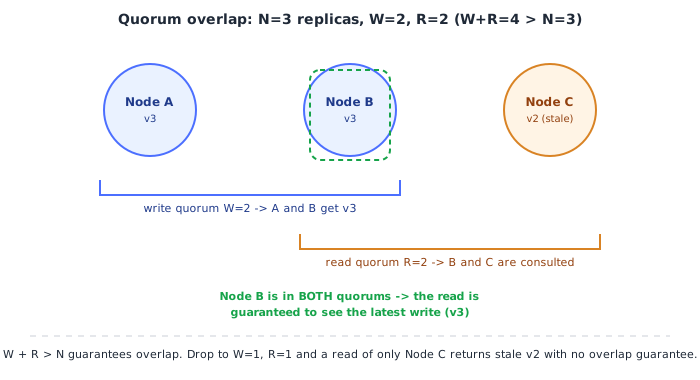
The concrete mechanism behind this choice is quorum replication. Say a piece of data is replicated across N nodes. Define:
W= number of nodes that must acknowledge a write before it's considered successfulR= number of nodes a read must consult before returning a result
If W + R > N, every read quorum overlaps with every write quorum by at least one node — so a read is mathematically guaranteed to see at least one copy of the most recent write. That's strong consistency, bought at the cost of latency (every write/read waits on multiple nodes) and availability (if not enough nodes are reachable to form a quorum, the operation fails rather than serving stale data).
N = 3 replicas
W = 2, R = 2   ->   W + R = 4 > 3   -> strong consistency, tolerates 1 node down
W = 1, R = 1 -> W + R = 2 < 3 -> fast, available, but a read can miss the latest write- CP example — HBase / MongoDB with
majoritywrite concern: a write isn't acknowledged until a majority of replica set members have it. If the primary is partitioned from the majority, it steps down and stops accepting writes rather than risk divergence — you lose availability to keep consistency. - AP example — Cassandra / DynamoDB with tunable consistency: you can set
W=1, R=1(ONEconsistency level in Cassandra terms) so every node keeps accepting reads and writes even during a partition, and reconciles conflicting versions later (via mechanisms like last-write-wins or vector clocks) — you keep availability and accept temporary inconsistency.
Why relational systems default to CP-like behavior on a single node
A single-instance relational database sidesteps the whole CAP trade-off for as long as it stays single-instance: there's only one copy of the data, so there's nothing to reconcile — every transaction is immediately, trivially consistent. The trade-off only reappears once you add replicas (see the Replication and Sharding topics), at which point Postgres/MySQL make the same real choice between synchronous replication (CP-leaning, safer, slower) and asynchronous replication (AP-leaning, faster, replicas can lag).
⚠️ Common Pitfalls
- Treating "NoSQL" as a single technology — a key-value store, a document store, and a graph database solve completely different problems; picking "NoSQL" without picking a specific data model is not a decision.
- Choosing a document store for data that's actually deeply relational — if your access patterns constantly need to join across many entities, you'll end up re-implementing joins in application code, slower and with none of the query planner's optimizations.
- Assuming "eventually consistent" means "wrong sometimes" — it means "correct, but possibly briefly stale," which is fine for a like counter and unacceptable for a bank balance.
- Ignoring embedding vs referencing trade-offs in document design — embedding avoids a second query but duplicates data that now must be kept in sync everywhere it's copied; there's no free lunch, just a different place the cost shows up.
- Picking based on scale you don't have yet — a single well-tuned Postgres instance comfortably handles far more load than most projects will ever produce; "we might need to scale like Google" is rarely a good reason to give up joins and transactions on day one.
📋 Quick Reference
Relational: schema-on-write, enforced constraints, joins across normalized tables, strong single-node consistency
Document/KV/wide-column/graph: schema-on-read (usually), duplication over joins, tunable consistency at scale

CAP: pick 2 of {Consistency, Availability, Partition tolerance} during an actual partition
Quorum: W + R > N -> strong consistency (every read/write quorum overlaps)
        W + R <= N -> faster, more available, can read stale data
🧠 Key takeaways
- Relational: schema-on-write, normalized tables, joins, ACID transactions.
- NoSQL families (key-value, document, wide-column, graph) favour access-pattern-driven models and horizontal scale.
- The real divide is often consistency and query flexibility, not 'SQL vs JSON'.
- Default to relational for business data; choose NoSQL for a specific, proven need.
🎤 Interview Q&A
Q1When would you choose a relational database over NoSQL?core▾
When data is relational with many relationships, you need multi-row ACID transactions, flexible ad-hoc queries and joins, and strong consistency (orders, payments, inventory). Modern relational databases also scale far with indexes, replicas and partitioning.
- And NoSQL? Known access patterns at very high scale, flexible/evolving schemas, or specialized models (key-value, document, wide-column, graph).
Q2Name the main NoSQL families with examples and use cases.core▾
Key-value (Redis, DynamoDB): sessions, caches, lookups by key. Document (MongoDB): nested JSON-like entities read as a whole. Wide-column (Cassandra, HBase): huge write volumes, time series. Graph (Neo4j): highly connected data, traversals like friends-of-friends. Search (Elasticsearch): full-text queries.
- Is Redis a database? Yes, an in-memory key-value store with optional persistence, often used as a cache.
Q3What does 'schemaless' really mean?core▾
The database doesn't enforce a schema, but the application still has one, implicitly. You move validation and migrations into code (handling multiple document shapes), which is flexible but can become messy without discipline or schema validation features.
- How do you migrate documents? Lazily on read/write with a version field, or with batch backfills.
Q4How does data modeling differ between SQL and NoSQL?senior▾
SQL: model entities and relationships, normalize, and write queries later. NoSQL (especially DynamoDB/Cassandra): start from access patterns and design tables/keys so each query is a single-partition lookup, denormalizing and duplicating data deliberately.
- What's single-table design? Storing several entity types in one DynamoDB table with composite keys to serve all access patterns.
Q5Is NoSQL always more scalable than SQL?core▾
No. NoSQL stores scale horizontally more easily for simple access patterns, but relational databases handle very large workloads with good indexing, replicas and sharding (and distributed SQL like CockroachDB, Spanner, Aurora). Choose by data model and query needs first.
- What's NewSQL? Distributed SQL databases offering horizontal scale with ACID transactions.
🛠️ Practice exercises
Each exercise is a file in this topic folder. Code exercises are self-checking: run them and make the checks pass.
✅ Check yourself
Answer the questions — feedback is instant.