Internet Gateway and NAT Gateway
Internet gateways let traffic in and out of public subnets; NAT gateways let private instances reach out without being reachable. Compare NAT layouts for availability and cost, and cut NAT bills with VPC endpoints.
🎯 What you'll learn
- Internet gateway vs NAT gateway: two directions
- The standard public/private layout
- How NAT translates addresses
- Costs, alternatives (VPC endpoints), Elastic IPs
📚 Before you start
1Two Directions, Two Gateways
| Internet Gateway (IGW) | NAT Gateway | |
|---|---|---|
| purpose | two-way internet access for resources with public IPs | outbound-only internet access for resources in private subnets |
| inbound from internet | yes (if SGs/NACLs allow) | no — unsolicited inbound connections are impossible |
| attached to | the VPC (one per VPC) | a public subnet in one AZ, with an Elastic IP |
| route that uses it | public subnet: 0.0.0.0/0 → igw-… | private subnet: 0.0.0.0/0 → nat-… |
| cost | free (data transfer still billed) | hourly charge plus per-GB processing |
| scaling/HA | horizontally scaled, redundant by AWS | redundant within its AZ; deploy one per AZ |
What makes a subnet "public" is only its route table having a route to an IGW (02-vpc_subnets_route_tables §3).
2The Standard Layout
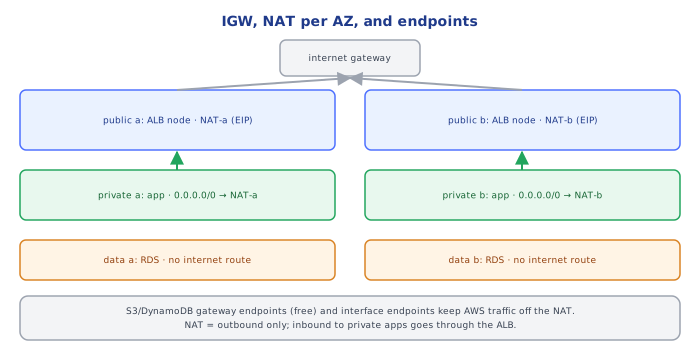
VPC 10.0.0.0/16                                         IGW
┌───────────────────────── AZ a ─────────┐ ┌──────── AZ b ─────────┐ ▲
│ public 10.0.0.0/24   [ALB node] [NAT-a]│ │ public 10.0.1.0/24 [NAT-b]│ │  0.0.0.0/0 → igw
│ private 10.0.10.0/24 [app] [app]       │ │ private 10.0.11.0/24 [app]│   0.0.0.0/0 → nat-a (AZ a) / nat-b (AZ b)
│ data 10.0.20.0/24    [RDS primary]     │ │ data 10.0.21.0/24 [standby]│  no internet route at all
└────────────────────────────────────────┘ └──────────────────────────┘- Public subnets: load balancers, NAT gateways (and almost nothing else).
- Private app subnets: route
0.0.0.0/0to the NAT in the same AZ — if one AZ fails, the others keep outbound access, and you avoid cross-AZ data charges. - Data subnets: no route to the internet at all.
3How NAT Works Here
An app instance 10.0.10.25 calls api.stripe.com:
10.0.10.25:51514 → (route 0.0.0.0/0 → nat-a) → NAT rewrites source to its Elastic IP 3.120.4.9:40123
→ IGW → internet → reply to 3.120.4.9:40123 → NAT looks up its translation table → 10.0.10.25:51514
The whole private fleet appears to the internet as the NAT's Elastic IP — useful for partner allow-lists ("allow our egress IP") — and nobody on the internet can initiate a connection to the private instances.
4Costs and Alternatives
NAT gateway data processing charges add up fast when private workloads pull lots of data from AWS services:
- Gateway VPC endpoints for S3 and DynamoDB are free and route that traffic privately — always add them.
- Interface VPC endpoints (PrivateLink) for ECR, CloudWatch Logs, SSM, Secrets Manager, STS, SQS… keep traffic off the NAT (hourly + per-GB, but often cheaper than NAT for heavy users, and no internet path at all).
- IPv6: public IPv6 addresses + an egress-only internet gateway give outbound-only behaviour without NAT.
- Dev/test: one NAT for all AZs (accepting the AZ dependency) to save cost.
5Elastic IPs and Public IPs
- Auto-assigned public IPv4 addresses change on stop/start; Elastic IPs are static and can be moved between resources. AWS charges for every public IPv4 address (in use or idle).
- Only resources that genuinely need to be reachable (load balancers, NAT gateways) should have public IPs.
Under the HoodWhy an IGW Isn't a Box▾
An internet gateway isn't a device sitting in your VPC that traffic queues through — it's a logical attachment to AWS's horizontally scaled edge, so it has no bandwidth limit and no availability-zone failure mode. It performs 1:1 NAT between an instance's private IP and its public IPv4 address: instances never see their public IP on their own interface (ip addr shows only 10.0.x.x); the mapping is applied by the VPC's virtual routing at the edge. A NAT gateway, by contrast, is a managed many-to-one (port address translation) service deployed into one subnet: each gateway supports up to ~55,000 simultaneous connections per destination (IP, port, protocol) per assigned IP — exceeded when thousands of workers hammer the same API endpoint, surfacing as ErrorPortAllocation; adding secondary IPs to the NAT or spreading destinations fixes it.
⚠️ Common Pitfalls
- One NAT for all AZs in production — an AZ outage cuts outbound access everywhere, plus cross-AZ charges.
- Putting app servers in public subnets "to reach the internet".
- No S3/DynamoDB gateway endpoints — paying NAT processing for internal AWS traffic.
- Expecting inbound connections through a NAT — impossible by design.
- Data tier with a route to the internet.
- NAT port exhaustion for high-concurrency calls to one destination.
📋 Quick Reference
| Need | Use |
|---|---|
| internet-facing resource | public subnet + route to IGW + public IP |
| private outbound internet | NAT gateway per AZ, route from private subnets |
| private access to S3/DynamoDB | gateway VPC endpoint (free) |
| private access to other AWS APIs | interface endpoints (PrivateLink) |
| IPv6 outbound only | egress-only internet gateway |
| static egress IP for partners | NAT gateway Elastic IP |
🧠 Key takeaways
- An IGW enables two-way internet access for resources with public IPs in public subnets.
- A NAT gateway (in a public subnet) gives private resources outbound-only access.
- Production: one NAT gateway per AZ; NAT charges per hour and per GB processed.
- Use VPC endpoints (S3/DynamoDB gateway endpoints are free) to keep AWS traffic off NAT.
🎤 Interview Q&A
Q1Internet gateway vs NAT gateway?core▾
An internet gateway enables two-way internet access for resources with public IPs in public subnets. A NAT gateway (in a public subnet) lets private-subnet resources make outbound connections without being reachable from the internet.
- Does an IGW cost money? No; NAT gateways charge hourly plus per GB processed.
Q2How do you make NAT highly available?core▾
A NAT gateway lives in one AZ; deploy one per AZ and route each private subnet to its own AZ's NAT gateway so an AZ failure doesn't cut other AZs' egress.
- Cost trade-off? One NAT saves money but creates a single point of failure and cross-AZ charges.
Q3How do you reduce NAT gateway costs?senior▾
Use VPC gateway endpoints for S3/DynamoDB and interface endpoints for heavy AWS API traffic, cache dependencies (container images via ECR pull-through), and avoid routing large data through NAT.
- Typical surprise bill? Containers pulling images or data from the internet through NAT.
Q4What's an egress-only internet gateway?core▾
The IPv6 equivalent of NAT for outbound-only access: IPv6 addresses are globally routable, so it allows outbound connections while blocking inbound ones.
- Why no NAT for IPv6? Address space is plentiful; filtering replaces translation.
Q5How do instances in private subnets get updates without NAT?core▾
Via VPC endpoints (SSM, S3 for repositories), a proxy, or baked AMIs/container images built elsewhere.
- Why avoid internet access entirely? Smaller attack surface for sensitive workloads.
🛠️ Practice exercises
Each exercise is a file in this topic folder. Code exercises are self-checking: run them and make the checks pass.
✅ Check yourself
Answer the questions — feedback is instant.