IP, IPv4, and IPv6
IP addresses every packet and routes it best-effort across networks. Read IPv4 and IPv6 addresses, know the private and special ranges, and see why IPv6 changes more than the address count.
🎯 What you'll learn
- What IP does (and doesn't guarantee)
- IPv4 addresses, private ranges and special addresses
- IPv6 notation and structure
- Why IPv6 exists, NAT's role and dual-stack pitfalls
📚 Before you start
1What IP Actually Does
The Internet Protocol (IP) is the network-layer protocol (see the OSI model and TCP/IP model topics) responsible for exactly one job: getting a packet from a source host to a destination host, across however many intermediate networks stand between them. It does this using addresses — every host that wants to be reachable on a network needs one.
IP itself is connectionless and best-effort: it does not guarantee a packet arrives, arrives once, or arrives in order. Those guarantees, when needed, are the transport layer's job (TCP — see the TCP vs UDP topic), not IP's. IP's contract is narrower and more honest: "I will try to route this packet toward its destination address using the information available to me right now."
There are two versions of IP in active use today: IPv4 and IPv6. They coexist, but they are not directly compatible — a IPv4-only host cannot natively send a packet to an IPv6-only address, and vice versa.
2IPv4 Addresses
An IPv4 address is 32 bits, almost universally written in dotted-decimal notation: four 8-bit numbers (0-255) separated by dots.
192.168.1.10Each of the four numbers is one octet (8 bits). Written in binary, that same address is:
192       .168      .1        .10
11000000  .10101000 .00000001 .00001010
32 bits gives a theoretical address space of 2³² ≈ 4.3 billion addresses. That sounds like a lot, but the internet has more than 4.3 billion connected devices today — this exhaustion is the single biggest reason IPv6 exists (more in the "Under the Hood" section).
Address classes and private ranges
IPv4 addresses are split into public (globally routable on the internet) and private (only meaningful inside a private network, never routed on the public internet). Three ranges are reserved for private use (RFC 1918):
10.0.0.0    – 10.255.255.255    (10.0.0.0/8)
172.16.0.0  – 172.31.255.255    (172.16.0.0/12)
192.168.0.0 – 192.168.255.255   (192.168.0.0/16)
If you check your laptop's local IP address, it's almost certainly in one of these ranges — your home router uses NAT (its own topic) to let many devices on a private range share one public IP.
Two other reserved addresses worth knowing on sight:
127.0.0.1— loopback, always refers to "this machine," never leaves the host.0.0.0.0— means "any address" (a server binding to it listens on all local interfaces) or "unspecified," depending on context.
3IPv6 Addresses
IPv6 addresses are 128 bits — written as eight groups of four hex digits, separated by colons.
2001:0db8:0000:0000:0000:0000:0000:0001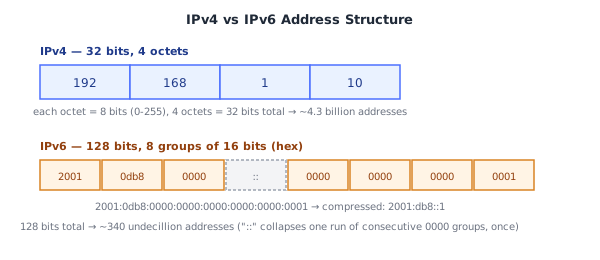
128 bits gives 2¹²⁸ addresses — roughly 340 undecillion (340 followed by 36 zeros). That number is intentionally, absurdly large: it's designed to never run out again, even accounting for wasteful allocation practices.
Compression rules
Writing out sixteen hex digits with seven colons every time is painful, so two shorthand rules exist:
- Leading zeros in each group can be dropped.
0db8→db8. - One contiguous run of all-zero groups can be collapsed to
::, but only once per address (if you could do it twice, the address would be ambiguous — you couldn't tell how many zero groups each::represents).
2001:0db8:0000:0000:0000:0000:0000:0001
  → drop leading zeros:  2001:db8:0:0:0:0:0:1
→ collapse zero run: 2001:db8::10000:0000:0000:0000:0000:0000:0000:0001 → ::1 (this is IPv6's loopback address)
0000:0000:0000:0000:0000:0000:0000:0000 → :: (this is IPv6's "unspecified" address)IPv6 address types worth knowing
- Global unicast — publicly routable, IPv6's equivalent of a public IPv4 address (typically starts
2000::/3). - Link-local — always starts
fe80::/10, auto-assigned to every interface, only valid on the local network segment (used heavily for things like router discovery — never routed beyond the local link). - Unique local — starts
fc00::/7, IPv6's rough equivalent of private IPv4 ranges (not routed on the public internet).
4Why IPv6 Exists (Beyond "More Addresses")
Address exhaustion is the headline reason, but IPv6 also cleans up several IPv4 design issues:
- No more built-in NAT dependency. IPv4 exhaustion forced NAT (its own topic) to become mandatory just to make private networks work; IPv6 has enough addresses that every device can get a real, globally unique address again, restoring true end-to-end connectivity (though NAT-like techniques still exist for other reasons, like privacy or firewalling).
- Simpler header. The IPv6 header is fixed-size and simpler to process than IPv4's variable-length header with optional fields, which helps routers process packets faster.
- No header checksum. IPv4 headers carry a checksum that every router must recompute at every hop (since fields like TTL change per hop); IPv6 drops this, relying on lower layers (link layer) and upper layers (TCP/UDP) for error detection instead.
- Built-in address autoconfiguration. IPv6 hosts can self-assign a valid address (SLAAC — Stateless Address Autoconfiguration) without needing DHCP (its own topic), by combining a network prefix advertised by a router with a locally generated interface identifier.
5Public vs Private Addresses, and NAT's Role
A private IPv4 address (like 192.168.1.10) only makes sense inside its own local network — no router on the public internet knows how to route to it, and in fact many networks reuse the exact same private ranges independently (your home network and your neighbor's home network can both use 192.168.1.10 for a different device, with zero conflict, because neither address is ever visible outside its own network).
To reach the public internet, a private address is translated to a public one at the network's edge — this translation is NAT, covered in depth in the NAT/DHCP/ARP topic. IPv6's abundant address space removes the forcing function for NAT (there's no shortage requiring address sharing), but doesn't eliminate every use of NAT-like techniques.
Under the HoodHow it works internally▾
IPv4 exhaustion, concretely
IPv4's 32-bit space was carved up early using wasteful "class-based" allocations (entire /8 blocks — 16.7 million addresses each — handed to single organizations). By the 1990s it was clear this would run out, which is why:
- CIDR (Classless Inter-Domain Routing — its own topic) replaced rigid address classes with flexible, variable-length prefixes, slowing exhaustion by allocating exactly as many addresses as needed instead of oversized fixed blocks.
- NAT let entire private networks share one public address, further slowing exhaustion.
- IANA still fully allocated the last free top-level IPv4 blocks to regional registries in 2011. IPv4 address space today is a scarce, actively traded resource — companies buy and sell IPv4 blocks for real money because there simply aren't more being created.
IPv6 doesn't patch this problem — it sidesteps it entirely with an address space so large that even extremely wasteful allocation (handing out a /64 — 2⁶⁴ addresses, more than the entire IPv4 space — to a single home network, which is standard practice) still leaves the space effectively inexhaustible.
Dual-stack and the transition mechanism
Because IPv4 and IPv6 packets are structurally different and neither host understands the other's addressing, the internet cannot flip a switch from one to the other — both must run side by side indefinitely. This coexistence strategy is called dual-stack: a host, router, or server keeps both an IPv4 and an IPv6 address/route simultaneously, and picks whichever protocol the other end of a connection also supports. When you resolve a hostname today (see DNS in a later topic), you often get back both an A record (IPv4 address) and an AAAA record (IPv6 address) — the OS chooses which to actually connect with, generally preferring IPv6 when both work end-to-end.
Where dual-stack isn't available end-to-end, transition mechanisms like NAT64 (translating between IPv6-only clients and IPv4-only servers) and tunneling (encapsulating IPv6 packets inside IPv4 ones, or vice versa, to cross a network that only understands one) bridge the gap — these exist purely because the two protocols cannot speak to each other natively.
Why the header actually got simpler
The IPv4 header has a variable length (with an "Options" field that's rarely used but that every router must still be prepared to parse) and includes a header checksum that must be recalculated at every single router hop, because the Time-To-Live (TTL) field decrements at each hop, changing the header's contents. Recomputing a checksum on every packet at every hop is real, non-trivial CPU work multiplied across billions of packets per second in core routers.
IPv6 fixes the header at a constant 40 bytes, removes the checksum entirely (trusting the link layer's own error detection, plus TCP/UDP's own checksums, to catch corruption), and moves rarely-used fields into optional "extension headers" that most routers can skip over entirely without parsing. The result: less per-packet, per-hop work in the routers that matter most for internet-scale throughput.
⚠️ Common Pitfalls
- Treating
192.168.x.xas "the" private range — there are three separate RFC 1918 ranges (10.0.0.0/8,172.16.0.0/12,192.168.0.0/16); assuming only192.168.x.xis private leads to misconfigured firewall rules that let unintended "private-looking" traffic through. - Assuming an IPv6 address with
::in it is missing information —::is a lossless compression of a run of zero groups, not an indication of a partial or unknown address;2001:db8::1and2001:db8:0:0:0:0:0:1are the exact same address. - Trying to use
::twice in one address — this is invalid and ambiguous (the parser can't tell how many zero groups each::stands for); RFC 5952 mandates at most one::per address. - Assuming NAT is a security feature — NAT exists to conserve addresses, not to secure a network; the fact that unsolicited inbound connections can't reach a NAT'd private address is a side effect of NAT's translation table (explained in the NAT/DHCP/ARP topic), not a designed firewall — a real firewall enforces policy on purpose, NAT just happens to make certain traffic patterns impossible.
- Believing IPv6 adoption means IPv4 is going away soon — the two protocols have coexisted via dual-stack for over two decades and will continue to for the foreseeable future; large parts of the internet's infrastructure and countless private networks remain IPv4-only or IPv4-primary.
- Confusing a private IPv4 address with a loopback or link-local address —
192.168.1.5(private, routable within its LAN),127.0.0.1(loopback, never leaves the host), andfe80::1(IPv6 link-local, never leaves the local link) all serve different, non-interchangeable purposes.
📋 Quick Reference
IPv4: 32 bits, dotted-decimal (192.168.1.10)
  Private ranges: 10.0.0.0/8, 172.16.0.0/12, 192.168.0.0/16
  Loopback: 127.0.0.1     Unspecified: 0.0.0.0
  Total space: ~4.3 billion addresses (exhausted at the registry level since 2011)

IPv6: 128 bits, hex groups (2001:0db8:0000:...:0001)
  Compression: drop leading zeros per group, collapse ONE run of zero groups to "::"
  Loopback: ::1            Unspecified: ::
  Link-local: fe80::/10    Unique local (private-ish): fc00::/7
  Total space: ~340 undecillion addresses

Coexistence: dual-stack (both protocols side by side) + NAT64/tunneling where needed
Neither protocol guarantees delivery — that's the transport layer's job (TCP/UDP)
🧠 Key takeaways
- IP provides addressing and best-effort routing; reliability comes from TCP or the application.
- IPv4: 32 bits, scarce; RFC 1918 private ranges + NAT stretched it.
- IPv6: 128 bits,
::compresses zeros, /64 subnets, SLAAC, no NAT needed (firewall still needed). - Know loopback, link-local, 0.0.0.0: binding to 127.0.0.1 in a container is a classic bug.
🎤 Interview Q&A
Q1What are the main differences between IPv4 and IPv6?core▾
IPv4 has 32-bit addresses (~4.3 billion, exhausted, hence NAT); IPv6 has 128-bit addresses, simplified headers, built-in autoconfiguration (SLAAC), no NAT needed, and mandatory multicast instead of broadcast.
- How are IPv6 addresses written? Eight hex groups, with
::compressing zeros, e.g.2001:db8::1.
Q2What are private IP ranges?core▾
IPv4 private ranges (RFC 1918): 10.0.0.0/8, 172.16.0.0/12, 192.168.0.0/16, not routable on the internet; reaching the internet requires NAT. Also loopback 127.0.0.0/8 and link-local 169.254.0.0/16.
- What uses 169.254.169.254? Cloud instance metadata services.
Q3How do IPv4 and IPv6 coexist?core▾
Dual-stack (hosts and networks run both), tunnelling IPv6 over IPv4, and translation (NAT64/DNS64). Clients use Happy Eyeballs: try IPv6 and IPv4 in parallel and use whichever connects first.
- What's an AAAA record? A DNS record mapping a name to an IPv6 address.
Q4What's the security risk of the cloud metadata IP?senior▾
SSRF attacks can make a server request http://169.254.169.254/ and steal cloud credentials. Mitigate with IMDSv2 (session tokens), blocking egress to it, and validating outbound URLs.
- Famous incident? The Capital One breach (2019).
Q5What does an IP address alone not tell you reliably?core▾
Identity and precise location: many users share an IP behind NAT or proxies, IPs are reassigned, and VPNs mask origin. Use IPs for coarse rate limiting and geolocation, not authentication.
- How do you get the real client IP behind a proxy? From
X-Forwarded-For, trusting only your own proxies' entries.
🛠️ Practice exercises
Each exercise is a file in this topic folder. Code exercises are self-checking: run them and make the checks pass.
✅ Check yourself
Answer the questions — feedback is instant.