Storage and StatefulSets
Containers forget everything on restart; persistent volumes don't. Learn PVs, PVCs and StorageClasses, then see what a StatefulSet adds (stable names, per-pod volumes, ordered rollout) and why databases on Kubernetes still need an operator.
🎯 What you'll learn
- Volume types and when to use them
- PV, PVC, StorageClass and dynamic provisioning (CSI)
- StatefulSets: stable identity, per-pod storage, ordering
- PDBs, zonal volumes, backups and operators
📚 Before you start
1Volumes
A container's filesystem disappears when the container restarts. Volumes attach storage to a Pod:
| Volume | Lifetime | Use |
|---|---|---|
emptyDir | Pod (survives container restarts) | scratch space, sharing files between containers; medium: Memory for tmpfs |
configMap / secret / projected | Pod | config files (03-configmaps_and_secrets/), ServiceAccount tokens |
hostPath | node | node agents only — a security risk for apps |
persistentVolumeClaim | independent of the Pod | databases, uploads, anything that must survive rescheduling |
2PersistentVolumes, Claims and StorageClasses
- PersistentVolume (PV): a piece of storage in the cluster (an EBS volume, an EFS share, a Ceph RBD image).
- PersistentVolumeClaim (PVC): a Pod's request for storage ("20 Gi, ReadWriteOnce, class gp3").
- StorageClass: how to dynamically provision PVs via a CSI driver.
apiVersion: storage.k8s.io/v1
kind: StorageClass
metadata: { name: gp3 }
provisioner: ebs.csi.aws.com
parameters: { type: gp3, encrypted: "true" }
reclaimPolicy: Retain                    # keep the disk when the PVC is deleted
allowVolumeExpansion: true
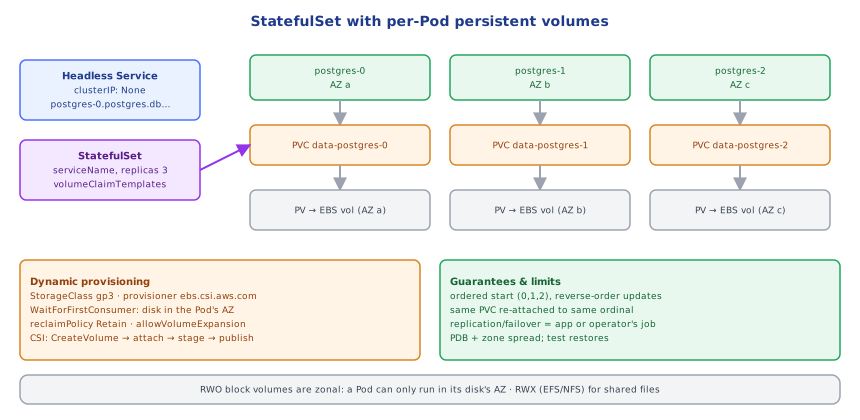
volumeBindingMode: WaitForFirstConsumer  # create the disk in the AZ where the Pod lands
---
apiVersion: v1
kind: PersistentVolumeClaim
metadata: { name: uploads }
spec:
  accessModes: [ReadWriteOnce]
  storageClassName: gp3
  resources: { requests: { storage: 20Gi } }
Access modes: ReadWriteOnce (one node — block storage like EBS), ReadWriteOncePod, ReadOnlyMany, ReadWriteMany (many nodes — network file systems like EFS/NFS/CephFS). Block volumes are zonal: a Pod using an EBS volume can only run in that volume's AZ.
Reclaim policy Delete (default for dynamic provisioning) deletes the disk with the PVC — use Retain for important data. VolumeSnapshots (CSI) give point-in-time copies; tools like Velero back up both resources and volumes.
3StatefulSets
Deployments treat Pods as interchangeable cattle. A StatefulSet gives each Pod a stable identity:
- stable names:
postgres-0,postgres-1,postgres-2 - stable DNS via a headless Service:
postgres-0.postgres.db.svc.cluster.local - one PVC per Pod from
volumeClaimTemplates, re-attached to the same ordinal after rescheduling - ordered start-up, scaling and rolling updates (by default):
-0before-1; updates in reverse order;partitionfor staged rollouts
apiVersion: v1
kind: Service
metadata: { name: postgres }
spec:
  clusterIP: None                # headless
  selector: { app: postgres }
  ports: [{ port: 5432 }]
---
apiVersion: apps/v1
kind: StatefulSet
metadata: { name: postgres }
spec:
  serviceName: postgres
  replicas: 3
  selector: { matchLabels: { app: postgres } }
  template:
    metadata: { labels: { app: postgres } }
    spec:
      terminationGracePeriodSeconds: 60
      containers:
        - name: postgres
          image: postgres:17
          ports: [{ containerPort: 5432 }]
          volumeMounts: [{ name: data, mountPath: /var/lib/postgresql/data }]
  volumeClaimTemplates:
    - metadata: { name: data }
      spec:
        accessModes: [ReadWriteOnce]
        storageClassName: gp3
        resources: { requests: { storage: 50Gi } }
A StatefulSet does not make an application clustered — replication, leader election and failover are the app's job. That's why production databases on Kubernetes use operators (CloudNativePG, Strimzi for Kafka, Redis operators) that encode backup, failover and upgrade procedures — or a managed service (RDS, Cloud SQL), which is often the better default (devops-cloud/aws/06-rds_and_databases).
4Stateful Workload Practices
- PodDisruptionBudget (
minAvailable: 2) so node drains don't take down quorum. - Anti-affinity / topology spread across zones; remember zonal volumes pin Pods to their AZ.
- Backups tested by restoring; snapshots + logical backups (pg_dump) + WAL archiving.
- Volume expansion: edit the PVC size (if the class allows); StatefulSet templates are immutable — expand each PVC.
Under the HoodDynamic Provisioning and Attachment▾
When a Pod with a PVC is created, the PVC is Pending. With WaitForFirstConsumer, the scheduler first picks a node (considering the class's topology), then annotates the PVC with that node; the external-provisioner sidecar of the CSI controller sees the PVC and calls the driver's CreateVolume (e.g. EBS CreateVolume in that AZ), then creates a PV and binds it to the PVC (a one-to-one, exclusive binding). The attach/detach controller creates a VolumeAttachment, and the CSI controller's external-attacher calls ControllerPublishVolume (attaching the EBS disk to the EC2 instance). On the node, the kubelet calls the CSI node plugin's NodeStageVolume (format if needed, mount to a global path) and NodePublishVolume (bind-mount into the Pod's directory), and only then starts the containers. When the Pod moves to another node, the volume must be detached first — which is why a Pod on a dead node can be stuck until the attachment times out or is force-detached.
⚠️ Common Pitfalls
- Databases in Deployments with a shared PVC.
reclaimPolicy: Deleteon irreplaceable data.Immediatebinding creating volumes in an AZ without capacity for the Pod.- No PDB — a cluster upgrade drains all replicas at once.
- Assuming StatefulSet = HA database without an operator.
- Never testing restores.
📋 Quick Reference
volumes: emptyDir · configMap/secret/projected · hostPath (avoid) · PVC
PV ↔ PVC (bind) · StorageClass + CSI (provisioner, reclaimPolicy Retain, WaitForFirstConsumer, expansion)
access: RWO (block, zonal) · RWX (EFS/NFS) · snapshots · Velero
StatefulSet: stable names + headless Service DNS + volumeClaimTemplates + ordered rollout · use operators · PDBs
🧠 Key takeaways
- Use PVCs for data that must survive pods; StorageClasses + CSI provision volumes dynamically.
- Set reclaimPolicy: Retain for precious data and WaitForFirstConsumer for zonal volumes.
- StatefulSets give stable names, stable DNS (headless Service), one PVC per pod and ordered rollouts.
- They don't make an app clustered: use operators or managed databases, plus PDBs and tested restores.
🎤 Interview Q&A
Q1Explain PersistentVolumes, PersistentVolumeClaims and StorageClasses.core▾
A PVC is a pod's request for storage; a PV is the actual volume; a StorageClass describes how to dynamically provision PVs (e.g. AWS EBS gp3) when a PVC is created.
- Access modes? ReadWriteOnce, ReadOnlyMany, ReadWriteMany, ReadWriteOncePod.
Q2What does a StatefulSet guarantee?core▾
Stable pod names and network identities (db-0, db-1 via a headless service), ordered startup/shutdown/scaling, and a dedicated PVC per pod (volumeClaimTemplates) that follows the pod when rescheduled.
- Why not a Deployment for databases? Pods are interchangeable and share/lose storage identity.
Q3Should you run databases in Kubernetes?senior▾
It's possible with operators (CloudNativePG, Strimzi, Vitess) that handle failover, backups and upgrades, but managed databases (RDS, Cloud SQL) are often simpler and safer unless you have the expertise or portability needs.
- What do operators add? Domain-specific automation encoded as controllers.
Q4What's the reclaim policy?core▾
What happens to a PV when its PVC is deleted: Delete (the underlying disk is deleted, default for dynamic provisioning) or Retain (kept for manual recovery).
- Production recommendation for important data? Retain plus backups.
Q5How do zone constraints affect stateful pods?core▾
Block volumes like EBS are bound to one availability zone, so a pod using it can only be scheduled there. Use WaitForFirstConsumer binding and plan replicas across zones.
- What happens if the zone fails? The pod can't move until the volume is available; replication at the app level is needed.
🛠️ Practice exercises
Each exercise is a file in this topic folder. Code exercises are self-checking: run them and make the checks pass.
✅ Check yourself
Answer the questions — feedback is instant.